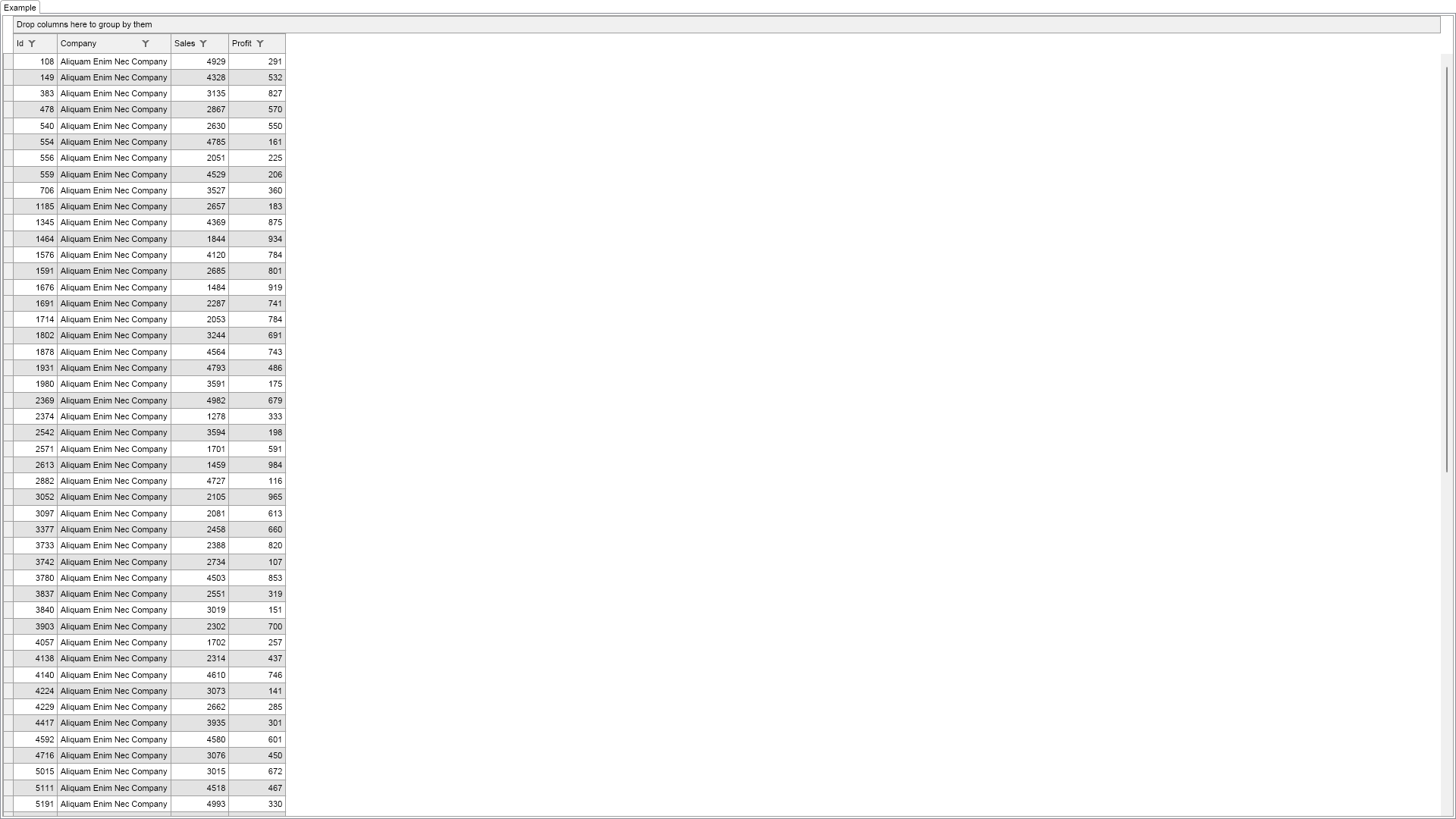
Demonstrates formula filtering as well as multiple filter conditions.
In this example we have used formula row conditions to specify the predicates that pass only records for a specific Company, for which the Sales are greater than 1000. You can use formula filtering to define complex filter rules.

| Language: C# |
using Nevron.Nov;
using Nevron.Nov.Data;
using Nevron.Nov.Dom;
using Nevron.Nov.Graphics;
using Nevron.Nov.Grid;
using Nevron.Nov.Layout;
using Nevron.Nov.UI;
using Nevron.Nov.Windows.Forms;
using System.Windows.Forms;
namespace NovWinFormsProject
{
public partial class Form1 : Form
{
#region Constructors
public Form1()
{
InitializeComponent();
// Set form title
Text = "NOV WinForms - NFormulaFilteringExample";
// Create the NOV example and its controls
NWidget exampleContent = CreateExampleContent();
NWidget exampleControls = CreateExampleControls();
if (exampleControls != null)
{
exampleControls.PreferredWidth = 300;
}
// Place the example and its controls in a pair box
NPairBox pairBox = new NPairBox(exampleContent, exampleControls);
pairBox.FillMode = ENStackFillMode.First;
pairBox.FitMode = ENStackFitMode.First;
pairBox.Margins = new NMargins(NDesign.HorizontalSpacing, NDesign.VerticalSpacing);
// Host the example in the form
NNovWidgetHost host = new NNovWidgetHost(pairBox);
host.Dock = DockStyle.Fill;
Controls.Add(host);
}
#endregion
#region Example
public NWidget CreateExampleContent()
{
// create a view and get its grid
NTableGridView view = new NTableGridView();
NTableGrid grid = view.Grid;
// bind to sales data source
NDataSource dataSource = NDummyDataSource.CreateCompanySalesDataSource();
grid.DataSource = dataSource;
// create an expression filter rule that matches records for which Company is equal to Leka
string companyFxName = dataSource.CreateFormulaFieldName("Company");
string expression1 = companyFxName + "==\"" + NDummyDataSource.RandomCompanyName() + "\"";
grid.FilteringRules.Add(new NFilteringRule(new NFormulaRowCondition(expression1)));
// create an expression filter rule that matches records for which Sales is larger than 1000
string salesFxName = dataSource.CreateFormulaFieldName("Sales");
string expression2 = salesFxName + ">1000";
grid.FilteringRules.Add(new NFilteringRule(new NFormulaRowCondition(expression2)));
grid.AllowSortColumns = true;
grid.AlternatingRows = true;
grid.RowHeaders.Visible = true;
return view;
}
public NWidget CreateExampleControls()
{
return null;
}
public string GetExampleDescription()
{
return @"
Demonstrates formula filtering as well as multiple filter conditions.
In this example we have used formula row conditions to specify the predicates that pass only records for a specific Company, for which the Sales are greater than 1000.
You can use formula filtering to define complex filter rules.
";
}
///
/// Gets the relevant documentation links for the example
///
///
public (string Name, string Url)[] GetDocumentationUrls()
{
return new[]
{
("Grid Filtering", "https://www.nevron.com/docs/openvision/grid-filtering.html"),
("Formula Basics", "https://www.nevron.com/docs/openvision/formula-basics.html"),
("Functions", "https://www.nevron.com/docs/openvision/formula-functions.html"),
("Grid Row Values", "https://www.nevron.com/docs/openvision/grid-row-values.html"),
};
}
#endregion
#region Implementation
#endregion
#region Event Handlers
#endregion
#region Fields
#endregion
#region Static Methods
#endregion
#region Constants
#endregion
#region Nested Types
#endregion
}
} | Language: VB.NET |
Imports Nevron.Nov
Imports Nevron.Nov.Data
Imports Nevron.Nov.Dom
Imports Nevron.Nov.Graphics
Imports Nevron.Nov.Grid
Imports Nevron.Nov.Layout
Imports Nevron.Nov.UI
Imports Nevron.Nov.Windows.Wpf
Class MainWindow
#Region "Constructors"
Public Sub New()
' This call is required by the designer.
InitializeComponent()
' Add any initialization after the InitializeComponent() call.
' Set form title
Title = "NOV WPF - NFormulaFilteringExample"
' Create the NOV example and its controls
Dim exampleContent As NWidget = CreateExampleContent()
Dim exampleControls As NWidget = CreateExampleControls()
If Not exampleControls Is Nothing Then
exampleControls.PreferredWidth = 300
End If
' Place the example and its controls in a pair box
Dim pairBox As NPairBox = New NPairBox(exampleContent, exampleControls)
pairBox.FillMode = ENStackFillMode.First
pairBox.FitMode = ENStackFitMode.First
pairBox.Margins = New NMargins(NDesign.HorizontalSpacing, NDesign.VerticalSpacing)
' Host the example in the form
Dim host As NNovWidgetHost(Of NWidget) = New NNovWidgetHost(Of NWidget)(pairBox)
Content = host
End Sub
#End Region
#Region "Example"
Public Function CreateExampleContent() As NWidget
' create a view and get its grid
Dim view As NTableGridView = New NTableGridView()
Dim grid = view.Grid
' bind to sales data source
Dim dataSource As NDataSource = NDummyDataSource.CreateCompanySalesDataSource()
grid.DataSource = dataSource
' create an expression filter rule that matches records for which Company is equal to Leka
Dim companyFxName = dataSource.CreateFormulaFieldName("Company")
Dim expression1 As String = companyFxName & "==""" & NDummyDataSource.RandomCompanyName().ToString().ToString() & """"
grid.FilteringRules.Add(New NFilteringRule(New NFormulaRowCondition(expression1)))
' create an expression filter rule that matches records for which Sales is larger than 1000
Dim salesFxName = dataSource.CreateFormulaFieldName("Sales")
Dim expression2 = salesFxName & ">1000"
grid.FilteringRules.Add(New NFilteringRule(New NFormulaRowCondition(expression2)))
grid.AllowSortColumns = True
grid.AlternatingRows = True
grid.RowHeaders.Visible = True
Return view
End Function
Public Function CreateExampleControls() As NWidget
Return Nothing
End Function
Public Function GetExampleDescription() As String
Return "
Demonstrates formula filtering as well as multiple filter conditions.
In this example we have used formula row conditions to specify the predicates that pass only records for a specific Company, for which the Sales are greater than 1000.
You can use formula filtering to define complex filter rules.
"
End Function
'''
''' Gets the relevant documentation links for the example
'''
'''
Public Function GetDocumentationUrls() As (String, String)()
Return {("Grid Filtering", "https://www.nevron.com/docs/openvision/grid-filtering.html"), ("Formula Basics", "https://www.nevron.com/docs/openvision/formula-basics.html"), ("Functions", "https://www.nevron.com/docs/openvision/formula-functions.html"), ("Grid Row Values", "https://www.nevron.com/docs/openvision/grid-row-values.html")}
End Function
#End Region
#Region "Implementation"
#End Region
#Region "Event Handlers"
#End Region
#Region "Fields"
#End Region
#Region "Static Methods"
#End Region
#Region "Constants"
#End Region
#Region "Nested Types"
#End Region
End Class