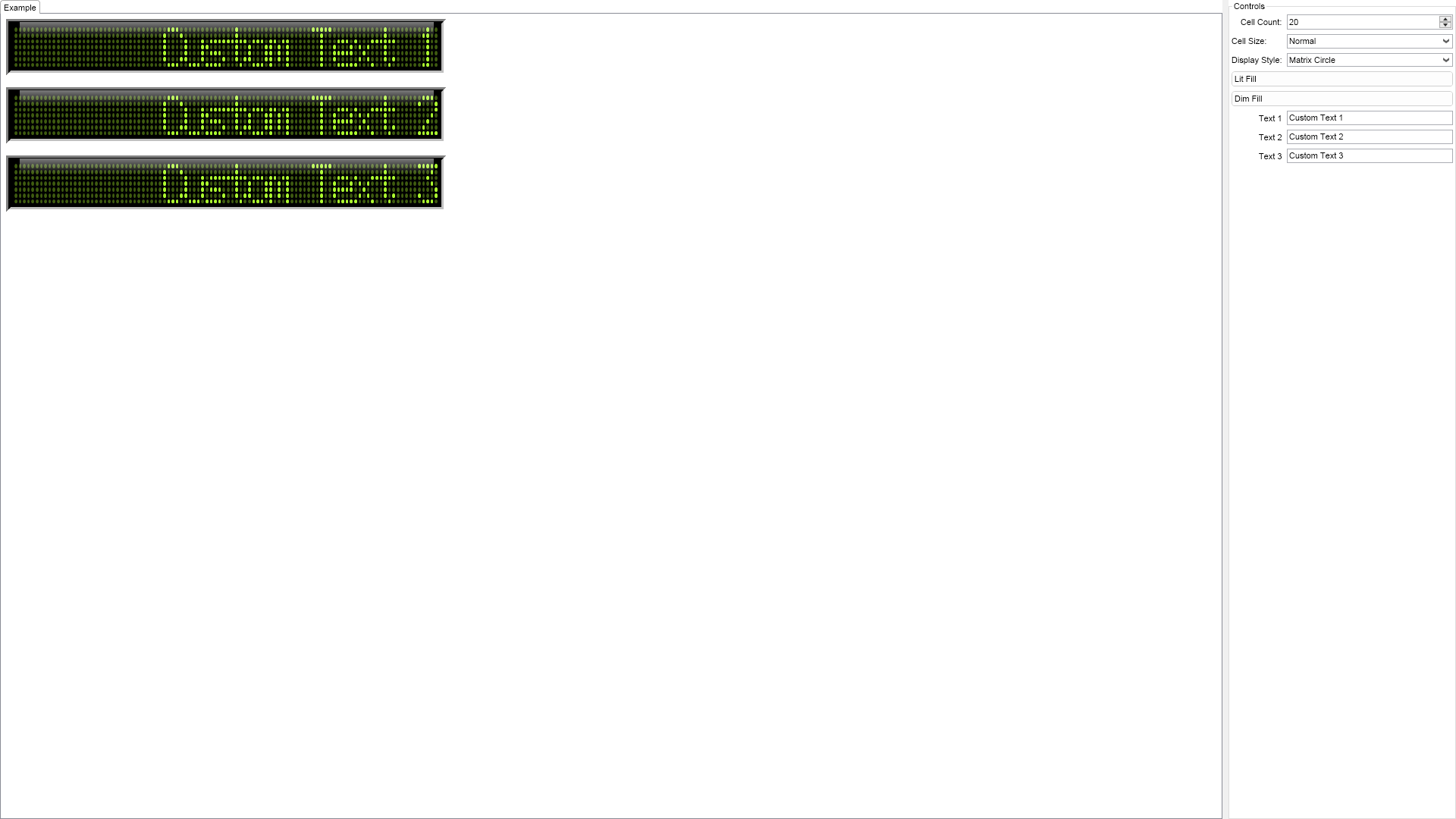
Text Led Display Example for WinForms

Nevron NOV Gauge for WinForms ships with hundreds of examples with full source code, as part of the Nevron Open Vision Suite. All WinForms Gauge examples are also available as a stand-alone Visual Studio solution in C# and VB.NET, which you can download from the links below.

Text Led Display Example for WinForms Description

The example demonstrates the properties of the text led display.


Text Led Display Example

C# Text Led Display Example Code for Nevron Gauge for WinForms
Language: C#

using Nevron.Nov;
using Nevron.Nov.Chart;
using Nevron.Nov.Dom;
using Nevron.Nov.Editors;
using Nevron.Nov.Graphics;
using Nevron.Nov.Layout;
using Nevron.Nov.UI;
using Nevron.Nov.Windows.Forms;
using System;
using System.Windows.Forms;

namespace NovWinFormsProject
{
	public partial class Form1 : Form
	{
		#region Constructors

		public Form1()
		{
			InitializeComponent();

			// Set form title
			Text = "NOV WinForms - NTextLedDisplayExample";

			// Create the NOV example and its controls
			NWidget exampleContent = CreateExampleContent();
			NWidget exampleControls = CreateExampleControls();
			if (exampleControls != null)
			{
				exampleControls.PreferredWidth = 300;
			}

			// Place the example and its controls in a pair box
			NPairBox pairBox = new NPairBox(exampleContent, exampleControls);
			pairBox.FillMode = ENStackFillMode.First;
			pairBox.FitMode = ENStackFitMode.First;
			pairBox.Margins = new NMargins(NDesign.HorizontalSpacing, NDesign.VerticalSpacing);

			// Host the example in the form
			NNovWidgetHost host = new NNovWidgetHost(pairBox);
			host.Dock = DockStyle.Fill;
			Controls.Add(host);
		}

		#endregion

        #region Example

        public NWidget CreateExampleContent()
		{
			NStackPanel stack = new NStackPanel();

			stack.HorizontalPlacement = ENHorizontalPlacement.Left;

			m_TextDisplay1 = CreateTextLedDisplay();
			stack.Add(m_TextDisplay1);

			m_TextDisplay2 = CreateTextLedDisplay();
			stack.Add(m_TextDisplay2);

			m_TextDisplay3 = CreateTextLedDisplay();
			stack.Add(m_TextDisplay3);
			
			return stack;
		}
        public NWidget CreateExampleControls()
        {
            NStackPanel stack = new NStackPanel();

			NStackPanel propertyStack = new NStackPanel();
			stack.Add(new NUniSizeBoxGroup(propertyStack));

			m_CellCountUpDown = new NNumericUpDown();
            m_CellCountUpDown.ValueChanged += OnCellCountValueChanged;
			m_CellCountUpDown.Value = 20;
            propertyStack.Add(NPairBox.Create("Cell Count:", m_CellCountUpDown));

            // init form controls
            m_CellSizeComboBox = new NComboBox();
			propertyStack.Add(new NPairBox("Cell Size:", m_CellSizeComboBox, true));

			m_CellSizeComboBox.Items.Add(new NComboBoxItem("Small"));
			m_CellSizeComboBox.Items.Add(new NComboBoxItem("Normal"));
			m_CellSizeComboBox.Items.Add(new NComboBoxItem("Large"));
			m_CellSizeComboBox.SelectedIndex = 1;
			m_CellSizeComboBox.SelectedIndexChanged += OnCellSizeComboBoxSelectedIndexChanged;

			m_DisplayStyleComboBox = new NComboBox();
			propertyStack.Add(new NPairBox("Display Style:", m_DisplayStyleComboBox, true));
			m_DisplayStyleComboBox.Items.FillFromEnum();
            m_DisplayStyleComboBox.SelectedIndexChanged += OnDisplayStyleComboBoxSelectedIndexChanged;
            m_DisplayStyleComboBox.SelectedIndex = (int)ENDisplayStyle.MatrixCircle;
            

			NButton litFillButton = new NButton("Lit Fill");
			litFillButton.Click += OnLitFillButtonClick;
			propertyStack.Add(litFillButton);

			NButton dimFillButton = new NButton("Dim Fill");
			dimFillButton.Click += OnDimFillButtonClick;
			propertyStack.Add(dimFillButton);


			NTextBox textBox1 = new NTextBox();
            textBox1.TextChanged += OnTextBox1TextChanged;
			textBox1.Text = "Custom Text 1";
            propertyStack.Add(NPairBox.Create("Text 1", textBox1));

            NTextBox textBox2 = new NTextBox();
            textBox2.TextChanged += OnTextBox2TextChanged;
            textBox2.Text = "Custom Text 2";
            propertyStack.Add(NPairBox.Create("Text 2", textBox2));

            NTextBox textBox3 = new NTextBox();
            textBox3.TextChanged += OnTextBox3TextChanged;
            textBox3.Text = "Custom Text 3";
            propertyStack.Add(NPairBox.Create("Text 3", textBox3));

            return stack;
        }

        public string GetExampleDescription()
		{
			return @"

The example demonstrates the properties of the text led display.

"; } /// /// Gets the relevant documentation links for the example /// /// public (string Name, string Url)[] GetDocumentationUrls() { return new[] { ("Numeric LED Display", "https://www.nevron.com/docs/openvision/numeric-led-display.html"), ("Instrumentation Overview", "https://www.nevron.com/docs/openvision/instrumentation-overview.html"), }; } #endregion #region Implementation private NTextLedDisplay CreateTextLedDisplay() { NTextLedDisplay textLedDisply = new NTextLedDisplay(); textLedDisply.CellCountMode = ENDisplayCellCountMode.Fixed; textLedDisply.CellCount = 7; textLedDisply.BackgroundFill = new NColorFill(NColor.Black); textLedDisply.Border = NBorder.CreateSunken3DBorder(new NUIThemeColorMap(ENUIThemeScheme.WindowsClassic)); textLedDisply.BorderThickness = new NMargins(6); textLedDisply.Margins = new NMargins(5); textLedDisply.Padding = new NMargins(5); textLedDisply.CapEffect = new NGelCapEffect(); return textLedDisply; } #endregion #region Event Handlers void OnLitFillButtonClick(NEventArgs arg) { NEditorWindow.CreateForType( (NFill)m_TextDisplay1.LitFill.DeepClone(), null, m_TextDisplay1.DisplayWindow, false, OnLitFillEdited).Open(); } void OnLitFillEdited(NFill fill) { m_TextDisplay1.LitFill = (NFill)(fill.DeepClone()); m_TextDisplay2.LitFill = (NFill)(fill.DeepClone()); m_TextDisplay3.LitFill = (NFill)(fill.DeepClone()); } void OnDimFillButtonClick(NEventArgs arg) { NEditorWindow.CreateForType( (NFill)m_TextDisplay1.DimFill.DeepClone(), null, m_TextDisplay1.DisplayWindow, false, OnDimFillEdited).Open(); } void OnDimFillEdited(NFill fill) { m_TextDisplay1.DimFill = (NFill)(fill.DeepClone()); m_TextDisplay2.DimFill = (NFill)(fill.DeepClone()); m_TextDisplay3.DimFill = (NFill)(fill.DeepClone()); } void OnCellSizeComboBoxSelectedIndexChanged(NValueChangeEventArgs arg) { double segmentWidth = 0.0; double segmentGap = 0.0; NSize cellSize = new NSize(0.0, 0.0); switch (m_CellSizeComboBox.SelectedIndex) { case 0: // small segmentWidth = 2.0; segmentGap = 1.0; cellSize = new NSize(15, 30); break; case 1: // normal segmentWidth = 3; segmentGap = 1; cellSize = new NSize(20, 40); break; case 2: // large segmentWidth = 4; segmentGap = 2; cellSize = new NSize(26, 52); break; } NTextLedDisplay[] displays = new NTextLedDisplay[] { m_TextDisplay1, m_TextDisplay2, m_TextDisplay3 }; for (int i = 0; i < displays.Length; i++) { NTextLedDisplay display = displays[i]; display.CellSize = cellSize; display.SegmentGap = segmentGap; display.SegmentWidth = segmentWidth; } } void OnDisplayStyleComboBoxSelectedIndexChanged(NValueChangeEventArgs arg) { m_TextDisplay1.DisplayStyle = (ENDisplayStyle)m_DisplayStyleComboBox.SelectedIndex; m_TextDisplay2.DisplayStyle = (ENDisplayStyle)m_DisplayStyleComboBox.SelectedIndex; m_TextDisplay3.DisplayStyle = (ENDisplayStyle)m_DisplayStyleComboBox.SelectedIndex; } private void OnTextBox1TextChanged(NValueChangeEventArgs arg) { m_TextDisplay1.Text = (string)arg.NewValue; } private void OnTextBox2TextChanged(NValueChangeEventArgs arg) { m_TextDisplay2.Text = (string)arg.NewValue; } private void OnTextBox3TextChanged(NValueChangeEventArgs arg) { m_TextDisplay3.Text = (string)arg.NewValue; } private void OnCellCountValueChanged(NValueChangeEventArgs arg) { m_TextDisplay1.CellCount = (int)m_CellCountUpDown.Value; m_TextDisplay2.CellCount = (int)m_CellCountUpDown.Value; m_TextDisplay3.CellCount = (int)m_CellCountUpDown.Value; } #endregion #region Fields private NComboBox m_DisplayStyleComboBox; private NTextLedDisplay m_TextDisplay1; private NTextLedDisplay m_TextDisplay2; private NTextLedDisplay m_TextDisplay3; private NComboBox m_CellSizeComboBox; private NNumericUpDown m_CellCountUpDown; #endregion #region Static Methods #endregion #region Constants #endregion #region Nested Types #endregion } }

Download a fully functional C# (.cs) Text Led Display Example for WinForms Solution

VB.NET Text Led Display Example Code for Nevron Gauge for WinForms
Language: VB.NET

Imports Nevron.Nov
Imports Nevron.Nov.Chart
Imports Nevron.Nov.Dom
Imports Nevron.Nov.Editors
Imports Nevron.Nov.Graphics
Imports Nevron.Nov.Layout
Imports Nevron.Nov.UI
Imports Nevron.Nov.Windows.Forms

Public Class Form1

#Region "Constructors"

    Public Sub New()
        ' This call is required by the designer.
        InitializeComponent()

        ' Add any initialization after the InitializeComponent() call.

        ' Set form title
        Text = "NOV WinForms - NTextLedDisplayExample"

        ' Create the NOV example and its controls
        Dim exampleContent As NWidget = CreateExampleContent()
        Dim exampleControls As NWidget = CreateExampleControls()
        If Not exampleControls Is Nothing Then
            exampleControls.PreferredWidth = 300
        End If

        ' Place the example and its controls in a pair box
        Dim pairBox As NPairBox = New NPairBox(exampleContent, exampleControls)
        pairBox.FillMode = ENStackFillMode.First
        pairBox.FitMode = ENStackFitMode.First
        pairBox.Margins = New NMargins(NDesign.HorizontalSpacing, NDesign.VerticalSpacing)

        ' Host the example in the form
        Dim host As NNovWidgetHost(Of NWidget) = New NNovWidgetHost(Of NWidget)(pairBox)
        host.Dock = DockStyle.Fill
        Controls.Add(host)
    End Sub


#End Region

#Region "Example"

        Public Function CreateExampleContent() As NWidget
            Dim stack As NStackPanel = New NStackPanel()

            stack.HorizontalPlacement = ENHorizontalPlacement.Left

            m_TextDisplay1 = CreateTextLedDisplay()
            stack.Add(m_TextDisplay1)

            m_TextDisplay2 = CreateTextLedDisplay()
            stack.Add(m_TextDisplay2)

            m_TextDisplay3 = CreateTextLedDisplay()
            stack.Add(m_TextDisplay3)

            Return stack
        End Function
        Public Function CreateExampleControls() As NWidget
            Dim stack As NStackPanel = New NStackPanel()

            Dim propertyStack As NStackPanel = New NStackPanel()
            stack.Add(New NUniSizeBoxGroup(propertyStack))

            m_CellCountUpDown = New NNumericUpDown()
            Me.m_CellCountUpDown.ValueChanged += AddressOf OnCellCountValueChanged
            m_CellCountUpDown.Value = 20
            propertyStack.Add(NPairBox.Create("Cell Count:", m_CellCountUpDown))

            ' init form controls
            m_CellSizeComboBox = New NComboBox()
            propertyStack.Add(New NPairBox("Cell Size:", m_CellSizeComboBox, True))

            m_CellSizeComboBox.Items.Add(New NComboBoxItem("Small"))
            m_CellSizeComboBox.Items.Add(New NComboBoxItem("Normal"))
            m_CellSizeComboBox.Items.Add(New NComboBoxItem("Large"))
            m_CellSizeComboBox.SelectedIndex = 1
            Me.m_CellSizeComboBox.SelectedIndexChanged += AddressOf OnCellSizeComboBoxSelectedIndexChanged

            m_DisplayStyleComboBox = New NComboBox()
            propertyStack.Add(New NPairBox("Display Style:", m_DisplayStyleComboBox, True))
            m_DisplayStyleComboBox.Items.FillFromEnum(Of ENDisplayStyle)()
            Me.m_DisplayStyleComboBox.SelectedIndexChanged += AddressOf OnDisplayStyleComboBoxSelectedIndexChanged
            m_DisplayStyleComboBox.SelectedIndex = CInt(ENDisplayStyle.MatrixCircle)


            Dim litFillButton As NButton = New NButton("Lit Fill")
            litFillButton.Click += AddressOf OnLitFillButtonClick
            propertyStack.Add(litFillButton)

            Dim dimFillButton As NButton = New NButton("Dim Fill")
            dimFillButton.Click += AddressOf OnDimFillButtonClick
            propertyStack.Add(dimFillButton)


            Dim textBox1 As NTextBox = New NTextBox()
            textBox1.TextChanged += AddressOf OnTextBox1TextChanged
            textBox1.Text = "Custom Text 1"
            propertyStack.Add(NPairBox.Create("Text 1", textBox1))

            Dim textBox2 As NTextBox = New NTextBox()
            textBox2.TextChanged += AddressOf OnTextBox2TextChanged
            textBox2.Text = "Custom Text 2"
            propertyStack.Add(NPairBox.Create("Text 2", textBox2))

            Dim textBox3 As NTextBox = New NTextBox()
            textBox3.TextChanged += AddressOf OnTextBox3TextChanged
            textBox3.Text = "Custom Text 3"
            propertyStack.Add(NPairBox.Create("Text 3", textBox3))

            Return stack
        End Function

        Public Function GetExampleDescription() As String
            Return "

The example demonstrates the properties of the text led display.

" End Function ''' ''' Gets the relevant documentation links for the example ''' ''' Public Function GetDocumentationUrls() As (String, String)() Return {("Numeric LED Display", "https://www.nevron.com/docs/openvision/numeric-led-display.html"), ("Instrumentation Overview", "https://www.nevron.com/docs/openvision/instrumentation-overview.html")} End Function #End Region #Region "Implementation" Private Function CreateTextLedDisplay() As NTextLedDisplay Dim textLedDisply As NTextLedDisplay = New NTextLedDisplay() textLedDisply.CellCountMode = ENDisplayCellCountMode.Fixed textLedDisply.CellCount = 7 textLedDisply.BackgroundFill = New NColorFill(NColor.Black) textLedDisply.Border = NBorder.CreateSunken3DBorder(New NUIThemeColorMap(ENUIThemeScheme.WindowsClassic)) textLedDisply.BorderThickness = New NMargins(6) textLedDisply.Margins = New NMargins(5) textLedDisply.Padding = New NMargins(5) textLedDisply.CapEffect = New NGelCapEffect() Return textLedDisply End Function #End Region #Region "Event Handlers" Private Sub OnLitFillButtonClick(arg As NEventArgs) Call NEditorWindow.CreateForType(CType(CType(m_TextDisplay1.LitFill.DeepClone(), NFill), NFill), Nothing, CType(m_TextDisplay1.DisplayWindow, NWindow), CBool(False), New DNFunction(Of T)(AddressOf OnLitFillEdited)).Open() End Sub Private Sub OnLitFillEdited(fill As NFill) m_TextDisplay1.LitFill = CType((fill.DeepClone()), NFill) m_TextDisplay2.LitFill = CType((fill.DeepClone()), NFill) m_TextDisplay3.LitFill = CType((fill.DeepClone()), NFill) End Sub Private Sub OnDimFillButtonClick(arg As NEventArgs) Call NEditorWindow.CreateForType(CType(CType(m_TextDisplay1.DimFill.DeepClone(), NFill), NFill), Nothing, CType(m_TextDisplay1.DisplayWindow, NWindow), CBool(False), New DNFunction(Of T)(AddressOf OnDimFillEdited)).Open() End Sub Private Sub OnDimFillEdited(fill As NFill) m_TextDisplay1.DimFill = CType((fill.DeepClone()), NFill) m_TextDisplay2.DimFill = CType((fill.DeepClone()), NFill) m_TextDisplay3.DimFill = CType((fill.DeepClone()), NFill) End Sub Private Sub OnCellSizeComboBoxSelectedIndexChanged(arg As NValueChangeEventArgs) Dim segmentWidth = 0.0 Dim segmentGap = 0.0 Dim cellSize As NSize = New NSize(0.0, 0.0) Select Case m_CellSizeComboBox.SelectedIndex Case 0 ' small segmentWidth = 2.0 segmentGap = 1.0 cellSize = New NSize(15, 30) Case 1 ' normal segmentWidth = 3 segmentGap = 1 cellSize = New NSize(20, 40) Case 2 ' large segmentWidth = 4 segmentGap = 2 cellSize = New NSize(26, 52) End Select Dim displays = New NTextLedDisplay() {m_TextDisplay1, m_TextDisplay2, m_TextDisplay3} For i = 0 To displays.Length - 1 Dim display = displays(i) display.CellSize = cellSize display.SegmentGap = segmentGap display.SegmentWidth = segmentWidth Next End Sub Private Sub OnDisplayStyleComboBoxSelectedIndexChanged(arg As NValueChangeEventArgs) m_TextDisplay1.DisplayStyle = CType(m_DisplayStyleComboBox.SelectedIndex, ENDisplayStyle) m_TextDisplay2.DisplayStyle = CType(m_DisplayStyleComboBox.SelectedIndex, ENDisplayStyle) m_TextDisplay3.DisplayStyle = CType(m_DisplayStyleComboBox.SelectedIndex, ENDisplayStyle) End Sub Private Sub OnTextBox1TextChanged(arg As NValueChangeEventArgs) m_TextDisplay1.Text = CStr(arg.NewValue) End Sub Private Sub OnTextBox2TextChanged(arg As NValueChangeEventArgs) m_TextDisplay2.Text = CStr(arg.NewValue) End Sub Private Sub OnTextBox3TextChanged(arg As NValueChangeEventArgs) m_TextDisplay3.Text = CStr(arg.NewValue) End Sub Private Sub OnCellCountValueChanged(arg As NValueChangeEventArgs) m_TextDisplay1.CellCount = CInt(m_CellCountUpDown.Value) m_TextDisplay2.CellCount = CInt(m_CellCountUpDown.Value) m_TextDisplay3.CellCount = CInt(m_CellCountUpDown.Value) End Sub #End Region #Region "Fields" Private m_DisplayStyleComboBox As NComboBox Private m_TextDisplay1 As NTextLedDisplay Private m_TextDisplay2 As NTextLedDisplay Private m_TextDisplay3 As NTextLedDisplay Private m_CellSizeComboBox As NComboBox Private m_CellCountUpDown As NNumericUpDown #End Region #Region "Static Methods" #End Region #Region "Constants" #End Region #Region "Nested Types" #End Region End Class

Download a fully functional VB.NET (.vb) Text Led Display Example for WinForms Solution