using Nevron.Nov;
using Nevron.Nov.DataStructures;
using Nevron.Nov.Dom;
using Nevron.Nov.Editors;
using Nevron.Nov.Graphics;
using Nevron.Nov.Layout;
using Nevron.Nov.Presentation;
using Nevron.Nov.Schedule;
using Nevron.Nov.UI;
using Nevron.Nov.Windows.Forms;
using System;
using System.Windows.Forms;
namespace NovWinFormsProject
{
public partial class Form1 : Form
{
#region Constructors
public Form1()
{
InitializeComponent();
// Set form title
Text = "NOV WinForms - NCurrentTimeIndicatorExample";
// Create the NOV example and its controls
NWidget exampleContent = CreateExampleContent();
NWidget exampleControls = CreateExampleControls();
if (exampleControls != null)
{
exampleControls.PreferredWidth = 300;
}
// Place the example and its controls in a pair box
NPairBox pairBox = new NPairBox(exampleContent, exampleControls);
pairBox.FillMode = ENStackFillMode.First;
pairBox.FitMode = ENStackFitMode.First;
pairBox.Margins = new NMargins(NDesign.HorizontalSpacing, NDesign.VerticalSpacing);
// Host the example in the form
NNovWidgetHost host = new NNovWidgetHost(pairBox);
host.Dock = DockStyle.Fill;
Controls.Add(host);
}
#endregion
#region Example
public NWidget CreateExampleContent()
{
// Create a simple schedule
NScheduleViewWithRibbon scheduleViewWithRibbon = new NScheduleViewWithRibbon();
m_ScheduleView = scheduleViewWithRibbon.View;
m_ScheduleView.Document.PauseHistoryService();
try
{
InitSchedule(m_ScheduleView.Content);
}
finally
{
m_ScheduleView.Document.ResumeHistoryService();
}
// Return the commanding widget
return scheduleViewWithRibbon;
}
public NWidget CreateExampleControls()
{
NTimeIndicator timeIndicator = m_ScheduleView.Content.CurrentTimeIndicator;
NList propertyEditors = NDesigner.GetDesigner(timeIndicator).CreateMemberEditors(
timeIndicator,
NTimeIndicator.VisibleProperty,
NTimeIndicator.FillProperty,
NTimeIndicator.ThicknessProperty
);
NStackPanel stack = new NStackPanel();
for (int i = 0; i < propertyEditors.Count; i++)
{
stack.Add(propertyEditors[i]);
}
return new NUniSizeBoxGroup(stack);
}
public string GetExampleDescription()
{
return @"
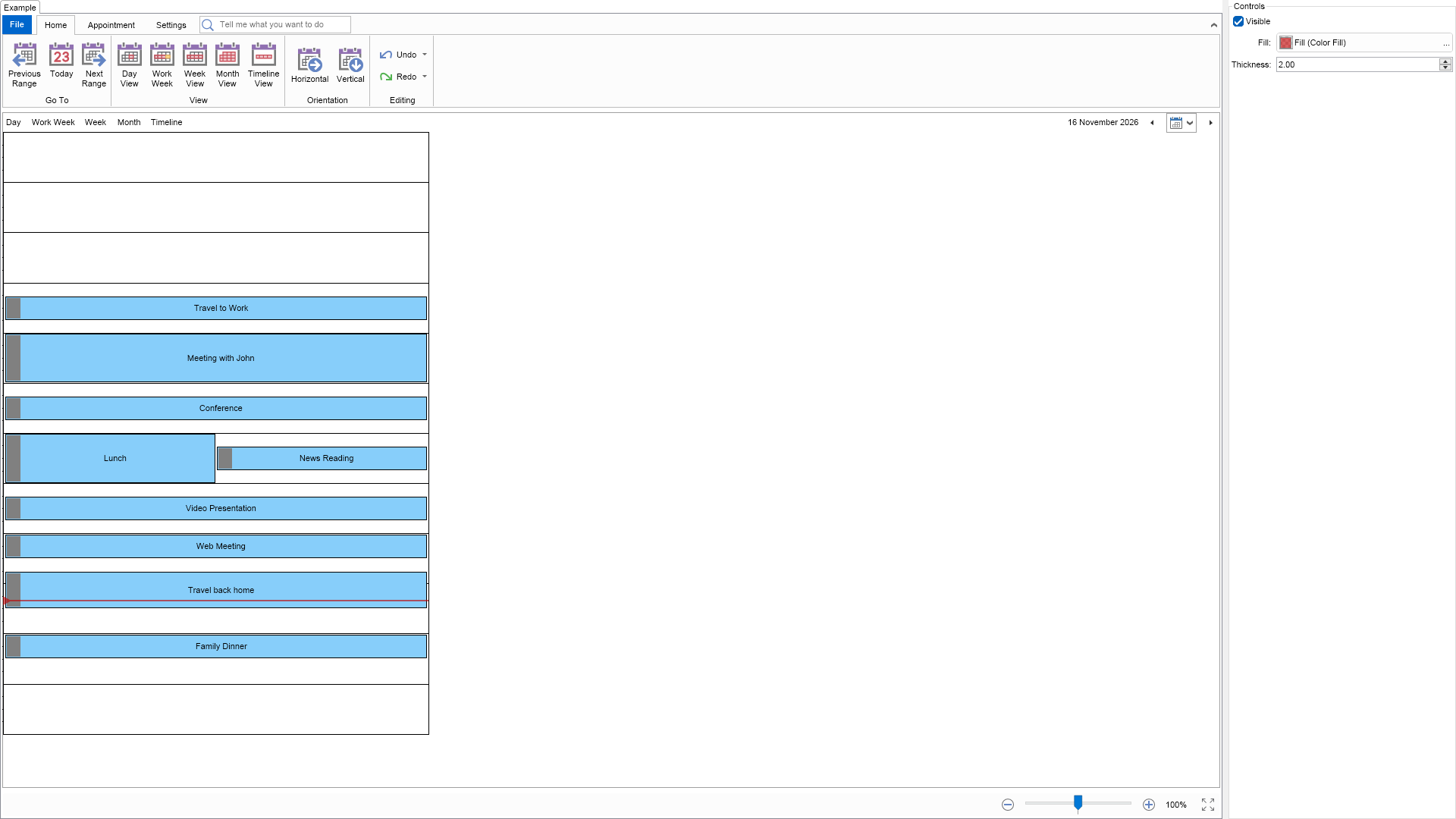
This example demonstrates how to show and configure the current time indicator. This is done via the following properties
of the schedule's CurrentTimeIndicator:
- Visible - determines whether to show the time indicator.
- Fill - determines the fill style of the time indicator. For best results set it to a semi-transparent color fill,
for example - new NColorFill(new NColor(192, 0, 0, 160)).
- Thickness - determines the thickness of the time indicator in DIPs. By default set to 2.
";
}
///
/// Gets the relevant documentation links for the example
///
///
public (string Name, string Url)[] GetDocumentationUrls()
{
return new[]
{
("Schedule Time Indicators", "https://www.nevron.com/docs/openvision/schedule-time-indicators.html"),
("Schedule Time Ruler", "https://www.nevron.com/docs/openvision/schedule-time-ruler.html"),
};
}
#endregion
#region Implementation
private void InitSchedule(NSchedule schedule)
{
DateTime today = DateTime.Today;
schedule.ViewMode = ENScheduleViewMode.Day;
// Add some appointments
schedule.Appointments.Add(new NAppointment("Travel to Work", today.AddHours(6.5), today.AddHours(7.5)));
schedule.Appointments.Add(new NAppointment("Meeting with John", today.AddHours(8), today.AddHours(10)));
schedule.Appointments.Add(new NAppointment("Conference", today.AddHours(10.5), today.AddHours(11.5)));
schedule.Appointments.Add(new NAppointment("Lunch", today.AddHours(12), today.AddHours(14)));
schedule.Appointments.Add(new NAppointment("News Reading", today.AddHours(12.5), today.AddHours(13.5)));
schedule.Appointments.Add(new NAppointment("Video Presentation", today.AddHours(14.5), today.AddHours(15.5)));
schedule.Appointments.Add(new NAppointment("Web Meeting", today.AddHours(16), today.AddHours(17)));
schedule.Appointments.Add(new NAppointment("Travel back home", today.AddHours(17.5), today.AddHours(19)));
schedule.Appointments.Add(new NAppointment("Family Dinner", today.AddHours(20), today.AddHours(21)));
// Show current time indicator
schedule.CurrentTimeIndicator.Visible = true;
}
#endregion
#region Event Handlers
#endregion
#region Fields
private NScheduleView m_ScheduleView;
#endregion
#region Static Methods
#endregion
#region Constants
#endregion
#region Nested Types
#endregion
}
}

 Chart for .NET
 Diagram for .NET
 User Interface for .NET
 Vision for SSRS
 Chart for SSRS
 Gauge for SSRS
 Map for SSRS
 Barcode for SSRS
 Vision for SharePoint
 Chart for SharePoint
 Gauge for SharePoint
 Map for SharePoint
 Barcode for SharePoint
 Open Vision for .NET


 Vision for .NET