Imports Nevron.Nov
Imports Nevron.Nov.Chart
Imports Nevron.Nov.Dom
Imports Nevron.Nov.Graphics
Imports Nevron.Nov.Layout
Imports Nevron.Nov.UI
Imports Nevron.Nov.Windows.Wpf
Imports System
Class MainWindow
#Region "Constructors"
Public Sub New()
' This call is required by the designer.
InitializeComponent()
' Add any initialization after the InitializeComponent() call.
' Set form title
Title = "NOV WPF - NLegendLayoutExample"
' Create the NOV example and its controls
Dim exampleContent As NWidget = CreateExampleContent()
Dim exampleControls As NWidget = CreateExampleControls()
If Not exampleControls Is Nothing Then
exampleControls.PreferredWidth = 300
End If
' Place the example and its controls in a pair box
Dim pairBox As NPairBox = New NPairBox(exampleContent, exampleControls)
pairBox.FillMode = ENStackFillMode.First
pairBox.FitMode = ENStackFitMode.First
pairBox.Margins = New NMargins(NDesign.HorizontalSpacing, NDesign.VerticalSpacing)
' Host the example in the form
Dim host As NNovWidgetHost(Of NWidget) = New NNovWidgetHost(Of NWidget)(pairBox)
Content = host
End Sub
#End Region
#Region "Example"
Public Function CreateExampleContent() As NWidget
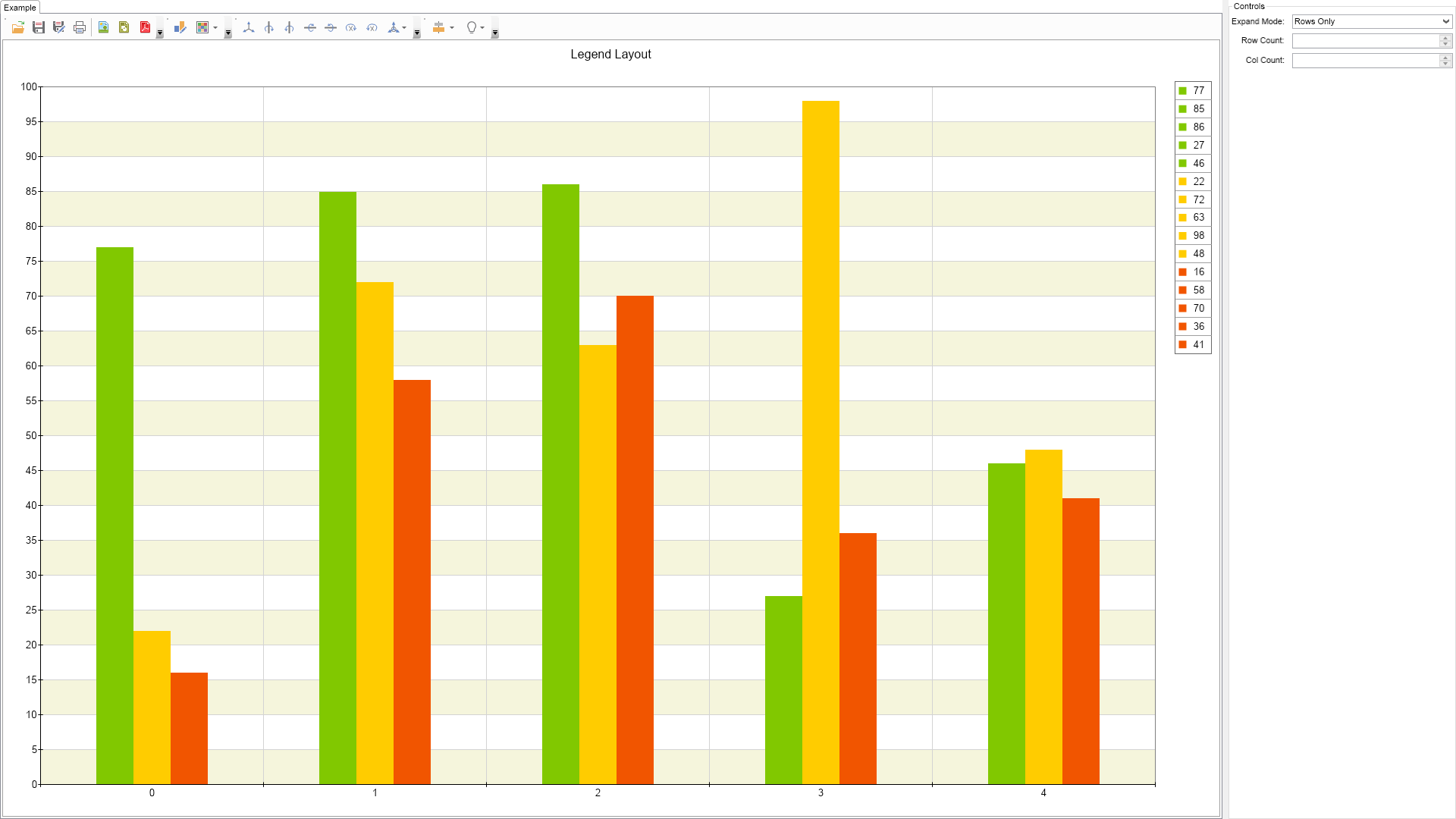
Dim chartViewWithCommandBars As NChartViewWithCommandBars = New NChartViewWithCommandBars()
m_ChartView = chartViewWithCommandBars.View
m_ChartView.Surface.CreatePredefinedChart(ENPredefinedChartType.Cartesian)
' configure title
m_ChartView.Surface.Titles(0).Text = "Legend Layout"
' configure chart
Dim chart = CType(m_ChartView.Surface.Charts(0), NCartesianChart)
' add interlace stripe
Dim linearScale As NLinearScale = TryCast(chart.Axes(ENCartesianAxis.PrimaryY).Scale, NLinearScale)
Dim strip As NScaleStrip = New NScaleStrip(New NColorFill(ENNamedColor.Beige), Nothing, True, 0, 0, 1, 1)
strip.Interlaced = True
linearScale.Strips.Add(strip)
' add a bar series
Dim bar1 As NBarSeries = New NBarSeries()
bar1.Name = "Bar1"
bar1.MultiBarMode = ENMultiBarMode.Series
bar1.LegendView.Mode = ENSeriesLegendMode.DataPoints
bar1.DataLabelStyle = New NDataLabelStyle(False)
bar1.ValueFormatter = New NNumericValueFormatter("0.###")
chart.Series.Add(bar1)
' add another bar series
Dim bar2 As NBarSeries = New NBarSeries()
bar2.Name = "Bar2"
bar2.MultiBarMode = ENMultiBarMode.Clustered
bar2.LegendView.Mode = ENSeriesLegendMode.DataPoints
bar2.DataLabelStyle = New NDataLabelStyle(False)
bar2.ValueFormatter = New NNumericValueFormatter("0.###")
chart.Series.Add(bar2)
' add another bar series
Dim bar3 As NBarSeries = New NBarSeries()
bar3.Name = "Bar2"
bar3.MultiBarMode = ENMultiBarMode.Clustered
bar3.LegendView.Mode = ENSeriesLegendMode.DataPoints
bar3.DataLabelStyle = New NDataLabelStyle(False)
bar3.ValueFormatter = New NNumericValueFormatter("0.###")
chart.Series.Add(bar3)
Dim random As Random = New Random()
For i = 0 To 4
bar1.DataPoints.Add(New NBarDataPoint(random.Next(10, 100)))
bar2.DataPoints.Add(New NBarDataPoint(random.Next(10, 100)))
bar3.DataPoints.Add(New NBarDataPoint(random.Next(10, 100)))
Next
m_ChartView.Document.StyleSheets.ApplyTheme(New NChartTheme(ENChartPalette.Bright, ENChartPaletteTarget.Series))
Return chartViewWithCommandBars
End Function
Public Function CreateExampleControls() As NWidget
Dim stack As NStackPanel = New NStackPanel()
Dim boxGroup As NUniSizeBoxGroup = New NUniSizeBoxGroup(stack)
Dim legendExpandModeComboBox As NComboBox = New NComboBox()
legendExpandModeComboBox.Items.FillFromEnum(Of ENLegendExpandMode)()
legendExpandModeComboBox.SelectedIndexChanged += AddressOf OnLegendExpandModeComboBoxSelectedIndexChanged
stack.Add(NPairBox.Create("Expand Mode: ", legendExpandModeComboBox))
m_RowCountUpDown = New NNumericUpDown()
m_RowCountUpDown.Enabled = False
m_RowCountUpDown.Minimum = 1
m_RowCountUpDown.Value = 1
Me.m_RowCountUpDown.ValueChanged += AddressOf OnRowCountUpDownValueChanged
stack.Add(NPairBox.Create("Row Count: ", m_RowCountUpDown))
m_ColCountUpDown = New NNumericUpDown()
m_ColCountUpDown.Enabled = False
m_ColCountUpDown.Minimum = 1
m_ColCountUpDown.Value = 1
Me.m_ColCountUpDown.ValueChanged += AddressOf OnColCountUpDownValueChanged
stack.Add(NPairBox.Create("Col Count: ", m_ColCountUpDown))
legendExpandModeComboBox.SelectedIndex = CInt(ENLegendExpandMode.RowsOnly)
Return boxGroup
End Function
Public Function GetExampleDescription() As String
Return "This example demonstrates different settings related to legend layout.
"
End Function
'''
''' Gets the relevant documentation links for the example
'''
'''
Public Function GetDocumentationUrls() As (String, String)()
Return {("Legend Layout", "https://www.nevron.com/docs/openvision/chart-legend-layout.html"), ("Overview", "https://www.nevron.com/docs/openvision/chart-legeng-overview.html")}
End Function
#End Region
#Region "Implementation"
#End Region
#Region "Event Handlers"
Private Sub OnRowCountUpDownValueChanged(arg As NValueChangeEventArgs)
m_ChartView.Surface.Legends(0).RowCount = CInt(CType(arg.TargetNode, NNumericUpDown).Value)
End Sub
Private Sub OnColCountUpDownValueChanged(arg As NValueChangeEventArgs)
m_ChartView.Surface.Legends(0).ColCount = CInt(CType(arg.TargetNode, NNumericUpDown).Value)
End Sub
Private Sub OnLegendExpandModeComboBoxSelectedIndexChanged(arg As NValueChangeEventArgs)
m_ChartView.Surface.Legends(0).ExpandMode = CType(CType(arg.TargetNode, NComboBox).SelectedIndex, ENLegendExpandMode)
Select Case m_ChartView.Surface.Legends(CInt(0)).ExpandMode
Case ENLegendExpandMode.ColsFixed
m_ColCountUpDown.Enabled = True
m_RowCountUpDown.Enabled = False
Case ENLegendExpandMode.RowsFixed
m_ColCountUpDown.Enabled = False
m_RowCountUpDown.Enabled = True
Case Else
m_ColCountUpDown.Enabled = False
m_RowCountUpDown.Enabled = False
End Select
End Sub
#End Region
#Region "Fields"
Private m_ChartView As NChartView
Private m_ColCountUpDown As NNumericUpDown
Private m_RowCountUpDown As NNumericUpDown
#End Region
#Region "Static Methods"
#End Region
#Region "Constants"
#End Region
#Region "Nested Types"
#End Region
End Class

 Chart for .NET
 Diagram for .NET
 User Interface for .NET
 Vision for SSRS
 Chart for SSRS
 Gauge for SSRS
 Map for SSRS
 Barcode for SSRS
 Vision for SharePoint
 Chart for SharePoint
 Gauge for SharePoint
 Map for SharePoint
 Barcode for SharePoint
 Open Vision for .NET


 Vision for .NET