using Nevron.Nov;
using Nevron.Nov.Chart;
using Nevron.Nov.Dom;
using Nevron.Nov.Graphics;
using Nevron.Nov.Layout;
using Nevron.Nov.UI;
using Nevron.Nov.Windows.Forms;
using System.Windows.Forms;
namespace NovWinFormsProject
{
public partial class Form1 : Form
{
#region Constructors
public Form1()
{
InitializeComponent();
// Set form title
Text = "NOV WinForms - NLinearGaugeIndicatorsExample";
// Create the NOV example and its controls
NWidget exampleContent = CreateExampleContent();
NWidget exampleControls = CreateExampleControls();
if (exampleControls != null)
{
exampleControls.PreferredWidth = 300;
}
// Place the example and its controls in a pair box
NPairBox pairBox = new NPairBox(exampleContent, exampleControls);
pairBox.FillMode = ENStackFillMode.First;
pairBox.FitMode = ENStackFitMode.First;
pairBox.Margins = new NMargins(NDesign.HorizontalSpacing, NDesign.VerticalSpacing);
// Host the example in the form
NNovWidgetHost host = new NNovWidgetHost(pairBox);
host.Dock = DockStyle.Fill;
Controls.Add(host);
}
#endregion
#region Example
public NWidget CreateExampleContent()
{
NStackPanel stack = new NStackPanel();
stack.HorizontalPlacement = ENHorizontalPlacement.Left;
// create a linear gauge
m_LinearGauge = new NLinearGauge();
stack.Add(m_LinearGauge);
m_LinearGauge.CapEffect = new NGelCapEffect();
m_LinearGauge.Border = CreateBorder();
m_LinearGauge.Padding = new NMargins(20);
m_LinearGauge.BorderThickness = new NMargins(6);
m_LinearGauge.BackgroundFill = new NStockGradientFill(NColor.Gray, NColor.Black);
m_LinearGauge.PreferredSize = new NSize(400, 150);
m_LinearGauge.Axes.Clear();
NRange celsiusRange = new NRange(-40.0, 60.0);
// add celsius and farenheit axes
NGaugeAxis celsiusAxis = new NGaugeAxis();
celsiusAxis.Range = celsiusRange;
celsiusAxis.Anchor = new NModelGaugeAxisAnchor(-5, ENVerticalAlignment.Center, ENScaleOrientation.Left, 0.0f, 100.0f);
//celsiusAxis.Anchor = new NDockGaugeAxisAnchor(ENGaugeAxisDockZone.Top);
m_LinearGauge.Axes.Add(celsiusAxis);
NGaugeAxis farenheitAxis = new NGaugeAxis();
farenheitAxis.Range = new NRange(CelsiusToFarenheit(celsiusRange.Begin), CelsiusToFarenheit(celsiusRange.End));
farenheitAxis.Anchor = new NModelGaugeAxisAnchor(5, ENVerticalAlignment.Center, ENScaleOrientation.Right, 0.0f, 100.0f);
//farenheitAxis.Anchor = new NDockGaugeAxisAnchor(ENGaugeAxisDockZone.Bottom);
m_LinearGauge.Axes.Add(farenheitAxis);
// configure the scales
NLinearScale celsiusScale = (NLinearScale)celsiusAxis.Scale;
ConfigureScale(celsiusScale, "°C");
celsiusScale.Sections.Add(CreateSection(NColor.Red, NColor.Red, new NRange(40, 60)));
celsiusScale.Sections.Add(CreateSection(NColor.Blue, NColor.SkyBlue, new NRange(-40, -20)));
NLinearScale farenheitScale = (NLinearScale)farenheitAxis.Scale;
ConfigureScale(farenheitScale, "°F");
farenheitScale.Sections.Add(CreateSection(NColor.Red, NColor.Red, new NRange(CelsiusToFarenheit(40), CelsiusToFarenheit(60))));
farenheitScale.Sections.Add(CreateSection(NColor.Blue, NColor.SkyBlue, new NRange(CelsiusToFarenheit(-40), CelsiusToFarenheit(-20))));
// now add two indicators
m_Indicator1 = new NRangeIndicator();
m_Indicator1.Value = 10;
m_Indicator1.Stroke.Color = NColor.DarkBlue;
m_Indicator1.Fill = new NStockGradientFill(ENGradientStyle.Vertical, ENGradientVariant.Variant1, NColor.LightBlue, NColor.Blue);
m_Indicator1.BeginWidth = 10;
m_Indicator1.EndWidth = 10;
m_LinearGauge.Indicators.Add(m_Indicator1);
m_Indicator2 = new NMarkerValueIndicator();
m_Indicator2.Value = 33;
// m_Indicator2.ShapFillStyle = new NStockGradientFill(ENGradientStyle.Horizontal, ENGradientVariant.Variant1, NColor.White, NColor.Red);
// m_Indicator2.Shape.StrokeStyle.Color = Color.DarkRed;
m_LinearGauge.Indicators.Add(m_Indicator2);
return stack;
}
public NWidget CreateExampleControls()
{
NStackPanel stack = new NStackPanel();
NStackPanel propertyStack = new NStackPanel();
stack.Add(new NUniSizeBoxGroup(propertyStack));
m_RangeIndicatorValueUpDown = new NNumericUpDown();
propertyStack.Add(new NPairBox("Range Indicator Value:", m_RangeIndicatorValueUpDown, true));
m_RangeIndicatorValueUpDown.Value = m_Indicator1.Value;
m_RangeIndicatorValueUpDown.ValueChanged += OnRangeIndicatorValueUpDownValueChanged;
m_RangeIndicatorOriginModeComboBox = new NComboBox();
propertyStack.Add(new NPairBox("Range Indicator Origin Mode:", m_RangeIndicatorOriginModeComboBox, true));
m_RangeIndicatorOriginModeComboBox.Items.FillFromEnum();
m_RangeIndicatorOriginModeComboBox.SelectedIndex = (int)ENRangeIndicatorOriginMode.ScaleMin;
m_RangeIndicatorOriginModeComboBox.SelectedIndexChanged +=OnRangeIndicatorOriginModeComboBoxSelectedIndexChanged;
m_RangeIndicatorOriginUpDown = new NNumericUpDown();
m_RangeIndicatorOriginUpDown.Value = 0.0;
m_RangeIndicatorOriginUpDown.Enabled = false;
propertyStack.Add(new NPairBox("Range Indicator Origin:", m_RangeIndicatorOriginUpDown, true));
m_RangeIndicatorOriginUpDown.ValueChanged += OnRangeIndicatorOriginUpDownValueChanged;
m_ValueIndicatorUpDown = new NNumericUpDown();
propertyStack.Add(new NPairBox("Value Indicator Value:", m_ValueIndicatorUpDown, true));
m_ValueIndicatorUpDown.Value = m_Indicator2.Value;
m_ValueIndicatorUpDown.ValueChanged += OnValueIndicatorUpDownValueChanged;
m_ValueIndicatorShapeComboBox = new NComboBox();
propertyStack.Add(new NPairBox("Value Indicator Shape", m_ValueIndicatorShapeComboBox, true));
m_ValueIndicatorShapeComboBox.Items.FillFromEnum();
m_ValueIndicatorShapeComboBox.SelectedIndex = (int)m_Indicator2.Shape;
m_ValueIndicatorShapeComboBox.SelectedIndexChanged += OnValueIndicatorShapeComboBoxSelectedIndexChanged;
m_GaugeOrientationCombo = new NComboBox();
propertyStack.Add(new NPairBox("Gauge Orientation:", m_GaugeOrientationCombo, true));
m_GaugeOrientationCombo.Items.FillFromEnum();
m_GaugeOrientationCombo.SelectedIndex = (int)ENLinearGaugeOrientation.Horizontal;
m_GaugeOrientationCombo.SelectedIndexChanged += OnGaugeOrientationComboSelectedIndexChanged;
m_MarkerWidthUpDown = new NNumericUpDown();
propertyStack.Add(new NPairBox("Marker Width:", m_MarkerWidthUpDown, true));
m_MarkerWidthUpDown.Value = m_Indicator2.Width;
m_MarkerHeightUpDown = new NNumericUpDown();
propertyStack.Add(new NPairBox("Marker Height:", m_MarkerHeightUpDown, true));
m_MarkerHeightUpDown.Value = m_Indicator2.Height;
return stack;
}
public string GetExampleDescription()
{
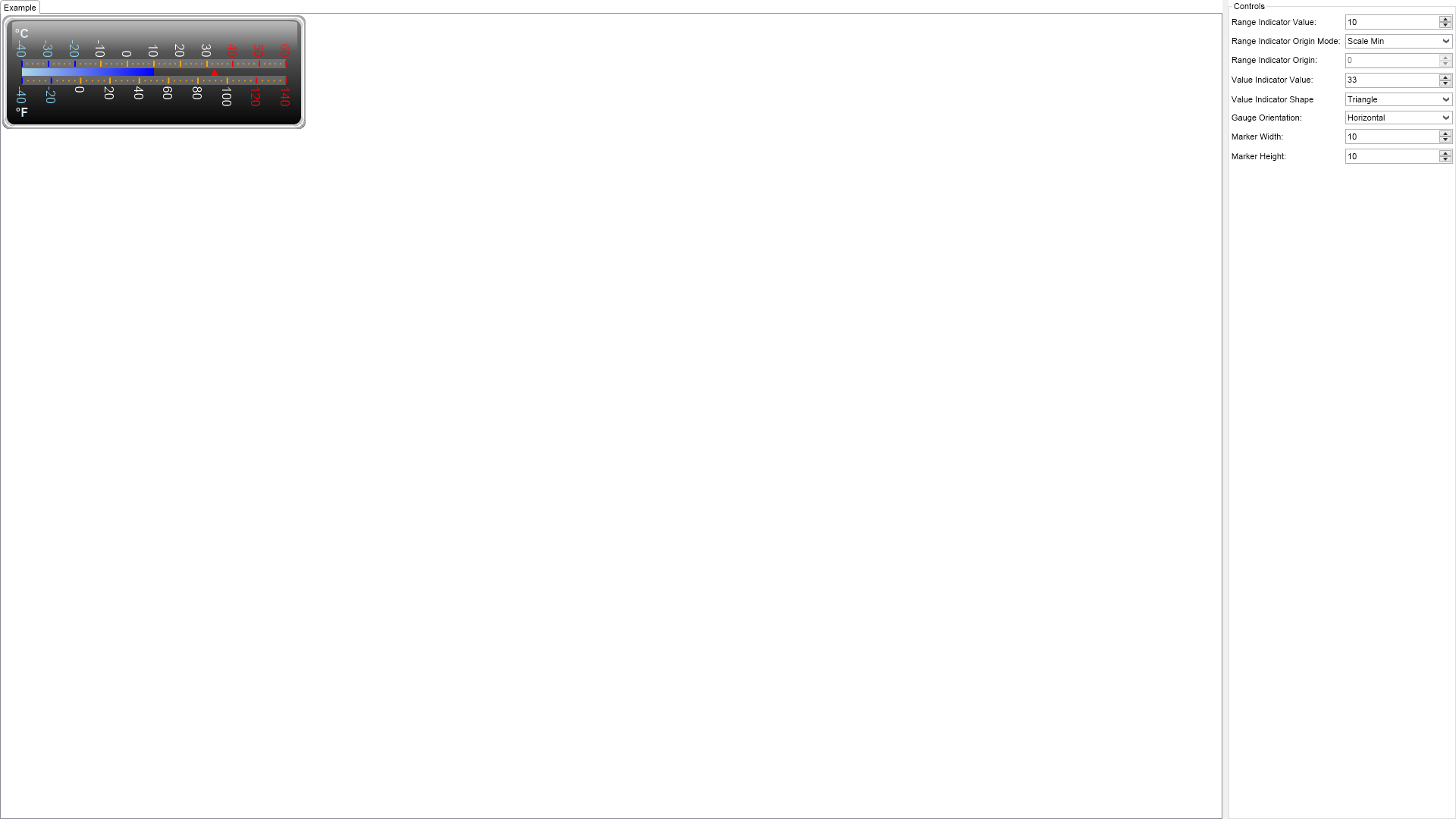
return @"The example demonstrates how to create range and marker gauge indicators.
";
}
///
/// Gets the relevant documentation links for the example
///
///
public (string Name, string Url)[] GetDocumentationUrls()
{
return new[]
{
("Gauges Indicators Overview", "https://www.nevron.com/docs/openvision/gauges-indicators-overview.html"),
("Gauges Needle Indicator", "https://www.nevron.com/docs/openvision/gauges-needle-indicator.html"),
("Gauges Range Indicator", "https://www.nevron.com/docs/openvision/gauges-range-indicator.html"),
("Gauges Marker Indicator", "https://www.nevron.com/docs/openvision/gauges-marker-indicator.html"),
("Gauges Knob Indicator", "https://www.nevron.com/docs/openvision/gauges-knob-indicator.html"),
};
}
#endregion
#region Implementation
private NScaleSection CreateSection(NColor tickColor, NColor labelColor, NRange range)
{
NScaleSection scaleSection = new NScaleSection();
scaleSection.Range = range;
scaleSection.MajorTickFill = new NColorFill(tickColor);
NTextStyle labelStyle = new NTextStyle();
labelStyle.Fill = new NColorFill(labelColor);
labelStyle.Font = new NFont("Arimo", 12, ENFontStyle.Bold);
scaleSection.LabelTextStyle = labelStyle;
return scaleSection;
}
private void ConfigureScale(NLinearScale scale, string text)
{
scale.SetPredefinedScale(ENPredefinedScaleStyle.PresentationNoStroke);
scale.Labels.Style.TextStyle.Font = new NFont("Arimo", 12.0, ENFontStyle.Bold);
scale.Labels.Style.TextStyle.Fill = new NColorFill(NColor.White);
scale.Labels.Style.Angle = new NScaleLabelAngle(ENScaleLabelAngleMode.Scale, 90);
scale.MinorTickCount = 4;
scale.Ruler.Stroke.Width = 0;
scale.Ruler.Fill = new NColorFill(NColor.FromColor(NColor.DarkGray, 0.4f));
scale.Title.RulerAlignment = ENHorizontalAlignment.Left;
scale.Title.Text = text;
scale.Title.Angle = new NScaleLabelAngle(ENScaleLabelAngleMode.View, 0);
scale.Title.Offset = 0.0;
scale.Title.TextStyle.Font.Size = 12;
scale.Title.TextStyle.Font.Style = ENFontStyle.Bold;
scale.Title.TextStyle.Fill = new NStockGradientFill(NColor.White, NColor.LightBlue);
scale.InflateViewRangeBegin = false;
scale.InflateViewRangeEnd = false;
}
static double FarenheitToCelsius(double farenheit)
{
return (farenheit - 32.0) * 5.0 / 9.0;
}
static double CelsiusToFarenheit(double celsius)
{
return (celsius * 9.0) / 5.0 + 32.0f;
}
#endregion
#region Event Handlers
void OnRangeIndicatorOriginModeComboBoxSelectedIndexChanged(NValueChangeEventArgs arg)
{
m_Indicator1.OriginMode = (ENRangeIndicatorOriginMode)m_RangeIndicatorOriginModeComboBox.SelectedIndex;
if (m_Indicator1.OriginMode != ENRangeIndicatorOriginMode.Custom)
{
m_RangeIndicatorOriginUpDown.Enabled = false;
}
else
{
m_RangeIndicatorOriginUpDown.Enabled = true;
}
}
void OnGaugeOrientationComboSelectedIndexChanged(NValueChangeEventArgs arg)
{
m_LinearGauge.Orientation = (ENLinearGaugeOrientation)m_GaugeOrientationCombo.SelectedIndex;
if (m_LinearGauge.Orientation == ENLinearGaugeOrientation.Horizontal)
{
m_LinearGauge.PreferredSize = new NSize(400, 150);
m_LinearGauge.Padding = new NMargins(20, 0, 10, 0);
}
else
{
m_LinearGauge.PreferredSize = new NSize(150, 400);
m_LinearGauge.Padding = new NMargins(0, 10, 0, 20);
}
}
void OnValueIndicatorUpDownValueChanged(NValueChangeEventArgs arg)
{
m_Indicator2.Value = m_ValueIndicatorUpDown.Value;
}
void OnRangeIndicatorValueUpDownValueChanged(NValueChangeEventArgs arg)
{
m_Indicator1.Value = m_RangeIndicatorValueUpDown.Value;
}
void OnRangeIndicatorOriginUpDownValueChanged(NValueChangeEventArgs arg)
{
m_Indicator1.Origin = m_RangeIndicatorOriginUpDown.Value;
}
void OnValueIndicatorShapeComboBoxSelectedIndexChanged(NValueChangeEventArgs arg)
{
m_Indicator2.Shape = (ENScaleValueMarkerShape)m_ValueIndicatorShapeComboBox.SelectedIndex;
}
private void ShowMarkerEditorButton_Click(object sender, System.EventArgs e)
{
}
private void MarkerWidthUpDown_ValueChanged(object sender, System.EventArgs e)
{
m_Indicator2.Width = m_MarkerWidthUpDown.Value;
}
private void MarkerHeightUpDown_ValueChanged(object sender, System.EventArgs e)
{
m_Indicator2.Height = m_MarkerHeightUpDown.Value;
}
#endregion
#region Fields
NLinearGauge m_LinearGauge;
NRangeIndicator m_Indicator1;
NMarkerValueIndicator m_Indicator2;
NNumericUpDown m_RangeIndicatorValueUpDown;
NNumericUpDown m_RangeIndicatorOriginUpDown;
NNumericUpDown m_ValueIndicatorUpDown;
NComboBox m_RangeIndicatorOriginModeComboBox;
NComboBox m_ValueIndicatorShapeComboBox;
NComboBox m_GaugeOrientationCombo;
NNumericUpDown m_MarkerWidthUpDown;
NNumericUpDown m_MarkerHeightUpDown;
#endregion
#region Static Methods
protected NBorder CreateBorder()
{
return NBorder.CreateThreeColorBorder(NColor.LightGray, NColor.White, NColor.DarkGray, 10, 10);
}
#endregion
#region Constants
#endregion
#region Nested Types
#endregion
}
}

 Chart for .NET
 Diagram for .NET
 User Interface for .NET
 Vision for SSRS
 Chart for SSRS
 Gauge for SSRS
 Map for SSRS
 Barcode for SSRS
 Vision for SharePoint
 Chart for SharePoint
 Gauge for SharePoint
 Map for SharePoint
 Barcode for SharePoint
 Open Vision for .NET


 Vision for .NET