Tools Example for WPF

Nevron NOV Schedule for WPF ships with hundreds of examples with full source code, as part of the Nevron Open Vision Suite. All WPF Schedule examples are also available as a stand-alone Visual Studio solution in C# and VB.NET, which you can download from the links below.

Tools Example for WPF Description

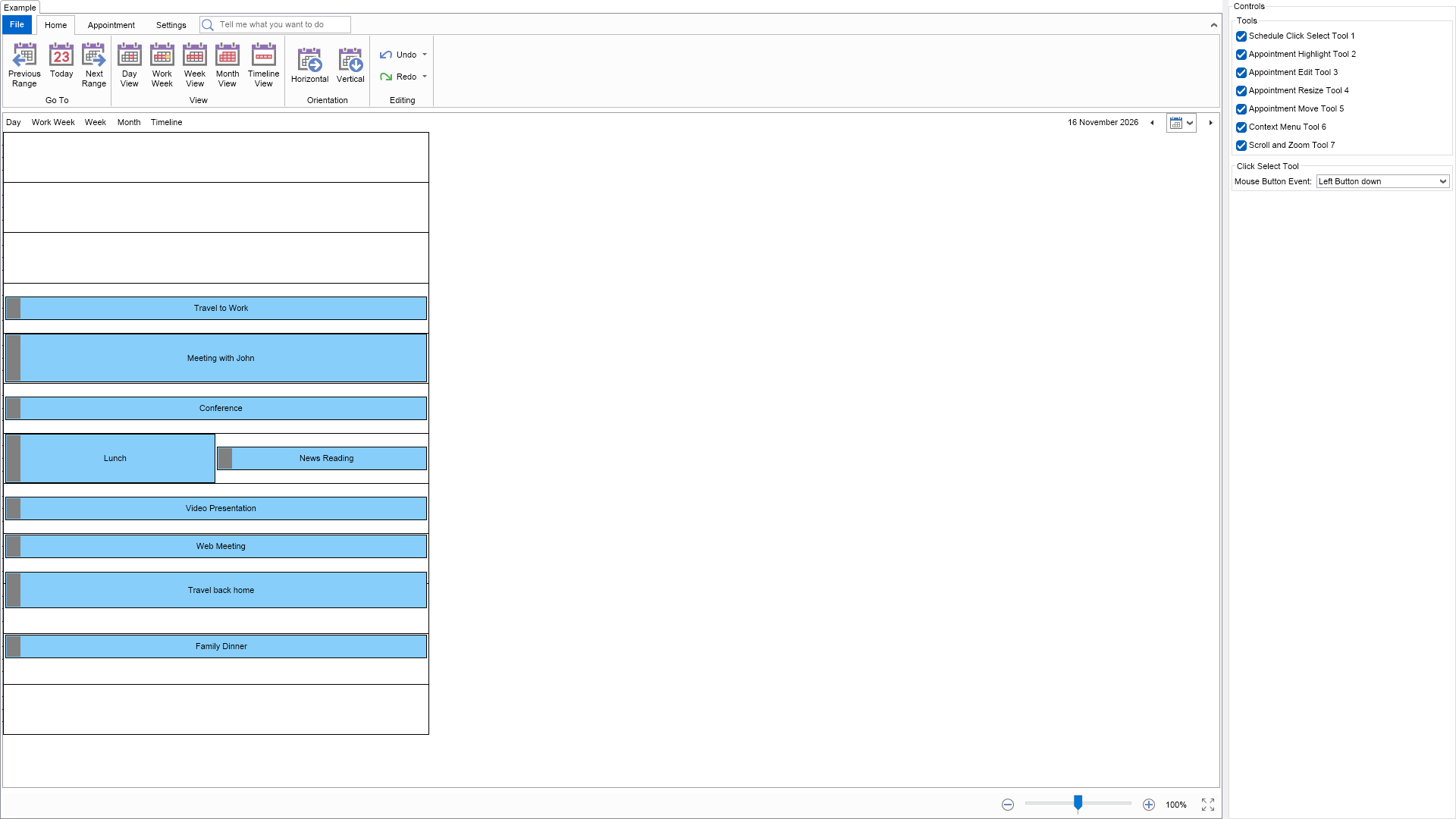
This example demonstrates how to configure, enable and disable schedule view tools. Use the widgets on the right to control the tools of the schedule view.


Tools Example

C# Tools Example Code for Nevron Schedule for WPF
Language: C#

using Nevron.Nov;
using Nevron.Nov.Dom;
using Nevron.Nov.Editors;
using Nevron.Nov.Graphics;
using Nevron.Nov.Layout;
using Nevron.Nov.Schedule;
using Nevron.Nov.UI;
using Nevron.Nov.Windows.Forms;
using System;
using System.Windows.Forms;

namespace NovWinFormsProject
{
	public partial class Form1 : Form
	{
		#region Constructors

		public Form1()
		{
			InitializeComponent();

			// Set form title
			Text = "NOV WinForms - NToolsExample";

			// Create the NOV example and its controls
			NWidget exampleContent = CreateExampleContent();
			NWidget exampleControls = CreateExampleControls();
			if (exampleControls != null)
			{
				exampleControls.PreferredWidth = 300;
			}

			// Place the example and its controls in a pair box
			NPairBox pairBox = new NPairBox(exampleContent, exampleControls);
			pairBox.FillMode = ENStackFillMode.First;
			pairBox.FitMode = ENStackFitMode.First;
			pairBox.Margins = new NMargins(NDesign.HorizontalSpacing, NDesign.VerticalSpacing);

			// Host the example in the form
			NNovWidgetHost host = new NNovWidgetHost(pairBox);
			host.Dock = DockStyle.Fill;
			Controls.Add(host);
		}

		#endregion

		#region Example

		public NWidget CreateExampleContent()
		{
			// Create a simple schedule
			NScheduleViewWithRibbon scheduleViewWithRibbon = new NScheduleViewWithRibbon();
			m_ScheduleView = scheduleViewWithRibbon.View;

			m_ScheduleView.Document.PauseHistoryService();
			try
			{
				InitSchedule(m_ScheduleView.Content);
			}
			finally
			{
				m_ScheduleView.Document.ResumeHistoryService();
			}

			// Return the commanding widget
			return scheduleViewWithRibbon;
		}
		public NWidget CreateExampleControls()
		{
			NStackPanel stack = new NStackPanel();

			// Add a check box for each tool of the schedule view
			NStackPanel toolsStack = new NStackPanel();
			for (int i = 0; i < m_ScheduleView.Interactor.Count; i++)
			{
				NTool tool = m_ScheduleView.Interactor[i];
				NCheckBox checkBox = new NCheckBox(tool.ToString(), tool.Enabled);
				checkBox.Tag = tool;
				checkBox.CheckedChanged += OnCheckBoxCheckedChanged;
				toolsStack.Add(checkBox);
			}

			stack.Add(new NGroupBox("Tools", toolsStack));

			// Add a setting for the mouse button event of the Click Select tool
			NStackPanel clickSelectStack = new NStackPanel();

			NScheduleClickSelectTool clickSelectTool = (NScheduleClickSelectTool)m_ScheduleView.Interactor.GetTool(
				NScheduleClickSelectTool.NScheduleClickSelectToolSchema);
			clickSelectStack.Add(NDesigner.GetDesigner(clickSelectTool).CreateMemberEditor(
				clickSelectTool, NScheduleClickSelectTool.MouseButtonEventProperty));

			stack.Add(new NGroupBox("Click Select Tool", clickSelectStack));

			return stack;
		}
		public string GetExampleDescription()
		{
			return @"

This example demonstrates how to configure, enable and disable schedule view tools. Use the widgets on the right to control the tools of the schedule view.

"; } /// /// Gets the relevant documentation links for the example /// /// public (string Name, string Url)[] GetDocumentationUrls() { return new[] { ("Schedule View", "https://www.nevron.com/docs/openvision/schedule-view.html"), ("Schedule Appointments", "https://www.nevron.com/docs/openvision/schedule-appointments.html"), }; } #endregion #region Implementation private void InitSchedule(NSchedule schedule) { DateTime today = DateTime.Today; schedule.ViewMode = ENScheduleViewMode.Day; schedule.Appointments.Add(new NAppointment("Travel to Work", today.AddHours(6.5), today.AddHours(7.5))); schedule.Appointments.Add(new NAppointment("Meeting with John", today.AddHours(8), today.AddHours(10))); schedule.Appointments.Add(new NAppointment("Conference", today.AddHours(10.5), today.AddHours(11.5))); schedule.Appointments.Add(new NAppointment("Lunch", today.AddHours(12), today.AddHours(14))); schedule.Appointments.Add(new NAppointment("News Reading", today.AddHours(12.5), today.AddHours(13.5))); schedule.Appointments.Add(new NAppointment("Video Presentation", today.AddHours(14.5), today.AddHours(15.5))); schedule.Appointments.Add(new NAppointment("Web Meeting", today.AddHours(16), today.AddHours(17))); schedule.Appointments.Add(new NAppointment("Travel back home", today.AddHours(17.5), today.AddHours(19))); schedule.Appointments.Add(new NAppointment("Family Dinner", today.AddHours(20), today.AddHours(21))); } #endregion #region Event Handlers private void OnCheckBoxCheckedChanged(NValueChangeEventArgs arg) { // Enable/Disable the tool based on the new value of the check box's Check property NTool tool = (NTool)arg.CurrentTargetNode.Tag; tool.Enabled = (bool)arg.NewValue; } #endregion #region Fields private NScheduleView m_ScheduleView; #endregion #region Static Methods #endregion #region Constants #endregion #region Nested Types #endregion } }

Download a fully functional C# (.cs) Tools Example for WPF Solution

VB.NET Tools Example Code for Nevron Schedule for WPF
Language: VB.NET

Imports Nevron.Nov
Imports Nevron.Nov.Dom
Imports Nevron.Nov.Editors
Imports Nevron.Nov.Graphics
Imports Nevron.Nov.Layout
Imports Nevron.Nov.Schedule
Imports Nevron.Nov.UI
Imports Nevron.Nov.Windows.Wpf

Class MainWindow

#Region "Constructors"

	Public Sub New()
		' This call is required by the designer.
		InitializeComponent()

		' Add any initialization after the InitializeComponent() call.

		' Set form title
		Title = "NOV WPF - NToolsExample"

		' Create the NOV example and its controls
		Dim exampleContent As NWidget = CreateExampleContent()
		Dim exampleControls As NWidget = CreateExampleControls()
		If Not exampleControls Is Nothing Then
			exampleControls.PreferredWidth = 300
		End If

		' Place the example and its controls in a pair box
		Dim pairBox As NPairBox = New NPairBox(exampleContent, exampleControls)
		pairBox.FillMode = ENStackFillMode.First
		pairBox.FitMode = ENStackFitMode.First
		pairBox.Margins = New NMargins(NDesign.HorizontalSpacing, NDesign.VerticalSpacing)

		' Host the example in the form
		Dim host As NNovWidgetHost(Of NWidget) = New NNovWidgetHost(Of NWidget)(pairBox)
		Content = host
	End Sub


#End Region

#Region "Example"

        Public Function CreateExampleContent() As NWidget
            ' Create a simple schedule
            Dim scheduleViewWithRibbon As NScheduleViewWithRibbon = New NScheduleViewWithRibbon()
            m_ScheduleView = scheduleViewWithRibbon.View

            m_ScheduleView.Document.PauseHistoryService()
            Try
                InitSchedule(m_ScheduleView.Content)
            Finally
                m_ScheduleView.Document.ResumeHistoryService()
            End Try

            ' Return the commanding widget
            Return scheduleViewWithRibbon
        End Function
        Public Function CreateExampleControls() As NWidget
            Dim stack As NStackPanel = New NStackPanel()

            ' Add a check box for each tool of the schedule view
            Dim toolsStack As NStackPanel = New NStackPanel()
            For i = 0 To m_ScheduleView.Interactor.Count - 1
                Dim tool = m_ScheduleView.Interactor(i)
                Dim checkBox As NCheckBox = New NCheckBox(tool.ToString(), tool.Enabled)
                checkBox.Tag = tool
                checkBox.CheckedChanged += AddressOf OnCheckBoxCheckedChanged
                toolsStack.Add(checkBox)
            Next

            stack.Add(New NGroupBox("Tools", toolsStack))

            ' Add a setting for the mouse button event of the Click Select tool
            Dim clickSelectStack As NStackPanel = New NStackPanel()

            Dim clickSelectTool = CType(m_ScheduleView.Interactor.GetTool(NScheduleClickSelectTool.NScheduleClickSelectToolSchema), NScheduleClickSelectTool)
            clickSelectStack.Add(NDesigner.GetDesigner(clickSelectTool).CreateMemberEditor(clickSelectTool, NScheduleClickTool.MouseButtonEventProperty))

            stack.Add(New NGroupBox("Click Select Tool", clickSelectStack))

            Return stack
        End Function
        Public Function GetExampleDescription() As String
            Return "

This example demonstrates how to configure, enable and disable schedule view tools. Use the widgets on the right to control the tools of the schedule view.

" End Function ''' ''' Gets the relevant documentation links for the example ''' ''' Public Function GetDocumentationUrls() As (String, String)() Return {("Schedule View", "https://www.nevron.com/docs/openvision/schedule-view.html"), ("Schedule Appointments", "https://www.nevron.com/docs/openvision/schedule-appointments.html")} End Function #End Region #Region "Implementation" Private Sub InitSchedule(schedule As NSchedule) Dim today = Date.Today schedule.ViewMode = ENScheduleViewMode.Day schedule.Appointments.Add(New NAppointment("Travel to Work", today.AddHours(6.5), today.AddHours(7.5))) schedule.Appointments.Add(New NAppointment("Meeting with John", today.AddHours(8), today.AddHours(10))) schedule.Appointments.Add(New NAppointment("Conference", today.AddHours(10.5), today.AddHours(11.5))) schedule.Appointments.Add(New NAppointment("Lunch", today.AddHours(12), today.AddHours(14))) schedule.Appointments.Add(New NAppointment("News Reading", today.AddHours(12.5), today.AddHours(13.5))) schedule.Appointments.Add(New NAppointment("Video Presentation", today.AddHours(14.5), today.AddHours(15.5))) schedule.Appointments.Add(New NAppointment("Web Meeting", today.AddHours(16), today.AddHours(17))) schedule.Appointments.Add(New NAppointment("Travel back home", today.AddHours(17.5), today.AddHours(19))) schedule.Appointments.Add(New NAppointment("Family Dinner", today.AddHours(20), today.AddHours(21))) End Sub #End Region #Region "Event Handlers" Private Sub OnCheckBoxCheckedChanged(arg As NValueChangeEventArgs) ' Enable/Disable the tool based on the new value of the check box's Check property Dim tool As NTool = arg.CurrentTargetNode.Tag tool.Enabled = CBool(arg.NewValue) End Sub #End Region #Region "Fields" Private m_ScheduleView As NScheduleView #End Region #Region "Static Methods" #End Region #Region "Constants" #End Region #Region "Nested Types" #End Region End Class

Download a fully functional VB.NET (.vb) Tools Example for WPF Solution

Related Documentation Links