Occurrences Modification Example for WPF

Nevron NOV Schedule for WPF ships with hundreds of examples with full source code, as part of the Nevron Open Vision Suite. All WPF Schedule examples are also available as a stand-alone Visual Studio solution in C# and VB.NET, which you can download from the links below.

Occurrences Modification Example for WPF Description

This example demonstrates how to create recurring appointments, i.e. appointments, which occur multiple times. Recurring appointments are created in the same way as ordinary appointments with the only difference that they have a recurrence rule assigned to their RecurrenceRule property and can be easily recognized by the circular arrows symbol at their top left corner.

This examples also shows how to change the properties or delete an occurrence of a recurring appointment. By default occurrences of recurring appointments inherit the property values of the recurring appointment, but you can easily change any of these properties for a specific occurrence. All changes to such occurrences are remembered, so even if you move to the previous or the next range of the schedule, when you get back to the current range, you'll be able to see all these changes again.
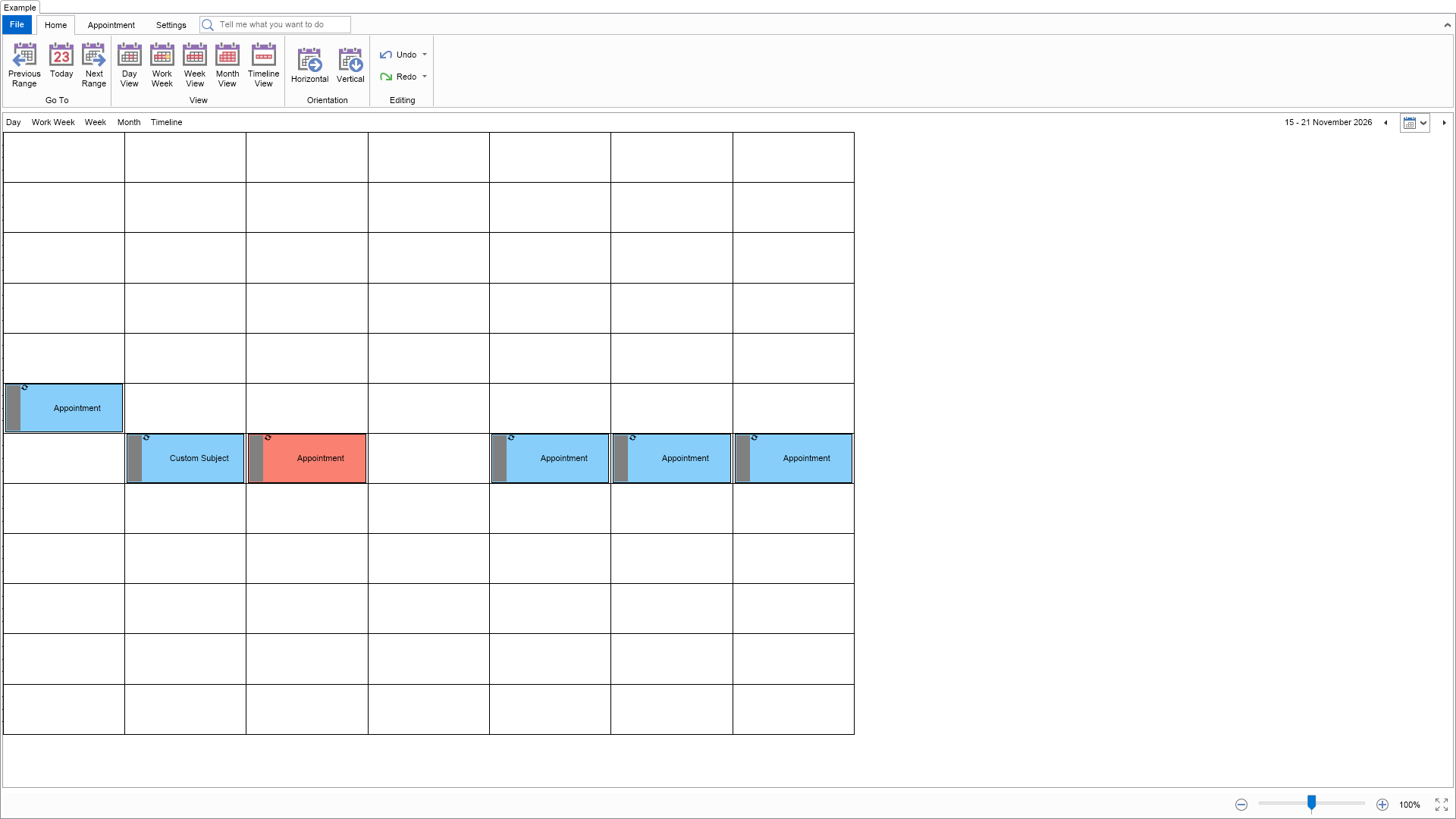

Occurrences Modification Example

C# Occurrences Modification Example Code for Nevron Schedule for WPF
Language: C#

using Nevron.Nov;
using Nevron.Nov.Dom;
using Nevron.Nov.Graphics;
using Nevron.Nov.Layout;
using Nevron.Nov.Schedule;
using Nevron.Nov.UI;
using Nevron.Nov.Windows.Forms;
using System;
using System.Windows.Forms;

namespace NovWinFormsProject
{
	public partial class Form1 : Form
	{
		#region Constructors

		public Form1()
		{
			InitializeComponent();

			// Set form title
			Text = "NOV WinForms - NOccurrencesModificationExample";

			// Create the NOV example and its controls
			NWidget exampleContent = CreateExampleContent();
			NWidget exampleControls = CreateExampleControls();
			if (exampleControls != null)
			{
				exampleControls.PreferredWidth = 300;
			}

			// Place the example and its controls in a pair box
			NPairBox pairBox = new NPairBox(exampleContent, exampleControls);
			pairBox.FillMode = ENStackFillMode.First;
			pairBox.FitMode = ENStackFitMode.First;
			pairBox.Margins = new NMargins(NDesign.HorizontalSpacing, NDesign.VerticalSpacing);

			// Host the example in the form
			NNovWidgetHost host = new NNovWidgetHost(pairBox);
			host.Dock = DockStyle.Fill;
			Controls.Add(host);
		}

		#endregion

		#region Example

		public NWidget CreateExampleContent()
		{
			// Create a simple schedule
			NScheduleViewWithRibbon scheduleViewWithRibbon = new NScheduleViewWithRibbon();
			m_ScheduleView = scheduleViewWithRibbon.View;

			m_ScheduleView.Document.PauseHistoryService();
			try
			{
				InitSchedule(m_ScheduleView.Content);
			}
			finally
			{
				m_ScheduleView.Document.ResumeHistoryService();
			}

			// Return the commanding widget
			return scheduleViewWithRibbon;
		}
		public NWidget CreateExampleControls()
		{
			return null;
		}
		public string GetExampleDescription()
		{
			return @"

This example demonstrates how to create recurring appointments, i.e. appointments, which occur multiple times. Recurring appointments are created in the same way as ordinary appointments with the only difference that they have a recurrence rule assigned to their RecurrenceRule property and can be easily recognized by the circular arrows symbol at their top left corner.

This examples also shows how to change the properties or delete an occurrence of a recurring appointment. By default occurrences of recurring appointments inherit the property values of the recurring appointment, but you can easily change any of these properties for a specific occurrence. All changes to such occurrences are remembered, so even if you move to the previous or the next range of the schedule, when you get back to the current range, you'll be able to see all these changes again.

"; } /// /// Gets the relevant documentation links for the example /// /// public (string Name, string Url)[] GetDocumentationUrls() { return new[] { ("Schedule Recurring Appointments", "https://www.nevron.com/docs/openvision/schedule-recurring-appointments.html"), ("Schedule Appointments", "https://www.nevron.com/docs/openvision/schedule-appointments.html"), ("Schedule", "https://www.nevron.com/docs/openvision/schedule.html"), ("Schedule View", "https://www.nevron.com/docs/openvision/schedule-view.html"), }; } #endregion #region Implementation private void InitSchedule(NSchedule schedule) { DateTime today = DateTime.Today; // Create a recurring appointment, which occurs every day NAppointment appointment = new NAppointment("Appointment", today.AddHours(12), today.AddHours(14)); NRecurrenceDailyRule rule = new NRecurrenceDailyRule(); rule.StartDate = new DateTime(2015, 1, 1); appointment.RecurrenceRule = rule; // Add the recurring appointment to the schedule schedule.Appointments.Add(appointment); // Change the time of the first appointment in the current week NAppointmentBase appChild = appointment.Occurrences[0]; appChild.Start = appChild.Start.AddHours(-2); appChild.End = appChild.End.AddHours(-2); // Change the subject of the second appointment appChild = appointment.Occurrences[1]; appChild.Subject = "Custom Subject"; // Change the category of the third appointment appChild = appointment.Occurrences[2]; appChild.Category = NCategory.Color.Red; // Delete the fourth appointment appointment.Occurrences.RemoveAt(3); } #endregion #region Event Handlers #endregion #region Fields private NScheduleView m_ScheduleView; #endregion #region Static Methods #endregion #region Constants #endregion #region Nested Types #endregion } }

Download a fully functional C# (.cs) Occurrences Modification Example for WPF Solution

VB.NET Occurrences Modification Example Code for Nevron Schedule for WPF
Language: VB.NET

Imports Nevron.Nov
Imports Nevron.Nov.Dom
Imports Nevron.Nov.Graphics
Imports Nevron.Nov.Layout
Imports Nevron.Nov.Schedule
Imports Nevron.Nov.UI
Imports Nevron.Nov.Windows.Wpf
Imports System

Class MainWindow

#Region "Constructors"

	Public Sub New()
		' This call is required by the designer.
		InitializeComponent()

		' Add any initialization after the InitializeComponent() call.

		' Set form title
		Title = "NOV WPF - NOccurrencesModificationExample"

		' Create the NOV example and its controls
		Dim exampleContent As NWidget = CreateExampleContent()
		Dim exampleControls As NWidget = CreateExampleControls()
		If Not exampleControls Is Nothing Then
			exampleControls.PreferredWidth = 300
		End If

		' Place the example and its controls in a pair box
		Dim pairBox As NPairBox = New NPairBox(exampleContent, exampleControls)
		pairBox.FillMode = ENStackFillMode.First
		pairBox.FitMode = ENStackFitMode.First
		pairBox.Margins = New NMargins(NDesign.HorizontalSpacing, NDesign.VerticalSpacing)

		' Host the example in the form
		Dim host As NNovWidgetHost(Of NWidget) = New NNovWidgetHost(Of NWidget)(pairBox)
		Content = host
	End Sub


#End Region

#Region "Example"

        Public Function CreateExampleContent() As NWidget
            ' Create a simple schedule
            Dim scheduleViewWithRibbon As NScheduleViewWithRibbon = New NScheduleViewWithRibbon()
            m_ScheduleView = scheduleViewWithRibbon.View

            m_ScheduleView.Document.PauseHistoryService()
            Try
                InitSchedule(m_ScheduleView.Content)
            Finally
                m_ScheduleView.Document.ResumeHistoryService()
            End Try

            ' Return the commanding widget
            Return scheduleViewWithRibbon
        End Function
        Public Function CreateExampleControls() As NWidget
            Return Nothing
        End Function
        Public Function GetExampleDescription() As String
            Return "

This example demonstrates how to create recurring appointments, i.e. appointments, which occur multiple times. Recurring appointments are created in the same way as ordinary appointments with the only difference that they have a recurrence rule assigned to their RecurrenceRule property and can be easily recognized by the circular arrows symbol at their top left corner.

This examples also shows how to change the properties or delete an occurrence of a recurring appointment. By default occurrences of recurring appointments inherit the property values of the recurring appointment, but you can easily change any of these properties for a specific occurrence. All changes to such occurrences are remembered, so even if you move to the previous or the next range of the schedule, when you get back to the current range, you'll be able to see all these changes again.

" End Function ''' ''' Gets the relevant documentation links for the example ''' ''' Public Function GetDocumentationUrls() As (String, String)() Return {("Schedule Recurring Appointments", "https://www.nevron.com/docs/openvision/schedule-recurring-appointments.html"), ("Schedule Appointments", "https://www.nevron.com/docs/openvision/schedule-appointments.html"), ("Schedule", "https://www.nevron.com/docs/openvision/schedule.html"), ("Schedule View", "https://www.nevron.com/docs/openvision/schedule-view.html")} End Function #End Region #Region "Implementation" Private Sub InitSchedule(schedule As NSchedule) Dim today = Date.Today ' Create a recurring appointment, which occurs every day Dim appointment As NAppointment = New NAppointment("Appointment", today.AddHours(12), today.AddHours(14)) Dim rule As NRecurrenceDailyRule = New NRecurrenceDailyRule() rule.StartDate = New DateTime(2015, 1, 1) appointment.RecurrenceRule = rule ' Add the recurring appointment to the schedule schedule.Appointments.Add(appointment) ' Change the time of the first appointment in the current week Dim appChild = appointment.Occurrences(0) appChild.Start = appChild.Start.AddHours(-2) appChild.End = appChild.End.AddHours(-2) ' Change the subject of the second appointment appChild = appointment.Occurrences(1) appChild.Subject = "Custom Subject" ' Change the category of the third appointment appChild = appointment.Occurrences(2) appChild.Category = NCategory.Color.Red ' Delete the fourth appointment appointment.Occurrences.RemoveAt(3) End Sub #End Region #Region "Event Handlers" #End Region #Region "Fields" Private m_ScheduleView As NScheduleView #End Region #Region "Static Methods" #End Region #Region "Constants" #End Region #Region "Nested Types" #End Region End Class

Download a fully functional VB.NET (.vb) Occurrences Modification Example for WPF Solution