Table Styles Example for Blazor

Nevron NOV RichTextEditor for Blazor ships with hundreds of examples with full source code, as part of the Nevron Open Vision Suite. All Blazor RichTextEditor examples are also available as a stand-alone Visual Studio solution in C#, which you can download from the links below.

Table Styles Example for Blazor Description

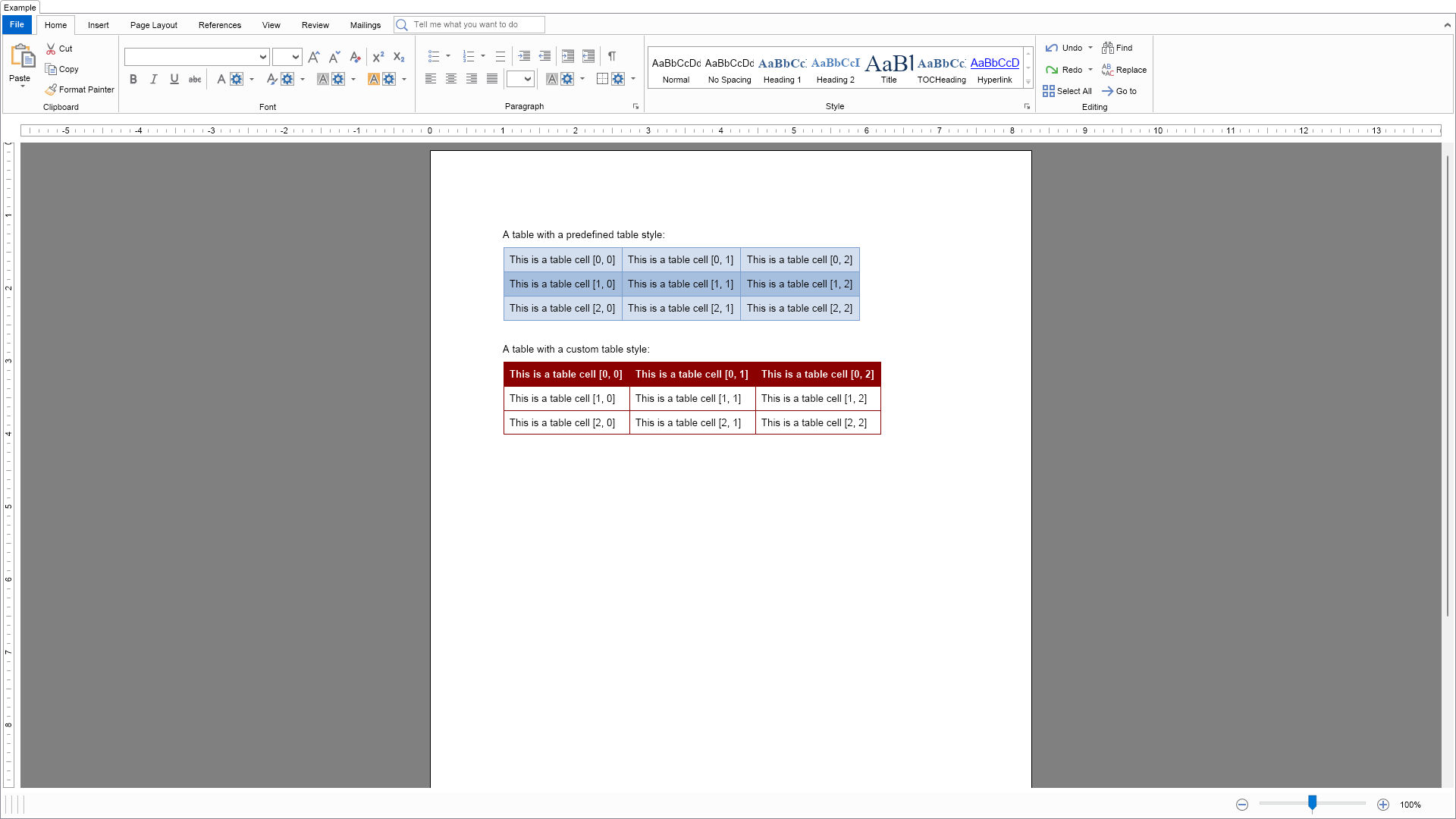
This example demonstrates how to create and apply table styles.


Table Styles Example

C# Table Styles Example Code for Nevron RichTextEditor for Blazor
Language: C#

using Nevron.Nov;
using Nevron.Nov.Dom;
using Nevron.Nov.Graphics;
using Nevron.Nov.Layout;
using Nevron.Nov.Text;
using Nevron.Nov.UI;
using Nevron.Nov.Windows.Forms;
using System.Windows.Forms;

namespace NovWinFormsProject
{
	public partial class Form1 : Form
	{
		#region Constructors

		public Form1()
		{
			InitializeComponent();

			// Set form title
			Text = "NOV WinForms - NTableStylesExample";

			// Create the NOV example and its controls
			NWidget exampleContent = CreateExampleContent();
			NWidget exampleControls = CreateExampleControls();
			if (exampleControls != null)
			{
				exampleControls.PreferredWidth = 300;
			}

			// Place the example and its controls in a pair box
			NPairBox pairBox = new NPairBox(exampleContent, exampleControls);
			pairBox.FillMode = ENStackFillMode.First;
			pairBox.FitMode = ENStackFitMode.First;
			pairBox.Margins = new NMargins(NDesign.HorizontalSpacing, NDesign.VerticalSpacing);

			// Host the example in the form
			NNovWidgetHost host = new NNovWidgetHost(pairBox);
			host.Dock = DockStyle.Fill;
			Controls.Add(host);
		}

		#endregion

		#region Example

		public NWidget CreateExampleContent()
		{
			// Create the rich text
			NRichTextViewWithRibbon richTextWithRibbon = new NRichTextViewWithRibbon();
			m_RichText = richTextWithRibbon.View;
			m_RichText.AcceptsTab = true;
			m_RichText.Content.Sections.Clear();

			// Populate the rich text
			PopulateRichText();

			return richTextWithRibbon;
		}
		public NWidget CreateExampleControls()
		{
			return null;
		}
		public string GetExampleDescription()
		{
			return @"

This example demonstrates how to create and apply table styles.

"; } /// /// Gets the relevant documentation links for the example /// /// public (string Name, string Url)[] GetDocumentationUrls() { return new[] { ("Rich Text Table Styles", "https://www.nevron.com/docs/openvision/rich-text-table-styles.html"), ("Rich Text Tables", "https://www.nevron.com/docs/openvision/rich-text-tables.html"), }; } private void PopulateRichText() { NDocumentBlock documentBlock = m_RichText.Content; NSection section = new NSection(); documentBlock.Sections.Add(section); // Create the first table section.Blocks.Add(new NParagraph("A table with a predefined table style:")); NTable table1 = CreateTable(); section.Blocks.Add(table1); // Apply a predefined table style NRichTextStyle predefinedStyle = documentBlock.Styles.FindStyleByTypeAndId(ENRichTextStyleType.Table, "GridTable2Blue"); predefinedStyle.Apply(table1); // Create the second table NParagraph paragraph = new NParagraph("A table with a custom table style:"); paragraph.MarginTop = 30; section.Blocks.Add(paragraph); NTable table2 = CreateTable(); section.Blocks.Add(table2); // Create a custom table style and apply it NTableStyle customStyle = new NTableStyle("CustomTableStyle"); customStyle.WholeTable = new NTablePartStyle(); customStyle.WholeTable.BorderRule = new NBorderRule(ENPredefinedBorderStyle.Solid, NColor.DarkRed, new NMargins(1)); customStyle.WholeTable.BorderRule.InsideHSides = new NBorderSideRule(ENPredefinedBorderStyle.Solid, NColor.DarkRed, 1); customStyle.WholeTable.BorderRule.InsideVSides = new NBorderSideRule(ENPredefinedBorderStyle.Solid, NColor.DarkRed, 1); customStyle.FirstRow = new NTablePartStyle(); customStyle.FirstRow.BackgroundFill = new NColorFill(NColor.DarkRed); customStyle.FirstRow.InlineRule = new NInlineRule(NColor.White); customStyle.FirstRow.InlineRule.FontStyle = ENFontStyle.Bold; customStyle.Apply(table2); } #endregion #region Implementation private NTable CreateTable() { NTable table = new NTable(); table.AllowSpacingBetweenCells = false; int rowCount = 3; int colCount = 3; // first create the columns for (int i = 0; i < colCount; i++) { table.Columns.Add(new NTableColumn()); } // then add rows with cells count matching the number of columns for (int row = 0; row < rowCount; row++) { NTableRow tableRow = new NTableRow(); table.Rows.Add(tableRow); for (int col = 0; col < colCount; col++) { NTableCell tableCell = new NTableCell(); tableRow.Cells.Add(tableCell); tableCell.Margins = new NMargins(4); tableCell.Border = NBorder.CreateFilledBorder(NColor.Black); tableCell.BorderThickness = new NMargins(1); NParagraph paragraph = new NParagraph("This is a table cell [" + row.ToString() + ", " + col.ToString() + "]"); tableCell.Blocks.Add(paragraph); } } return table; } #endregion #region Event Handlers #endregion #region Fields private NRichTextView m_RichText; #endregion #region Static Methods #endregion #region Constants #endregion #region Nested Types #endregion } }

Download a fully functional C# (.cs) Table Styles Example for Blazor Solution

Related Documentation Links