Grouping by Fields Example for Blazor

Nevron NOV Grid for Blazor ships with hundreds of examples with full source code, as part of the Nevron Open Vision Suite. All Blazor Grid examples are also available as a stand-alone Visual Studio solution in C#, which you can download from the links below.

Grouping by Fields Example for Blazor Description

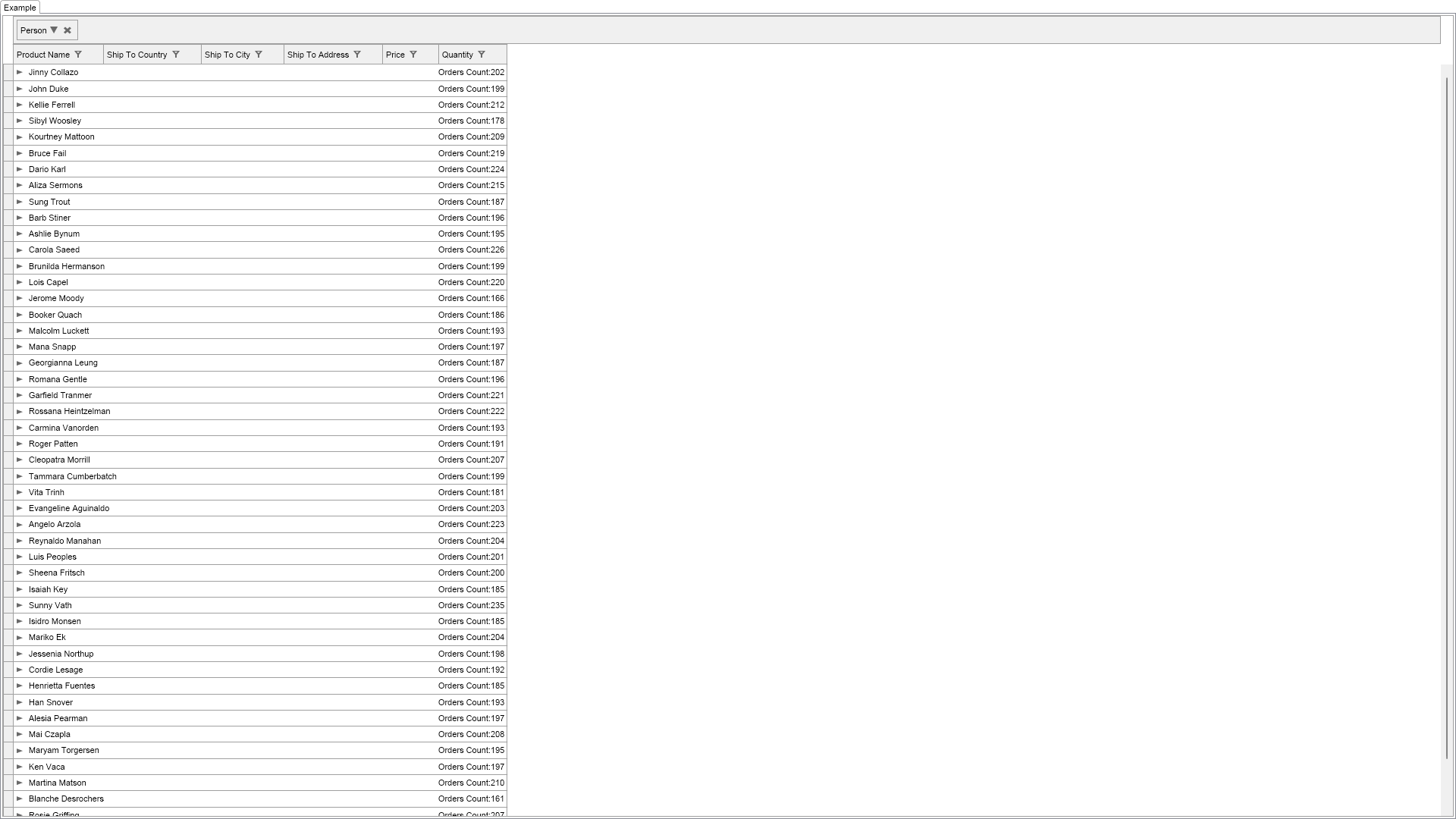
Demonstrates fields grouping, custom group header content and custom group row cells.

In this example we group the PersonSales data source by the PersonId field, which is intentionally hidden from display in the grid.

Because the PersonId field is not very informative for the user, we create custom GroupRow cells, that pull the person Name by Id from the Persons data source.


Field Grouping Example

C# Grouping by Fields Example Code for Nevron Grid for Blazor
Language: C#

using Nevron.Nov;
using Nevron.Nov.Data;
using Nevron.Nov.Dom;
using Nevron.Nov.Graphics;
using Nevron.Nov.Grid;
using Nevron.Nov.Layout;
using Nevron.Nov.UI;
using Nevron.Nov.Windows.Forms;
using System;
using System.Windows.Forms;

namespace NovWinFormsProject
{
	public partial class Form1 : Form
	{
		#region Constructors

		public Form1()
		{
			InitializeComponent();

			// Set form title
			Text = "NOV WinForms - NFieldGroupingExample";

			// Create the NOV example and its controls
			NWidget exampleContent = CreateExampleContent();
			NWidget exampleControls = CreateExampleControls();
			if (exampleControls != null)
			{
				exampleControls.PreferredWidth = 300;
			}

			// Place the example and its controls in a pair box
			NPairBox pairBox = new NPairBox(exampleContent, exampleControls);
			pairBox.FillMode = ENStackFillMode.First;
			pairBox.FitMode = ENStackFitMode.First;
			pairBox.Margins = new NMargins(NDesign.HorizontalSpacing, NDesign.VerticalSpacing);

			// Host the example in the form
			NNovWidgetHost host = new NNovWidgetHost(pairBox);
			host.Dock = DockStyle.Fill;
			Controls.Add(host);
		}

		#endregion

        #region Example

        public NWidget CreateExampleContent()
        {
            // create a view and get its grid
            NTableGridView view = new NTableGridView();
            NTableGrid grid = view.Grid;

            // customize the grid
            grid.AllowEdit = false;

            // create the dummy persons data source - we will use it to obtain person names from person ids from it.
            m_PersonsDataSource = NDummyDataSource.CreatePersonsDataSource();

            // bind to data source, but exclude the "PersonId" field from binding 
            grid.AutoCreateColumn += delegate(NAutoCreateColumnEventArgs arg)
            {
                if (arg.FieldInfo.Name == "PersonId")
                {
                    arg.DataColumn = null;
                }
            };
            grid.DataSource = NDummyDataSource.CreatePersonsOrdersDataSource();

            // create a grouping rule that groups by the PersonId field
            NGroupingRule groupingRule = new NGroupingRule();
            groupingRule.RowValue = new NFieldRowValue("PersonId");

            // create a custom grouping header named "Person"
            groupingRule.CreateGroupingHeaderContentDelegate = delegate(NGroupingRule theGroupingRule)
            {
                return new NLabel("Person");
            };

            // create custom group row cells that display the person Name and number of orders 
            groupingRule.CreateGroupRowCellsDelegate = delegate(NGroupingRuleCreateGroupRowCellsArgs arg)
            {
                // get the person id from the row for which we create row cells.
                int personId = (int)arg.GroupRow.GroupValue;

                // get the person name that corresponds to that person id.
                int idField = m_PersonsDataSource.GetFieldIndex("Id");
                NRecordset rs = m_PersonsDataSource.GetOrCreateIndex(idField).GetRecordsForValue(personId);
                string personName = (string)m_PersonsDataSource.GetValue(rs[0], "Name");

                // create the group row cells
                NGroupRowCell personNameCell = new NGroupRowCell(personName);
                personNameCell.EndXPosition.Mode = ENSpanCellEndXPositionMode.NextCellBeginX;

                NGroupRowCell ordersCountCell = new NGroupRowCell("Orders Count:" + arg.GroupRow.Recordset.Count);
                ordersCountCell.EndXPosition.Mode = ENSpanCellEndXPositionMode.RowEndX;
                ordersCountCell.BeginXPosition.Mode = ENSpanCellBeginXPositionMode.AnchorToEndX;

                return new NGroupRowCell[] { personNameCell, ordersCountCell };
            };
            grid.GroupingRules.Add(groupingRule);

            return view;
        }

        public NWidget CreateExampleControls()
        {
            return null;
        }
        public string GetExampleDescription()
        {
            return @"

Demonstrates fields grouping, custom group header content and custom group row cells.

In this example we group the PersonSales data source by the PersonId field, which is intentionally hidden from display in the grid.

Because the PersonId field is not very informative for the user, we create custom GroupRow cells, that pull the person Name by Id from the Persons data source.

"; } /// /// Gets the relevant documentation links for the example /// /// public (string Name, string Url)[] GetDocumentationUrls() { return new[] { ("Grid Grouping", "https://www.nevron.com/docs/openvision/grid-grouping.html"), ("Grid Data Processing Overview", "https://www.nevron.com/docs/openvision/grid-data-processing-overview.html"), }; } #endregion #region Implementation #endregion #region Event Handlers #endregion #region Fields NDataSource m_PersonsDataSource; #endregion #region Static Methods #endregion #region Constants #endregion #region Nested Types #endregion } }

Download a fully functional C# (.cs) Grouping by Fields Example for Blazor Solution