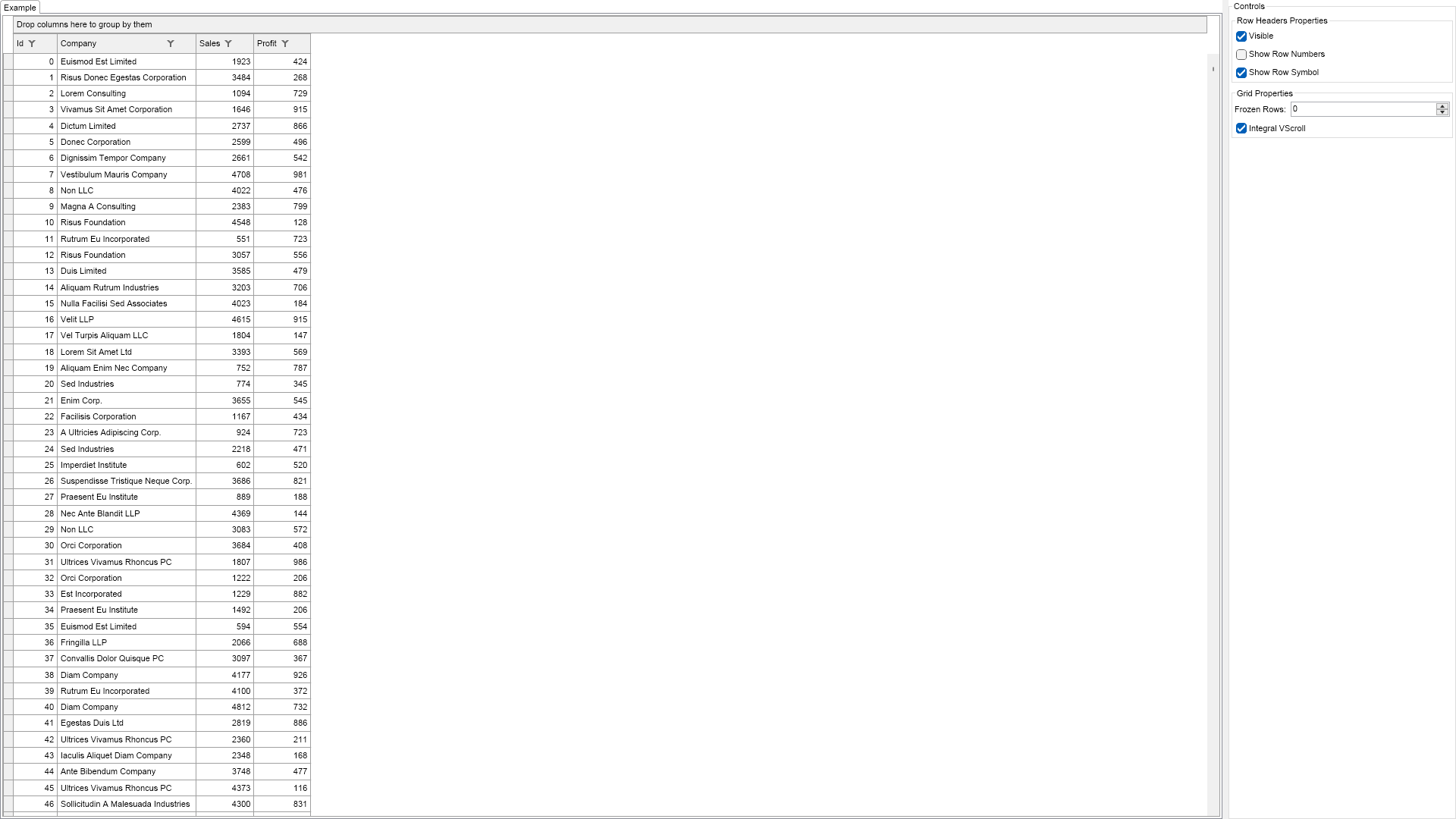
Demonstrates the row headers.
Row headers are small button-like elements that you can use to select rows. Besides for selection, row headers indicate the row state (e.g. current or editing status) and can be configured to show the row ordinal in the data source.

| Language: C# |
using Nevron.Nov;
using Nevron.Nov.Data;
using Nevron.Nov.DataStructures;
using Nevron.Nov.Dom;
using Nevron.Nov.Editors;
using Nevron.Nov.Graphics;
using Nevron.Nov.Grid;
using Nevron.Nov.Layout;
using Nevron.Nov.Presentation;
using Nevron.Nov.UI;
using Nevron.Nov.Windows.Forms;
using System;
using System.Windows.Forms;
namespace NovWinFormsProject
{
public partial class Form1 : Form
{
#region Constructors
public Form1()
{
InitializeComponent();
// Set form title
Text = "NOV WinForms - NRowHeadersExample";
// Create the NOV example and its controls
NWidget exampleContent = CreateExampleContent();
NWidget exampleControls = CreateExampleControls();
if (exampleControls != null)
{
exampleControls.PreferredWidth = 300;
}
// Place the example and its controls in a pair box
NPairBox pairBox = new NPairBox(exampleContent, exampleControls);
pairBox.FillMode = ENStackFillMode.First;
pairBox.FitMode = ENStackFitMode.First;
pairBox.Margins = new NMargins(NDesign.HorizontalSpacing, NDesign.VerticalSpacing);
// Host the example in the form
NNovWidgetHost host = new NNovWidgetHost(pairBox);
host.Dock = DockStyle.Fill;
Controls.Add(host);
}
#endregion
#region Example
public NWidget CreateExampleContent()
{
m_TableView = new NTableGridView();
m_TableView.Grid.DataSource = NDummyDataSource.CreateCompanySalesDataSource();
// show the row headers
m_TableView.Grid.RowHeaders.Visible = true;
return m_TableView;
}
public NWidget CreateExampleControls()
{
NStackPanel stack = new NStackPanel();
// create the row headers properties
{
NStackPanel rowHeadersStack = new NStackPanel();
NDesigner designer = NDesigner.GetDesigner(NRowHeaderCollection.NRowHeaderCollectionSchema);
NList editors = designer.CreateMemberEditors(m_TableView.Grid.RowHeaders,
NRowHeaderCollection.VisibleProperty,
NRowHeaderCollection.ShowRowNumbersProperty,
NRowHeaderCollection.ShowRowSymbolProperty);
for (int i = 0; i < editors.Count; i++)
{
rowHeadersStack.Add(editors[i]);
}
NGroupBox rowHeadersGroup = new NGroupBox("Row Headers Properties", rowHeadersStack);
stack.Add(new NUniSizeBoxGroup(rowHeadersGroup));
}
// create the grid properties
{
NStackPanel gridStack = new NStackPanel();
NList editors = NDesigner.GetDesigner(m_TableView.Grid).CreateMemberEditors(m_TableView.Grid,
NGrid.FrozenRowsProperty,
NGrid.IntegralVScrollProperty);
for (int i = 0; i < editors.Count; i++)
{
gridStack.Add(editors[i]);
}
NGroupBox gridGroup = new NGroupBox("Grid Properties", gridStack);
stack.Add(new NUniSizeBoxGroup(gridGroup));
}
return stack;
}
public string GetExampleDescription()
{
return @"
Demonstrates the row headers.
Row headers are small button-like elements that you can use to select rows.
Besides for selection, row headers indicate the row state (e.g. current or editing status) and can be configured to show the row ordinal in the data source.
";
}
///
/// Gets the relevant documentation links for the example
///
///
public (string Name, string Url)[] GetDocumentationUrls()
{
return new[]
{
("Grid Row Headers", "https://www.nevron.com/docs/openvision/grid-row-headers.html"),
("Grid Rows", "https://www.nevron.com/docs/openvision/grid-rows.html"),
};
}
#endregion
#region Implementation
#endregion
#region Event Handlers
#endregion
#region Fields
NTableGridView m_TableView;
#endregion
#region Static Methods
#endregion
#region Constants
#endregion
#region Nested Types
#endregion
}
}