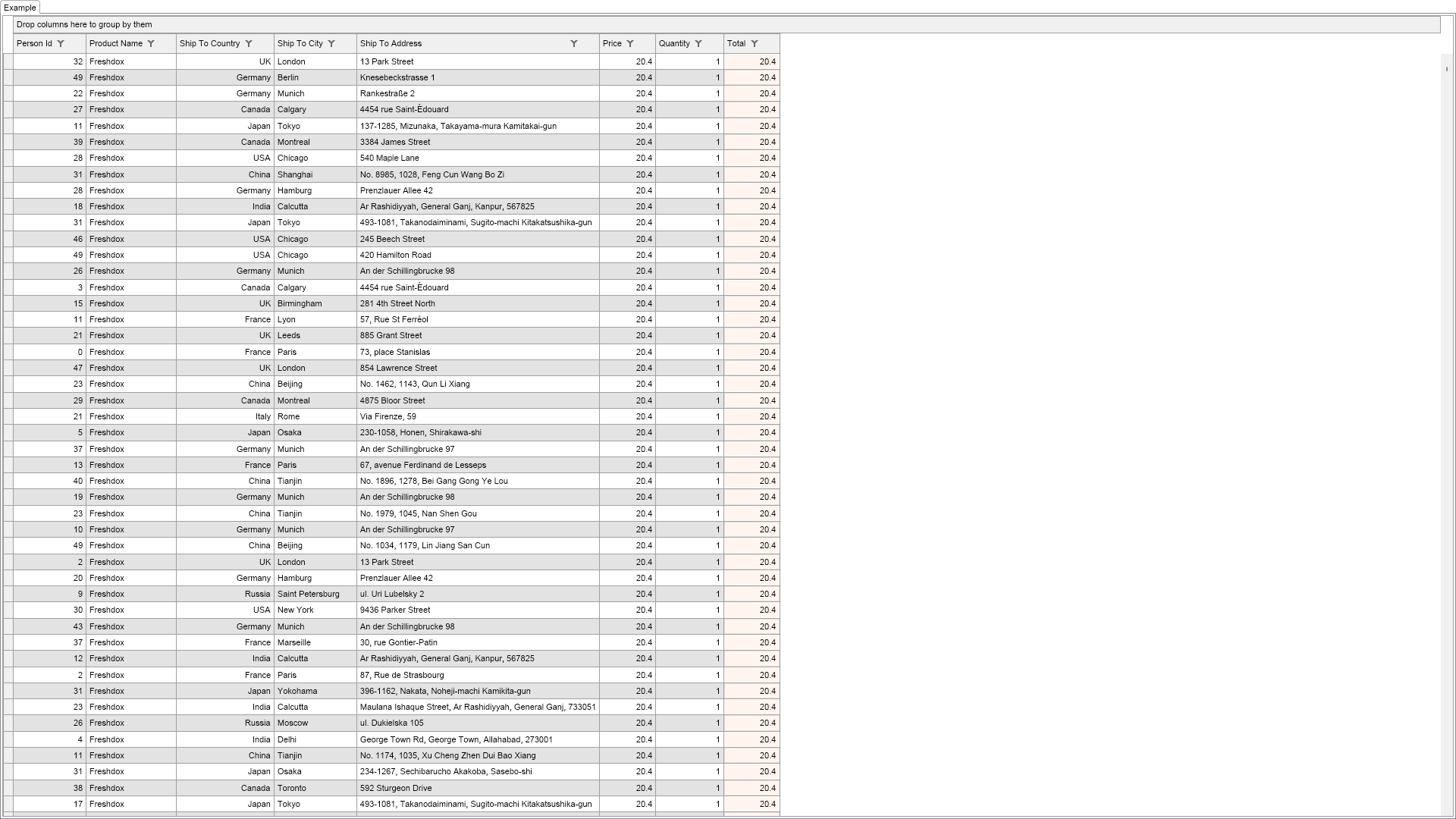
Demonstrates expression sorting rules in combination with calculated columns.
In this example we have created an NCustomCalculatedColumn that displays the Price * Quantity calculation (e.g. Total).
We have also created a sorting rule that sorts by the Total calculated column in a different way - via a Formula Expression.

| Language: C# |
using Nevron.Nov;
using Nevron.Nov.Dom;
using Nevron.Nov.Graphics;
using Nevron.Nov.Grid;
using Nevron.Nov.Layout;
using Nevron.Nov.UI;
using Nevron.Nov.Windows.Forms;
using System;
using System.Windows.Forms;
namespace NovWinFormsProject
{
public partial class Form1 : Form
{
#region Constructors
public Form1()
{
InitializeComponent();
// Set form title
Text = "NOV WinForms - NFormulaSortingExample";
// Create the NOV example and its controls
NWidget exampleContent = CreateExampleContent();
NWidget exampleControls = CreateExampleControls();
if (exampleControls != null)
{
exampleControls.PreferredWidth = 300;
}
// Place the example and its controls in a pair box
NPairBox pairBox = new NPairBox(exampleContent, exampleControls);
pairBox.FillMode = ENStackFillMode.First;
pairBox.FitMode = ENStackFitMode.First;
pairBox.Margins = new NMargins(NDesign.HorizontalSpacing, NDesign.VerticalSpacing);
// Host the example in the form
NNovWidgetHost host = new NNovWidgetHost(pairBox);
host.Dock = DockStyle.Fill;
Controls.Add(host);
}
#endregion
#region Example
public NWidget CreateExampleContent()
{
// create a view and get its grid
NTableGridView view = new NTableGridView();
NTableGrid grid = view.Grid;
// bind the grid to the data source
grid.DataSource = NDummyDataSource.CreatePersonsOrdersDataSource();
// add a custom calculated column of type Double that displays the Total (e.g. Price * Quantity)
NCustomCalculatedColumn totalColumn = new NCustomCalculatedColumn();
totalColumn.Title = "Total";
totalColumn.GetRowValueDelegate += delegate(NCustomCalculatedColumnGetRowValueArgs arg)
{
// calculate a RowValue for the RowIndex
double price = Convert.ToDouble(arg.DataSource.GetValue(arg.RowIndex, "Price"));
double quantity = Convert.ToDouble(arg.DataSource.GetValue(arg.RowIndex, "Quantity"));
return (double)(price * quantity);
};
totalColumn.Format.BackgroundFill = new NColorFill(NColor.SeaShell);
grid.Columns.Add(totalColumn);
// create the sales sorting rule.
// also subcribe for the create sorting rule event to recreate the rule when users
grid.SortingRules.Add(CreateTotalSortingRule(grid));
totalColumn.CreateSortingRuleDelegate = delegate(NColumn theColumn)
{
return CreateTotalSortingRule(grid);
};
// alter some view preferences
grid.AllowSortColumns = true;
grid.AlternatingRows = true;
grid.RowHeaders.Visible = true;
return view;
}
public NWidget CreateExampleControls()
{
return null;
}
public string GetExampleDescription()
{
return @"
Demonstrates expression sorting rules in combination with calculated columns.
In this example we have created an NCustomCalculatedColumn that displays the Price * Quantity calculation (e.g. Total).
We have also created a sorting rule that sorts by the Total calculated column in a different way - via a Formula Expression.
";
}
///
/// Gets the relevant documentation links for the example
///
///
public (string Name, string Url)[] GetDocumentationUrls()
{
return new[]
{
("Grid Sorting", "https://www.nevron.com/docs/openvision/grid-sorting.html"),
("Formula Basics", "https://www.nevron.com/docs/openvision/formula-basics.html"),
("Functions", "https://www.nevron.com/docs/openvision/formula-functions.html"),
("Grid Row Values", "https://www.nevron.com/docs/openvision/grid-row-values.html"),
};
}
#endregion
#region Implementation
NSortingRule CreateTotalSortingRule(NTableGrid grid)
{
NColumn salesColumn = grid.Columns.GetColumnByFieldName("Sales");
NColumn priceColumn = grid.Columns.GetColumnByFieldName("Price");
// create a sorting rule that sorts by the Total value
string quantityFieldName = grid.CreateFormulaFieldName("Quantity");
string priceFieldName = grid.CreateFormulaFieldName("Price");
NSortingRule sortingRule = NSortingRule.FromFormula(null, priceFieldName + "*" + quantityFieldName, ENSortingDirection.Ascending);
sortingRule.Column = salesColumn;
return sortingRule;
}
#endregion
#region Event Handlers
#endregion
#region Fields
#endregion
#region Static Methods
#endregion
#region Constants
#endregion
#region Nested Types
#endregion
}
}