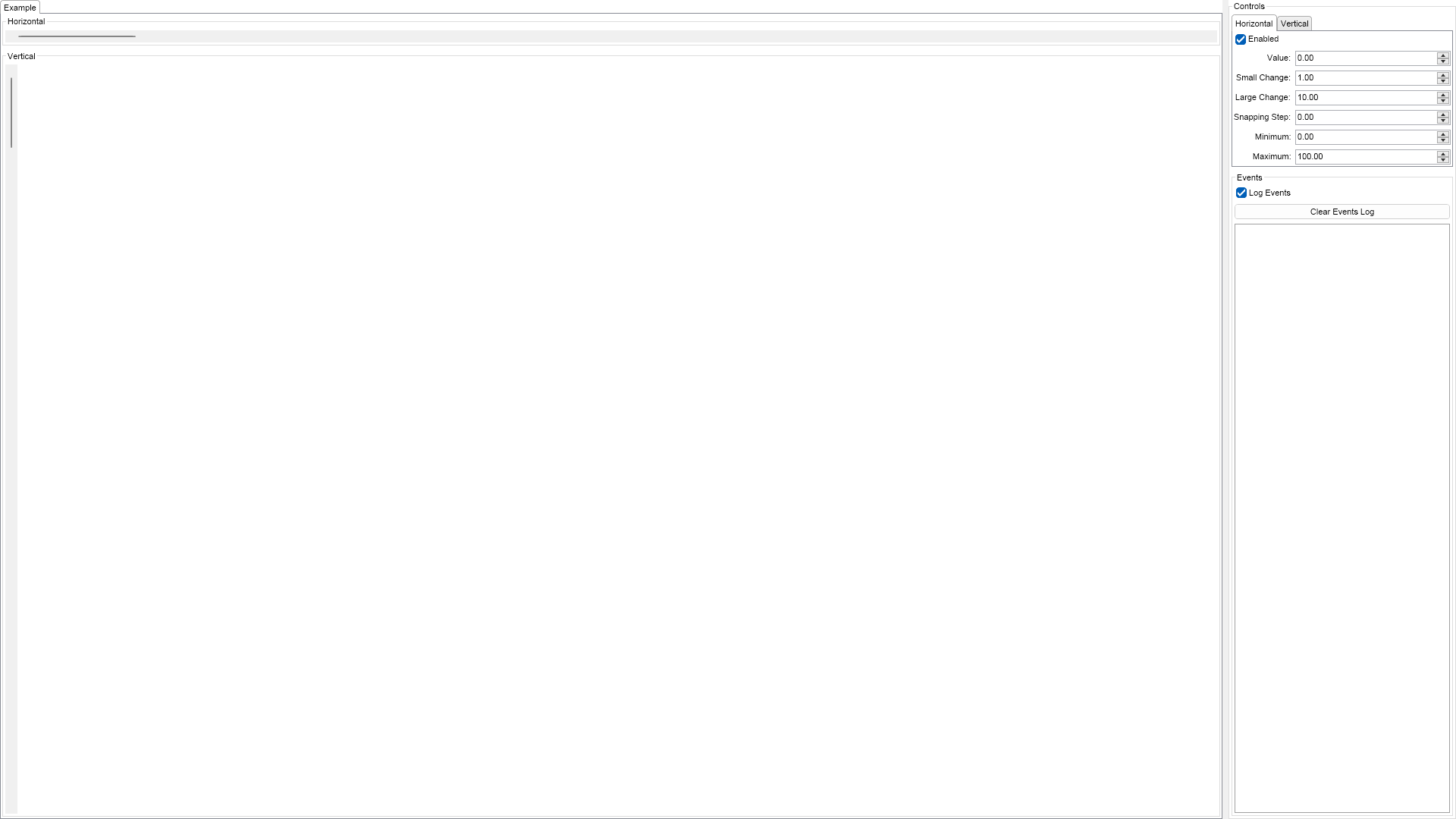
This example demonstrates how to create and use scrollbars. Scrollbars are range based widgets, which come in handy when you need to display large content in a limited area on screen. The scrollbars let the user change the currently visible part of this large content by dragging a thumb or clicking on an arrow button. The scrollbars can be horizontal and vertical and expose a set of properties, which you can use to control their appearance and behavior.

| Language: C# |
using Nevron.Nov;
using Nevron.Nov.DataStructures;
using Nevron.Nov.Dom;
using Nevron.Nov.Editors;
using Nevron.Nov.Graphics;
using Nevron.Nov.Layout;
using Nevron.Nov.Presentation;
using Nevron.Nov.UI;
using Nevron.Nov.Windows.Forms;
using System.Windows.Forms;
namespace NovWinFormsProject
{
public partial class Form1 : Form
{
#region Constructors
public Form1()
{
InitializeComponent();
// Set form title
Text = "NOV WinForms - NScrollBarsExample";
// Create the NOV example and its controls
NWidget exampleContent = CreateExampleContent();
NWidget exampleControls = CreateExampleControls();
if (exampleControls != null)
{
exampleControls.PreferredWidth = 300;
}
// Place the example and its controls in a pair box
NPairBox pairBox = new NPairBox(exampleContent, exampleControls);
pairBox.FillMode = ENStackFillMode.First;
pairBox.FitMode = ENStackFitMode.First;
pairBox.Margins = new NMargins(NDesign.HorizontalSpacing, NDesign.VerticalSpacing);
// Host the example in the form
NNovWidgetHost host = new NNovWidgetHost(pairBox);
host.Dock = DockStyle.Fill;
Controls.Add(host);
}
#endregion
#region Example
public NWidget CreateExampleContent()
{
// create the root tab
NStackPanel stack = new NStackPanel();
stack.FillMode = ENStackFillMode.Last;
stack.FitMode = ENStackFitMode.Last;
// create the HScrollBar
m_HScrollBar = new NHScrollBar();
m_HScrollBar.VerticalPlacement = ENVerticalPlacement.Top;
m_HScrollBar.StartScrolling += OnScrollBarStartScrolling;
m_HScrollBar.ValueChanged += OnScrollBarValueChanged;
m_HScrollBar.EndScrolling += OnScrollBarEndScrolling;
stack.Add(new NGroupBox("Horizontal", m_HScrollBar));
// create the VScrollBar
m_VScrollBar = new NVScrollBar();
m_VScrollBar.HorizontalPlacement = ENHorizontalPlacement.Left;
m_VScrollBar.StartScrolling += OnScrollBarStartScrolling;
m_VScrollBar.ValueChanged += OnScrollBarValueChanged;
m_VScrollBar.EndScrolling += OnScrollBarEndScrolling;
stack.Add(new NGroupBox("Vertical", m_VScrollBar));
return stack;
}
public NWidget CreateExampleControls()
{
NStackPanel stack = new NStackPanel();
stack.FillMode = ENStackFillMode.Last;
stack.FitMode = ENStackFitMode.Last;
// Create a tab
NTab tab = new NTab();
stack.Add(tab);
NProperty[] properties = new NProperty[] {
NScrollBar.EnabledProperty,
NScrollBar.ValueProperty,
NScrollBar.SmallChangeProperty,
NScrollBar.LargeChangeProperty,
NScrollBar.SnappingStepProperty,
NScrollBar.MinimumProperty,
NScrollBar.MaximumProperty
};
// Create the Horizontal scrollbar properties
NStackPanel hsbStack = new NStackPanel();
NList editors = NDesigner.GetDesigner(m_HScrollBar).CreateMemberEditors(
m_HScrollBar,
properties);
for (int i = 0; i < editors.Count; i++)
{
hsbStack.Add(editors[i]);
}
tab.TabPages.Add(new NTabPage("Horizontal", hsbStack));
// Create the Vertical scrollbar properties
NStackPanel vsbStack = new NStackPanel();
editors = NDesigner.GetDesigner(m_VScrollBar).CreateMemberEditors(
m_VScrollBar, properties);
for (int i = 0; i < editors.Count; i++)
{
vsbStack.Add(editors[i]);
}
tab.TabPages.Add(new NTabPage("Vertical", vsbStack));
// Add events log
m_EventsLog = new NExampleEventsLog();
stack.Add(m_EventsLog);
return new NUniSizeBoxGroup(stack);
}
public string GetExampleDescription()
{
return @"
This example demonstrates how to create and use scrollbars. Scrollbars are range based widgets, which come in handy
when you need to display large content in a limited area on screen. The scrollbars let the user change the currently
visible part of this large content by dragging a thumb or clicking on an arrow button. The scrollbars can be horizontal
and vertical and expose a set of properties, which you can use to control their appearance and behavior.
";
}
///
/// Gets the relevant documentation links for the example
///
///
public (string Name, string Url)[] GetDocumentationUrls()
{
return new[]
{
("Scrollbars", "https://www.nevron.com/docs/openvision/ui-scrollbars.html"),
("Range Based Widgets Overview", "https://www.nevron.com/docs/openvision/ui-range-based-widgets-overview.html"),
};
}
#endregion
#region Implementation
#endregion
#region Event Handlers
private void OnScrollBarStartScrolling(NEventArgs arg1)
{
m_EventsLog.LogEvent("Start Scrolling");
}
private void OnScrollBarEndScrolling(NEventArgs arg1)
{
m_EventsLog.LogEvent("End Scrolling");
}
private void OnScrollBarValueChanged(NValueChangeEventArgs args)
{
m_EventsLog.LogEvent("Value: " + args.NewValue.ToString());
}
#endregion
#region Fields
private NExampleEventsLog m_EventsLog;
private NHScrollBar m_HScrollBar;
private NVScrollBar m_VScrollBar;
#endregion
#region Static Methods
#endregion
#region Constants
#endregion
#region Nested Types
#endregion
}
} | Language: VB.NET |
Imports Nevron.Nov
Imports Nevron.Nov.Dom
Imports Nevron.Nov.Editors
Imports Nevron.Nov.Graphics
Imports Nevron.Nov.Layout
Imports Nevron.Nov.UI
Imports Nevron.Nov.Windows.Forms
Public Class Form1
#Region "Constructors"
Public Sub New()
' This call is required by the designer.
InitializeComponent()
' Add any initialization after the InitializeComponent() call.
' Set form title
Text = "NOV WinForms - NScrollBarsExample"
' Create the NOV example and its controls
Dim exampleContent As NWidget = CreateExampleContent()
Dim exampleControls As NWidget = CreateExampleControls()
If Not exampleControls Is Nothing Then
exampleControls.PreferredWidth = 300
End If
' Place the example and its controls in a pair box
Dim pairBox As NPairBox = New NPairBox(exampleContent, exampleControls)
pairBox.FillMode = ENStackFillMode.First
pairBox.FitMode = ENStackFitMode.First
pairBox.Margins = New NMargins(NDesign.HorizontalSpacing, NDesign.VerticalSpacing)
' Host the example in the form
Dim host As NNovWidgetHost(Of NWidget) = New NNovWidgetHost(Of NWidget)(pairBox)
host.Dock = DockStyle.Fill
Controls.Add(host)
End Sub
#End Region
#Region "Example"
Public Function CreateExampleContent() As NWidget
' create the root tab
Dim stack As NStackPanel = New NStackPanel()
stack.FillMode = ENStackFillMode.Last
stack.FitMode = ENStackFitMode.Last
' create the HScrollBar
m_HScrollBar = New NHScrollBar()
m_HScrollBar.VerticalPlacement = ENVerticalPlacement.Top
Me.m_HScrollBar.StartScrolling += AddressOf OnScrollBarStartScrolling
Me.m_HScrollBar.ValueChanged += AddressOf OnScrollBarValueChanged
Me.m_HScrollBar.EndScrolling += AddressOf OnScrollBarEndScrolling
stack.Add(New NGroupBox("Horizontal", m_HScrollBar))
' create the VScrollBar
m_VScrollBar = New NVScrollBar()
m_VScrollBar.HorizontalPlacement = ENHorizontalPlacement.Left
Me.m_VScrollBar.StartScrolling += AddressOf OnScrollBarStartScrolling
Me.m_VScrollBar.ValueChanged += AddressOf OnScrollBarValueChanged
Me.m_VScrollBar.EndScrolling += AddressOf OnScrollBarEndScrolling
stack.Add(New NGroupBox("Vertical", m_VScrollBar))
Return stack
End Function
Public Function CreateExampleControls() As NWidget
Dim stack As NStackPanel = New NStackPanel()
stack.FillMode = ENStackFillMode.Last
stack.FitMode = ENStackFitMode.Last
' Create a tab
Dim tab As NTab = New NTab()
stack.Add(tab)
Dim properties = New NProperty() {NInputElement.EnabledProperty, NRangeBase.ValueProperty, NScrollBar.SmallChangeProperty, NScrollBar.LargeChangeProperty, NScrollBar.SnappingStepProperty, NRangeBase.MinimumProperty, NRangeBase.MaximumProperty}
' Create the Horizontal scrollbar properties
Dim hsbStack As NStackPanel = New NStackPanel()
Dim editors = NDesigner.GetDesigner(m_HScrollBar).CreateMemberEditors(m_HScrollBar, properties)
For i = 0 To editors.Count - 1
hsbStack.Add(editors(i))
Next
tab.TabPages.Add(New NTabPage("Horizontal", hsbStack))
' Create the Vertical scrollbar properties
Dim vsbStack As NStackPanel = New NStackPanel()
editors = NDesigner.GetDesigner(m_VScrollBar).CreateMemberEditors(m_VScrollBar, properties)
For i = 0 To editors.Count - 1
vsbStack.Add(editors(i))
Next
tab.TabPages.Add(New NTabPage("Vertical", vsbStack))
' Add events log
m_EventsLog = New NExampleEventsLog()
stack.Add(m_EventsLog)
Return New NUniSizeBoxGroup(stack)
End Function
Public Function GetExampleDescription() As String
Return "
This example demonstrates how to create and use scrollbars. Scrollbars are range based widgets, which come in handy
when you need to display large content in a limited area on screen. The scrollbars let the user change the currently
visible part of this large content by dragging a thumb or clicking on an arrow button. The scrollbars can be horizontal
and vertical and expose a set of properties, which you can use to control their appearance and behavior.
"
End Function
'''
''' Gets the relevant documentation links for the example
'''
'''
Public Function GetDocumentationUrls() As (String, String)()
Return {("Scrollbars", "https://www.nevron.com/docs/openvision/ui-scrollbars.html"), ("Range Based Widgets Overview", "https://www.nevron.com/docs/openvision/ui-range-based-widgets-overview.html")}
End Function
#End Region
#Region "Implementation"
#End Region
#Region "Event Handlers"
Private Sub OnScrollBarStartScrolling(arg1 As NEventArgs)
m_EventsLog.LogEvent("Start Scrolling")
End Sub
Private Sub OnScrollBarEndScrolling(arg1 As NEventArgs)
m_EventsLog.LogEvent("End Scrolling")
End Sub
Private Sub OnScrollBarValueChanged(args As NValueChangeEventArgs)
m_EventsLog.LogEvent("Value: " & args.NewValue.ToString())
End Sub
#End Region
#Region "Fields"
Private m_EventsLog As NExampleEventsLog
Private m_HScrollBar As NHScrollBar
Private m_VScrollBar As NVScrollBar
#End Region
#Region "Static Methods"
#End Region
#Region "Constants"
#End Region
#Region "Nested Types"
#End Region
End Class