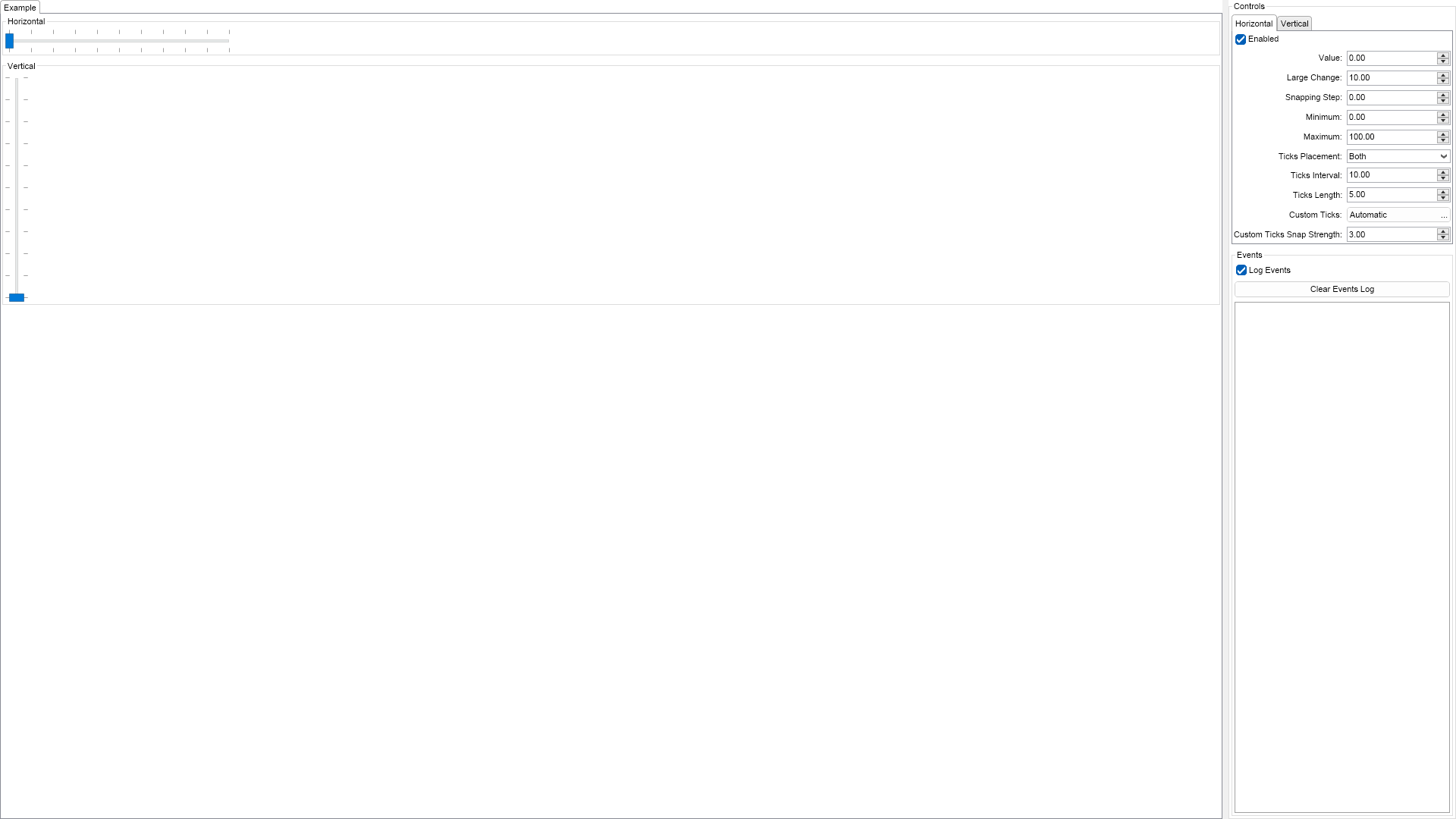
This example demonstrates how to create and use sliders. The slider is a widget that lets the user select a distinct value in a given range by dragging a thumb. You can specify whether the slider is horizontally or vertically oriented through its Orientation property. To control the tick visibility and placement use the TicksLength, TicksInterval and TicksPlacement properties.
The slider can also work with user-provided custom ticks via the CustomTicks property. When custom ticks are provided, the slider will not generate automatic ticks and will snap only to the custom ones. A snapping vicinity is defined around each custom tick, with its size controlled by the CustomTicksSnapStrength property. When the slider thumb enters this vicinity, it automatically snaps to the corresponding custom tick value.
| Language: C# |
using Nevron.Nov;
using Nevron.Nov.DataStructures;
using Nevron.Nov.Dom;
using Nevron.Nov.Editors;
using Nevron.Nov.Graphics;
using Nevron.Nov.Layout;
using Nevron.Nov.Presentation;
using Nevron.Nov.UI;
using Nevron.Nov.Windows.Forms;
using System.Windows.Forms;
namespace NovWinFormsProject
{
public partial class Form1 : Form
{
#region Constructors
public Form1()
{
InitializeComponent();
// Set form title
Text = "NOV WinForms - NSliderExample";
// Create the NOV example and its controls
NWidget exampleContent = CreateExampleContent();
NWidget exampleControls = CreateExampleControls();
if (exampleControls != null)
{
exampleControls.PreferredWidth = 300;
}
// Place the example and its controls in a pair box
NPairBox pairBox = new NPairBox(exampleContent, exampleControls);
pairBox.FillMode = ENStackFillMode.First;
pairBox.FitMode = ENStackFitMode.First;
pairBox.Margins = new NMargins(NDesign.HorizontalSpacing, NDesign.VerticalSpacing);
// Host the example in the form
NNovWidgetHost host = new NNovWidgetHost(pairBox);
host.Dock = DockStyle.Fill;
Controls.Add(host);
}
#endregion
#region Example
public NWidget CreateExampleContent()
{
NStackPanel stack = new NStackPanel();
NGroupBox gbh = new NGroupBox("Horizontal");
stack.Add(gbh);
m_HSlider = new NSlider();
gbh.Content = m_HSlider;
m_HSlider.HorizontalPlacement = ENHorizontalPlacement.Left;
m_HSlider.PreferredWidth = 300;
m_HSlider.ValueChanged += OnSliderValueChanged;
NGroupBox gbv = new NGroupBox("Vertical");
stack.Add(gbv);
m_VSlider = new NSlider();
gbv.Content = m_VSlider;
m_VSlider.Orientation = ENHVOrientation.Vertical;
m_VSlider.PreferredHeight = 300;
m_VSlider.HorizontalPlacement = ENHorizontalPlacement.Left;
m_VSlider.ValueChanged += OnSliderValueChanged;
return stack;
}
public NWidget CreateExampleControls()
{
NStackPanel stack = new NStackPanel();
stack.FillMode = ENStackFillMode.Last;
stack.FitMode = ENStackFitMode.Last;
// Create a tab
NTab tab = new NTab();
stack.Add(tab);
NProperty[] properties = new NProperty[] {
NSlider.EnabledProperty,
NSlider.ValueProperty,
NSlider.LargeChangeProperty,
NSlider.SnappingStepProperty,
NSlider.MinimumProperty,
NSlider.MaximumProperty,
NSlider.TicksPlacementProperty,
NSlider.TicksIntervalProperty,
NSlider.TicksLengthProperty,
NSlider.CustomTicksProperty,
NSlider.CustomTicksSnapStrengthProperty
};
// Create the Horizontal slider properties
NStackPanel hsbStack = new NStackPanel();
NList editors = NDesigner.GetDesigner(m_HSlider).CreateMemberEditors(
m_HSlider,
properties);
for (int i = 0; i < editors.Count; i++)
{
hsbStack.Add(editors[i]);
}
tab.TabPages.Add(new NTabPage("Horizontal", hsbStack));
// Create the Vertical slider properties
NStackPanel vsbStack = new NStackPanel();
editors = NDesigner.GetDesigner(m_VSlider).CreateMemberEditors(
m_VSlider, properties);
for (int i = 0; i < editors.Count; i++)
{
vsbStack.Add(editors[i]);
}
tab.TabPages.Add(new NTabPage("Vertical", vsbStack));
// Add events log
m_EventsLog = new NExampleEventsLog();
stack.Add(m_EventsLog);
return new NUniSizeBoxGroup(stack);
}
public string GetExampleDescription()
{
return @"
This example demonstrates how to create and use sliders. The slider is a widget that
lets the user select a distinct value in a given range by dragging a thumb. You can
specify whether the slider is horizontally or vertically oriented through its
Orientation property. To control the tick visibility and placement use the
TicksLength, TicksInterval and TicksPlacement properties.
The slider can also work with user-provided custom ticks via the CustomTicks property.
When custom ticks are provided, the slider will not generate automatic ticks and will snap only to the custom ones.
A snapping vicinity is defined around each custom tick, with its size controlled by the CustomTicksSnapStrength property.
When the slider thumb enters this vicinity, it automatically snaps to the corresponding custom tick value.
";
}
///
/// Gets the relevant documentation links for the example
///
///
public (string Name, string Url)[] GetDocumentationUrls()
{
return new[]
{
("Slider", "https://www.nevron.com/docs/openvision/ui-slider.html"),
("Range Based Widgets Overview", "https://www.nevron.com/docs/openvision/ui-range-based-widgets-overview.html"),
};
}
#endregion
#region Implementation
#endregion
#region Event Handlers
private void OnSliderValueChanged(NValueChangeEventArgs args)
{
string text = args.TargetNode == m_HSlider ? "Horizontal: " : "Vertical: ";
text += args.NewValue.ToString();
m_EventsLog.LogEvent(text);
}
#endregion
#region Fields
private NSlider m_HSlider;
private NSlider m_VSlider;
private NExampleEventsLog m_EventsLog;
#endregion
#region Static Methods
#endregion
#region Constants
#endregion
#region Nested Types
#endregion
}
} | Language: VB.NET |
Imports Nevron.Nov
Imports Nevron.Nov.Dom
Imports Nevron.Nov.Editors
Imports Nevron.Nov.Graphics
Imports Nevron.Nov.Layout
Imports Nevron.Nov.UI
Imports Nevron.Nov.Windows.Forms
Public Class Form1
#Region "Constructors"
Public Sub New()
' This call is required by the designer.
InitializeComponent()
' Add any initialization after the InitializeComponent() call.
' Set form title
Text = "NOV WinForms - NSliderExample"
' Create the NOV example and its controls
Dim exampleContent As NWidget = CreateExampleContent()
Dim exampleControls As NWidget = CreateExampleControls()
If Not exampleControls Is Nothing Then
exampleControls.PreferredWidth = 300
End If
' Place the example and its controls in a pair box
Dim pairBox As NPairBox = New NPairBox(exampleContent, exampleControls)
pairBox.FillMode = ENStackFillMode.First
pairBox.FitMode = ENStackFitMode.First
pairBox.Margins = New NMargins(NDesign.HorizontalSpacing, NDesign.VerticalSpacing)
' Host the example in the form
Dim host As NNovWidgetHost(Of NWidget) = New NNovWidgetHost(Of NWidget)(pairBox)
host.Dock = DockStyle.Fill
Controls.Add(host)
End Sub
#End Region
#Region "Example"
Public Function CreateExampleContent() As NWidget
Dim stack As NStackPanel = New NStackPanel()
Dim gbh As NGroupBox = New NGroupBox("Horizontal")
stack.Add(gbh)
m_HSlider = New NSlider()
gbh.Content = m_HSlider
m_HSlider.HorizontalPlacement = ENHorizontalPlacement.Left
m_HSlider.PreferredWidth = 300
Me.m_HSlider.ValueChanged += AddressOf OnSliderValueChanged
Dim gbv As NGroupBox = New NGroupBox("Vertical")
stack.Add(gbv)
m_VSlider = New NSlider()
gbv.Content = m_VSlider
m_VSlider.Orientation = ENHVOrientation.Vertical
m_VSlider.PreferredHeight = 300
m_VSlider.HorizontalPlacement = ENHorizontalPlacement.Left
Me.m_VSlider.ValueChanged += AddressOf OnSliderValueChanged
Return stack
End Function
Public Function CreateExampleControls() As NWidget
Dim stack As NStackPanel = New NStackPanel()
stack.FillMode = ENStackFillMode.Last
stack.FitMode = ENStackFitMode.Last
' Create a tab
Dim tab As NTab = New NTab()
stack.Add(tab)
Dim properties = New NProperty() {NInputElement.EnabledProperty, NRangeBase.ValueProperty, NSlider.LargeChangeProperty, NSlider.SnappingStepProperty, NRangeBase.MinimumProperty, NRangeBase.MaximumProperty, NSlider.TicksPlacementProperty, NSlider.TicksIntervalProperty, NSlider.TicksLengthProperty, NSlider.CustomTicksProperty, NSlider.CustomTicksSnapStrengthProperty}
' Create the Horizontal slider properties
Dim hsbStack As NStackPanel = New NStackPanel()
Dim editors = NDesigner.GetDesigner(m_HSlider).CreateMemberEditors(m_HSlider, properties)
For i = 0 To editors.Count - 1
hsbStack.Add(editors(i))
Next
tab.TabPages.Add(New NTabPage("Horizontal", hsbStack))
' Create the Vertical slider properties
Dim vsbStack As NStackPanel = New NStackPanel()
editors = NDesigner.GetDesigner(m_VSlider).CreateMemberEditors(m_VSlider, properties)
For i = 0 To editors.Count - 1
vsbStack.Add(editors(i))
Next
tab.TabPages.Add(New NTabPage("Vertical", vsbStack))
' Add events log
m_EventsLog = New NExampleEventsLog()
stack.Add(m_EventsLog)
Return New NUniSizeBoxGroup(stack)
End Function
Public Function GetExampleDescription() As String
Return "
This example demonstrates how to create and use sliders. The slider is a widget that
lets the user select a distinct value in a given range by dragging a thumb. You can
specify whether the slider is horizontally or vertically oriented through its
Orientation property. To control the tick visibility and placement use the
TicksLength, TicksInterval and TicksPlacement properties.
The slider can also work with user-provided custom ticks via the CustomTicks property.
When custom ticks are provided, the slider will not generate automatic ticks and will snap only to the custom ones.
A snapping vicinity is defined around each custom tick, with its size controlled by the CustomTicksSnapStrength property.
When the slider thumb enters this vicinity, it automatically snaps to the corresponding custom tick value.
"
End Function
'''
''' Gets the relevant documentation links for the example
'''
'''
Public Function GetDocumentationUrls() As (String, String)()
Return {("Slider", "https://www.nevron.com/docs/openvision/ui-slider.html"), ("Range Based Widgets Overview", "https://www.nevron.com/docs/openvision/ui-range-based-widgets-overview.html")}
End Function
#End Region
#Region "Implementation"
#End Region
#Region "Event Handlers"
Private Sub OnSliderValueChanged(args As NValueChangeEventArgs)
Dim text = If(args.TargetNode Is m_HSlider, "Horizontal: ", "Vertical: ")
text += args.NewValue.ToString()
m_EventsLog.LogEvent(text)
End Sub
#End Region
#Region "Fields"
Private m_HSlider As NSlider
Private m_VSlider As NSlider
Private m_EventsLog As NExampleEventsLog
#End Region
#Region "Static Methods"
#End Region
#Region "Constants"
#End Region
#Region "Nested Types"
#End Region
End Class