Tip Over Tree Layout Example for WPF

Nevron NOV Diagram for WPF ships with hundreds of examples with full source code, as part of the Nevron Open Vision Suite. All WPF Diagram examples are also available as a stand-alone Visual Studio solution in C# and VB.NET, which you can download from the links below.

Tip Over Tree Layout Example for WPF Description

The tip-over tree layout is a tree layout, which uses shapes provided data to determine whether the vertex children should be placed in a row, column or 2 columns. It produces orthogonal tree drawings. The layout satisfies to the following aesthetic criteria:

  • No edge crossings - edges do not cross each other.
  • No vertex-vertex overlaps - vertices do not overlap each other.
  • No vertex-edge overlaps - vertices do not overlap edges.
  • Compactness - you can optimize the compactness of the drawing in both the breadth and depth dimensions of the tree by setting the Compact property to true.

You can change the way the children and the leafs are placed using the corresponding properties. You can also set the children placement for the children of each vertex individually using the TipOverChildrenPlacement property in the LayoutData collection of the shape.

This type of layout is typically used in Org Charts, but can also be used in all cases where classical tree layouts (e.g. layouts with uniform parent placement) do not produce width/height ratio compact results.

In this example the nodes whose children are arranged in cols are highlighted with orange.

To experiment with the layout just change its properties from the property grid and click the Layout button. To see the layout in action on a different trees, just click the Random Tree button.
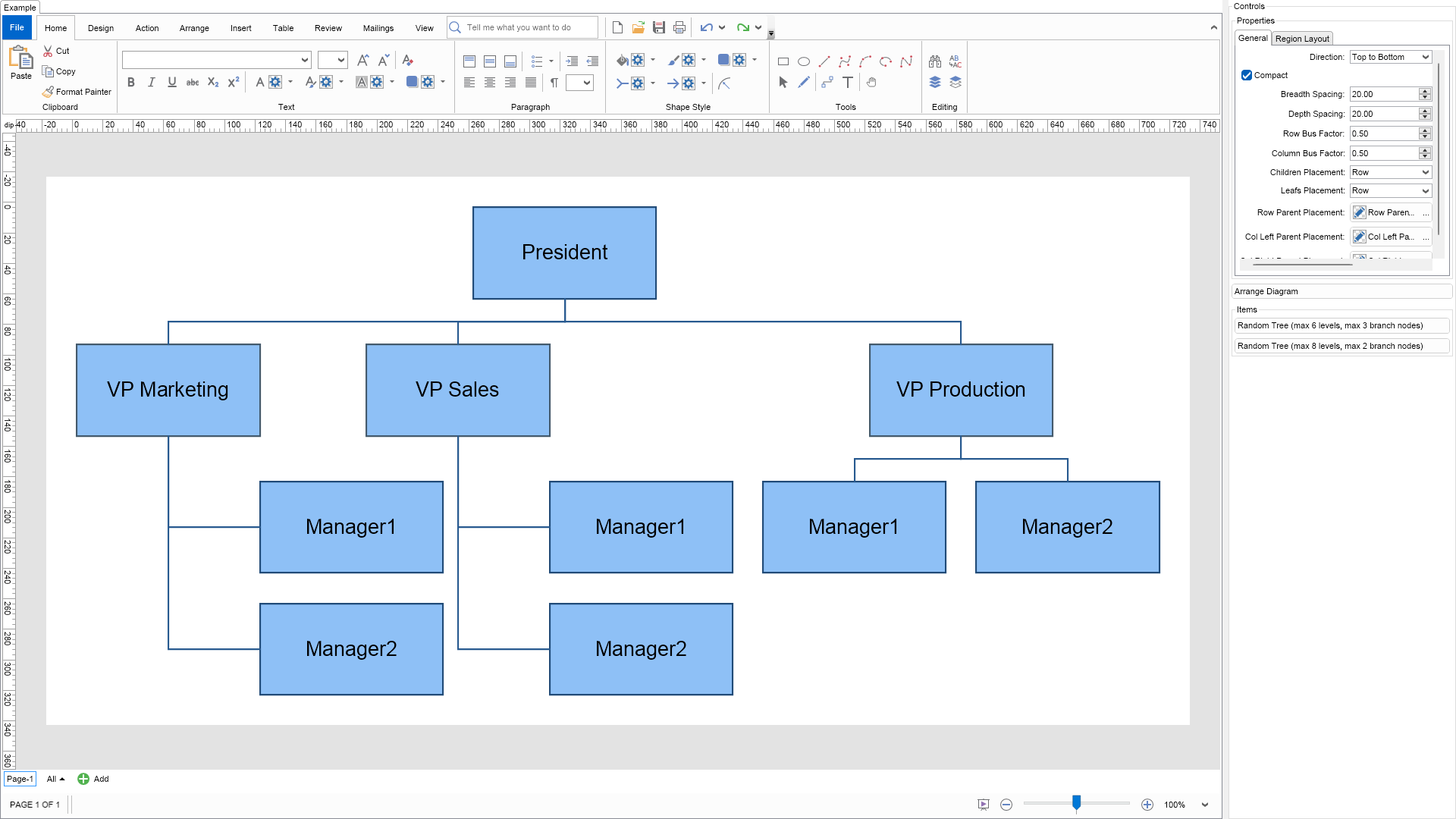

Tip over Tree Layout Example

C# Tip Over Tree Layout Example Code for Nevron Diagram for WPF
Language: C#

using Nevron.Nov;
using Nevron.Nov.DataStructures;
using Nevron.Nov.Diagram;
using Nevron.Nov.Diagram.Layout;
using Nevron.Nov.Diagram.Shapes;
using Nevron.Nov.Dom;
using Nevron.Nov.Editors;
using Nevron.Nov.Graphics;
using Nevron.Nov.Layout;
using Nevron.Nov.UI;
using Nevron.Nov.Windows.Forms;
using System;
using System.Windows.Forms;

namespace NovWinFormsProject
{
	public partial class Form1 : Form
	{
		#region Constructors

		public Form1()
		{
			InitializeComponent();

			// Set form title
			Text = "NOV WinForms - NTipOverTreeLayoutExample";

			// Create the NOV example and its controls
			NWidget exampleContent = CreateExampleContent();
			NWidget exampleControls = CreateExampleControls();
			if (exampleControls != null)
			{
				exampleControls.PreferredWidth = 300;
			}

			// Place the example and its controls in a pair box
			NPairBox pairBox = new NPairBox(exampleContent, exampleControls);
			pairBox.FillMode = ENStackFillMode.First;
			pairBox.FitMode = ENStackFitMode.First;
			pairBox.Margins = new NMargins(NDesign.HorizontalSpacing, NDesign.VerticalSpacing);

			// Host the example in the form
			NNovWidgetHost host = new NNovWidgetHost(pairBox);
			host.Dock = DockStyle.Fill;
			Controls.Add(host);
		}

		#endregion

        #region Example

        public NWidget CreateExampleContent()
        {
            // Create a simple drawing
            NDrawingViewWithRibbon drawingViewWithRibbon = new NDrawingViewWithRibbon();
            m_DrawingView = drawingViewWithRibbon.View;

            m_DrawingView.Document.HistoryService.Pause();
            try
            {
                InitDiagram(m_DrawingView.Document);
            }
            finally
            {
                m_DrawingView.Document.HistoryService.Resume();
            }

            return drawingViewWithRibbon;
        }
        public NWidget CreateExampleControls()
        {
            m_Layout.Changed += OnLayoutChanged;

            NStackPanel stack = new NStackPanel();

            // property editor
            NEditor editor = NDesigner.GetDesigner(m_Layout).CreateStandaloneEditor(m_Layout);
            stack.Add(new NGroupBox("Properties", editor));

            NButton arrangeButton = new NButton("Arrange Diagram");
            arrangeButton.Click += OnArrangeButtonClick;
            stack.Add(arrangeButton);

            // items stack
            NStackPanel itemsStack = new NStackPanel();

            // NOTE: For Tree layouts we provide the user with the ability to generate random tree diagrams so that he/she can test the layouts
            NButton randomTree1Button = new NButton("Random Tree (max 6 levels, max 3 branch nodes)");
            randomTree1Button.Click += OnRandomTree1ButtonClick;
            itemsStack.Add(randomTree1Button);

            NButton randomTree2Button = new NButton("Random Tree (max 8 levels, max 2 branch nodes)");
            randomTree2Button.Click += OnRandomTree2ButtonClick;
            itemsStack.Add(randomTree2Button);

            stack.Add(new NGroupBox("Items", itemsStack));

            return stack;
        }
        public string GetExampleDescription()
        {
            return @"

The tip-over tree layout is a tree layout, which uses shapes provided data to determine whether the vertex children should be placed in a row, column or 2 columns. It produces orthogonal tree drawings. The layout satisfies to the following aesthetic criteria:

  • No edge crossings - edges do not cross each other.
  • No vertex-vertex overlaps - vertices do not overlap each other.
  • No vertex-edge overlaps - vertices do not overlap edges.
  • Compactness - you can optimize the compactness of the drawing in both the breadth and depth dimensions of the tree by setting the Compact property to true.

You can change the way the children and the leafs are placed using the corresponding properties. You can also set the children placement for the children of each vertex individually using the TipOverChildrenPlacement property in the LayoutData collection of the shape.

This type of layout is typically used in Org Charts, but can also be used in all cases where classical tree layouts (e.g. layouts with uniform parent placement) do not produce width/height ratio compact results.

In this example the nodes whose children are arranged in cols are highlighted with orange.

To experiment with the layout just change its properties from the property grid and click the Layout button. To see the layout in action on a different trees, just click the Random Tree button.

"; } /// /// Gets the relevant documentation links for the example /// /// public (string Name, string Url)[] GetDocumentationUrls() { return new[] { ("Tip-over Tree Layout", "https://www.nevron.com/docs/openvision/diagram-tip-over-tree-layout.html"), ("Layouts Overview", "https://www.nevron.com/docs/openvision/diagram-drawing-layouts-overview.html"), ("Graph Regions and Regions Layouts", "https://www.nevron.com/docs/openvision/diagram-graph-regions-and-region-layouts.html"), }; } private void InitDiagram(NDrawingDocument drawingDocument) { const double ShapeWidth = 120; const double ShapeHeight = 60; // Hide ports drawingDocument.Content.ScreenVisibility.ShowPorts = false; NPage activePage = drawingDocument.Content.ActivePage; // We will be using basic shapes with default size of 120, 60 NBasicShapeFactory basicShapes = new NBasicShapeFactory(); basicShapes.DefaultSize = new NSize(ShapeWidth, ShapeHeight); // Create the president NShape president = basicShapes.CreateShape(ENBasicShape.Rectangle); president.Text = "President"; activePage.Items.Add(president); // Create the VPs. // NOTE: The child nodes of the VPs are layed out in cols NShape vpMarketing = basicShapes.CreateShape(ENBasicShape.Rectangle); vpMarketing.Text = "VP Marketing"; vpMarketing.Geometry.Stroke = new NStroke(1, new NColor(68, 90, 108)); vpMarketing.LayoutData.TipOverChildrenPlacement = ENTipOverChildrenPlacement.ColRight; activePage.Items.Add(vpMarketing); NShape vpSales = basicShapes.CreateShape(ENBasicShape.Rectangle); vpSales.Text = "VP Sales"; vpSales.Geometry.Stroke = new NStroke(1, new NColor(68, 90, 108)); vpSales.LayoutData.TipOverChildrenPlacement = ENTipOverChildrenPlacement.ColRight; activePage.Items.Add(vpSales); NShape vpProduction = basicShapes.CreateShape(ENBasicShape.Rectangle); vpProduction.Text = "VP Production"; vpSales.LayoutData.TipOverChildrenPlacement = ENTipOverChildrenPlacement.ColRight; vpProduction.Geometry.Stroke = new NStroke(1, new NColor(68, 90, 108)); activePage.Items.Add(vpProduction); // Connect president with VP NRoutableConnector connector = new NRoutableConnector(); activePage.Items.Add(connector); connector.GlueBeginToShape(president); connector.GlueEndToShape(vpMarketing); connector = new NRoutableConnector(); activePage.Items.Add(connector); connector.GlueBeginToShape(president); connector.GlueEndToShape(vpSales); connector = new NRoutableConnector(); activePage.Items.Add(connector); connector.GlueBeginToShape(president); connector.GlueEndToShape(vpProduction); // Create the marketing managers NShape marketingManager1 = basicShapes.CreateShape(ENBasicShape.Rectangle); marketingManager1.Text = "Manager1"; activePage.Items.Add(marketingManager1); NShape marketingManager2 = basicShapes.CreateShape(ENBasicShape.Rectangle); marketingManager2.Text = "Manager2"; activePage.Items.Add(marketingManager2); // Connect the marketing manager with the marketing VP connector = new NRoutableConnector(); activePage.Items.Add(connector); connector.GlueBeginToShape(vpMarketing); connector.GlueEndToShape(marketingManager1); connector = new NRoutableConnector(); activePage.Items.Add(connector); connector.GlueBeginToShape(vpMarketing); connector.GlueEndToShape(marketingManager2); // Create the sales managers NShape salesManager1 = basicShapes.CreateShape(ENBasicShape.Rectangle); salesManager1.Text = "Manager1"; activePage.Items.Add(salesManager1); NShape salesManager2 = basicShapes.CreateShape(ENBasicShape.Rectangle); salesManager2.Text = "Manager2"; activePage.Items.Add(salesManager2); // Connect the sales manager with the sales VP connector = new NRoutableConnector(); activePage.Items.Add(connector); connector.GlueBeginToShape(vpSales); connector.GlueEndToShape(salesManager1); connector = new NRoutableConnector(); activePage.Items.Add(connector); connector.GlueBeginToShape(vpSales); connector.GlueEndToShape(salesManager2); // Create the production managers NShape productionManager1 = basicShapes.CreateShape(ENBasicShape.Rectangle); productionManager1.Text = "Manager1"; activePage.Items.Add(productionManager1); NShape productionManager2 = basicShapes.CreateShape(ENBasicShape.Rectangle); productionManager2.Text = "Manager2"; activePage.Items.Add(productionManager2); // Connect the production manager with the production VP connector = new NRoutableConnector(); activePage.Items.Add(connector); connector.GlueBeginToShape(vpProduction); connector.GlueEndToShape(productionManager1); connector = new NRoutableConnector(); activePage.Items.Add(connector); connector.GlueBeginToShape(vpProduction); connector.GlueEndToShape(productionManager2); // Arrange diagram ArrangeDiagram(drawingDocument); // Fit active page drawingDocument.Content.ActivePage.ZoomMode = ENZoomMode.Fit; } #endregion #region Implementation private void CreateTreeDiagram(NDrawingDocument drawingDocument, int levels, int branchNodes) { // Create a random tree NGenericTreeTemplate tree = new NGenericTreeTemplate(); tree.EdgeUserClass = NDR.StyleSheetNameConnectors; tree.Balanced = false; tree.Levels = levels; tree.BranchNodes = branchNodes; tree.HorizontalSpacing = 10; tree.VerticalSpacing = 10; tree.VertexShape = VertexShape; tree.VertexSize = VertexSize; tree.VertexSizeDeviation = 1; tree.Create(drawingDocument); // Randomly set the children placement of ten shapes to col NList shapes = drawingDocument.Content.ActivePage.GetShapes(false, NDiagramFilters.ShapeType2D); Random random = new Random(); for (int i = 0; i < shapes.Count / 2; i++) { int index = random.Next(shapes.Count); NShape shape = shapes[index]; shape.Geometry.Fill = new NColorFill(NColor.Orange); shape.LayoutData.TipOverChildrenPlacement = ENTipOverChildrenPlacement.ColRight; } } /// /// Arranges the shapes in the active page. /// /// private void ArrangeDiagram(NDrawingDocument drawingDocument) { // get all top-level shapes that reside in the active page NPage activePage = drawingDocument.Content.ActivePage; NList shapes = activePage.GetShapes(false); // create a layout context and use it to arrange the shapes using the current layout NDrawingLayoutContext layoutContext = new NDrawingLayoutContext(drawingDocument, activePage); m_Layout.Arrange(shapes.CastAll(), layoutContext); // size the page to the content size activePage.SizeToContent(); } #endregion #region Event Handlers private void OnLayoutChanged(NEventArgs arg) { ArrangeDiagram(m_DrawingView.Document); } private void OnArrangeButtonClick(NEventArgs arg) { ArrangeDiagram(m_DrawingView.Document); } private void OnRandomTree1ButtonClick(NEventArgs arg) { m_DrawingView.ActivePage.Items.Clear(); // create a random tree CreateTreeDiagram(m_DrawingView.Document, 6, 3); // layout the tree ArrangeDiagram(m_DrawingView.Document); } private void OnRandomTree2ButtonClick(NEventArgs arg) { m_DrawingView.ActivePage.Items.Clear(); // create a random tree CreateTreeDiagram(m_DrawingView.Document, 8, 2); // layout the tree ArrangeDiagram(m_DrawingView.Document); } #endregion #region Fields private NDrawingView m_DrawingView; private NTipOverTreeLayout m_Layout = new NTipOverTreeLayout(); #endregion #region Static Methods #endregion #region Constants private const ENBasicShape VertexShape = ENBasicShape.Rectangle; private static readonly NSize VertexSize = new NSize(60, 60); #endregion #region Nested Types #endregion } }

Download a fully functional C# (.cs) Tip Over Tree Layout Example for WPF Solution

VB.NET Tip Over Tree Layout Example Code for Nevron Diagram for WPF
Language: VB.NET

Imports Nevron.Nov
Imports Nevron.Nov.Diagram
Imports Nevron.Nov.Diagram.Layout
Imports Nevron.Nov.Diagram.Shapes
Imports Nevron.Nov.Dom
Imports Nevron.Nov.Editors
Imports Nevron.Nov.Graphics
Imports Nevron.Nov.Layout
Imports Nevron.Nov.UI
Imports Nevron.Nov.Windows.Wpf
Imports System

Class MainWindow

#Region "Constructors"

	Public Sub New()
		' This call is required by the designer.
		InitializeComponent()

		' Add any initialization after the InitializeComponent() call.

		' Set form title
		Title = "NOV WPF - NTipOverTreeLayoutExample"

		' Create the NOV example and its controls
		Dim exampleContent As NWidget = CreateExampleContent()
		Dim exampleControls As NWidget = CreateExampleControls()
		If Not exampleControls Is Nothing Then
			exampleControls.PreferredWidth = 300
		End If

		' Place the example and its controls in a pair box
		Dim pairBox As NPairBox = New NPairBox(exampleContent, exampleControls)
		pairBox.FillMode = ENStackFillMode.First
		pairBox.FitMode = ENStackFitMode.First
		pairBox.Margins = New NMargins(NDesign.HorizontalSpacing, NDesign.VerticalSpacing)

		' Host the example in the form
		Dim host As NNovWidgetHost(Of NWidget) = New NNovWidgetHost(Of NWidget)(pairBox)
		Content = host
	End Sub


#End Region

#Region "Example"

        Public Function CreateExampleContent() As NWidget
            ' Create a simple drawing
            Dim drawingViewWithRibbon As NDrawingViewWithRibbon = New NDrawingViewWithRibbon()
            m_DrawingView = drawingViewWithRibbon.View

            m_DrawingView.Document.HistoryService.Pause()
            Try
                InitDiagram(m_DrawingView.Document)
            Finally
                m_DrawingView.Document.HistoryService.Resume()
            End Try

            Return drawingViewWithRibbon
        End Function
        Public Function CreateExampleControls() As NWidget
            Me.m_Layout.Changed += AddressOf OnLayoutChanged

            Dim stack As NStackPanel = New NStackPanel()

            ' property editor
            Dim editor As NEditor = NDesigner.GetDesigner(m_Layout).CreateStandaloneEditor(m_Layout)
            stack.Add(New NGroupBox("Properties", editor))

            Dim arrangeButton As NButton = New NButton("Arrange Diagram")
            arrangeButton.Click += AddressOf OnArrangeButtonClick
            stack.Add(arrangeButton)

            ' items stack
            Dim itemsStack As NStackPanel = New NStackPanel()

            ' NOTE: For Tree layouts we provide the user with the ability to generate random tree diagrams so that he/she can test the layouts
            Dim randomTree1Button As NButton = New NButton("Random Tree (max 6 levels, max 3 branch nodes)")
            randomTree1Button.Click += AddressOf OnRandomTree1ButtonClick
            itemsStack.Add(randomTree1Button)

            Dim randomTree2Button As NButton = New NButton("Random Tree (max 8 levels, max 2 branch nodes)")
            randomTree2Button.Click += AddressOf OnRandomTree2ButtonClick
            itemsStack.Add(randomTree2Button)

            stack.Add(New NGroupBox("Items", itemsStack))

            Return stack
        End Function
        Public Function GetExampleDescription() As String
            Return "

The tip-over tree layout is a tree layout, which uses shapes provided data to determine whether the vertex children should be placed in a row, column or 2 columns. It produces orthogonal tree drawings. The layout satisfies to the following aesthetic criteria:

  • No edge crossings - edges do not cross each other.
  • No vertex-vertex overlaps - vertices do not overlap each other.
  • No vertex-edge overlaps - vertices do not overlap edges.
  • Compactness - you can optimize the compactness of the drawing in both the breadth and depth dimensions of the tree by setting the Compact property to true.

You can change the way the children and the leafs are placed using the corresponding properties. You can also set the children placement for the children of each vertex individually using the TipOverChildrenPlacement property in the LayoutData collection of the shape.

This type of layout is typically used in Org Charts, but can also be used in all cases where classical tree layouts (e.g. layouts with uniform parent placement) do not produce width/height ratio compact results.

In this example the nodes whose children are arranged in cols are highlighted with orange.

To experiment with the layout just change its properties from the property grid and click the Layout button. To see the layout in action on a different trees, just click the Random Tree button.

" End Function ''' ''' Gets the relevant documentation links for the example ''' ''' Public Function GetDocumentationUrls() As (String, String)() Return {("Tip-over Tree Layout", "https://www.nevron.com/docs/openvision/diagram-tip-over-tree-layout.html"), ("Layouts Overview", "https://www.nevron.com/docs/openvision/diagram-drawing-layouts-overview.html"), ("Graph Regions and Regions Layouts", "https://www.nevron.com/docs/openvision/diagram-graph-regions-and-region-layouts.html")} End Function Private Sub InitDiagram(drawingDocument As NDrawingDocument) Const ShapeWidth As Double = 120 Const ShapeHeight As Double = 60 ' Hide ports drawingDocument.Content.ScreenVisibility.ShowPorts = False Dim activePage = drawingDocument.Content.ActivePage ' We will be using basic shapes with default size of 120, 60 Dim basicShapes As NBasicShapeFactory = New NBasicShapeFactory() basicShapes.DefaultSize = New NSize(ShapeWidth, ShapeHeight) ' Create the president Dim president = basicShapes.CreateShape(ENBasicShape.Rectangle) president.Text = "President" activePage.Items.Add(president) ' Create the VPs. ' NOTE: The child nodes of the VPs are layed out in cols Dim vpMarketing = basicShapes.CreateShape(ENBasicShape.Rectangle) vpMarketing.Text = "VP Marketing" vpMarketing.Geometry.Stroke = New NStroke(1, New NColor(68, 90, 108)) vpMarketing.LayoutData.TipOverChildrenPlacement = ENTipOverChildrenPlacement.ColRight activePage.Items.Add(vpMarketing) Dim vpSales = basicShapes.CreateShape(ENBasicShape.Rectangle) vpSales.Text = "VP Sales" vpSales.Geometry.Stroke = New NStroke(1, New NColor(68, 90, 108)) vpSales.LayoutData.TipOverChildrenPlacement = ENTipOverChildrenPlacement.ColRight activePage.Items.Add(vpSales) Dim vpProduction = basicShapes.CreateShape(ENBasicShape.Rectangle) vpProduction.Text = "VP Production" vpSales.LayoutData.TipOverChildrenPlacement = ENTipOverChildrenPlacement.ColRight vpProduction.Geometry.Stroke = New NStroke(1, New NColor(68, 90, 108)) activePage.Items.Add(vpProduction) ' Connect president with VP Dim connector As NRoutableConnector = New NRoutableConnector() activePage.Items.Add(connector) connector.GlueBeginToShape(president) connector.GlueEndToShape(vpMarketing) connector = New NRoutableConnector() activePage.Items.Add(connector) connector.GlueBeginToShape(president) connector.GlueEndToShape(vpSales) connector = New NRoutableConnector() activePage.Items.Add(connector) connector.GlueBeginToShape(president) connector.GlueEndToShape(vpProduction) ' Create the marketing managers Dim marketingManager1 = basicShapes.CreateShape(ENBasicShape.Rectangle) marketingManager1.Text = "Manager1" activePage.Items.Add(marketingManager1) Dim marketingManager2 = basicShapes.CreateShape(ENBasicShape.Rectangle) marketingManager2.Text = "Manager2" activePage.Items.Add(marketingManager2) ' Connect the marketing manager with the marketing VP connector = New NRoutableConnector() activePage.Items.Add(connector) connector.GlueBeginToShape(vpMarketing) connector.GlueEndToShape(marketingManager1) connector = New NRoutableConnector() activePage.Items.Add(connector) connector.GlueBeginToShape(vpMarketing) connector.GlueEndToShape(marketingManager2) ' Create the sales managers Dim salesManager1 = basicShapes.CreateShape(ENBasicShape.Rectangle) salesManager1.Text = "Manager1" activePage.Items.Add(salesManager1) Dim salesManager2 = basicShapes.CreateShape(ENBasicShape.Rectangle) salesManager2.Text = "Manager2" activePage.Items.Add(salesManager2) ' Connect the sales manager with the sales VP connector = New NRoutableConnector() activePage.Items.Add(connector) connector.GlueBeginToShape(vpSales) connector.GlueEndToShape(salesManager1) connector = New NRoutableConnector() activePage.Items.Add(connector) connector.GlueBeginToShape(vpSales) connector.GlueEndToShape(salesManager2) ' Create the production managers Dim productionManager1 = basicShapes.CreateShape(ENBasicShape.Rectangle) productionManager1.Text = "Manager1" activePage.Items.Add(productionManager1) Dim productionManager2 = basicShapes.CreateShape(ENBasicShape.Rectangle) productionManager2.Text = "Manager2" activePage.Items.Add(productionManager2) ' Connect the production manager with the production VP connector = New NRoutableConnector() activePage.Items.Add(connector) connector.GlueBeginToShape(vpProduction) connector.GlueEndToShape(productionManager1) connector = New NRoutableConnector() activePage.Items.Add(connector) connector.GlueBeginToShape(vpProduction) connector.GlueEndToShape(productionManager2) ' Arrange diagram ArrangeDiagram(drawingDocument) ' Fit active page drawingDocument.Content.ActivePage.ZoomMode = ENZoomMode.Fit End Sub #End Region #Region "Implementation" Private Sub CreateTreeDiagram(drawingDocument As NDrawingDocument, levels As Integer, branchNodes As Integer) ' Create a random tree Dim tree As NGenericTreeTemplate = New NGenericTreeTemplate() tree.EdgeUserClass = NDR.StyleSheetNameConnectors tree.Balanced = False tree.Levels = levels tree.BranchNodes = branchNodes tree.HorizontalSpacing = 10 tree.VerticalSpacing = 10 tree.VertexShape = VertexShape tree.VertexSize = VertexSize tree.VertexSizeDeviation = 1 tree.Create(drawingDocument) ' Randomly set the children placement of ten shapes to col Dim shapes = drawingDocument.Content.ActivePage.GetShapes(False, NDiagramFilters.ShapeType2D) Dim random As Random = New Random() For i As Integer = 0 To shapes.Count / 2 - 1 Dim index = random.Next(shapes.Count) Dim shape = shapes(index) shape.Geometry.Fill = New NColorFill(NColor.Orange) shape.LayoutData.TipOverChildrenPlacement = ENTipOverChildrenPlacement.ColRight Next End Sub ''' ''' Arranges the shapes in the active page. ''' ''' Private Sub ArrangeDiagram(drawingDocument As NDrawingDocument) ' get all top-level shapes that reside in the active page Dim activePage = drawingDocument.Content.ActivePage Dim shapes = activePage.GetShapes(False) ' create a layout context and use it to arrange the shapes using the current layout Dim layoutContext As NDrawingLayoutContext = New NDrawingLayoutContext(drawingDocument, activePage) m_Layout.Arrange(shapes.CastAll(Of Object)(), layoutContext) ' size the page to the content size activePage.SizeToContent() End Sub #End Region #Region "Event Handlers" Private Sub OnLayoutChanged(arg As NEventArgs) ArrangeDiagram(m_DrawingView.Document) End Sub Private Sub OnArrangeButtonClick(arg As NEventArgs) ArrangeDiagram(m_DrawingView.Document) End Sub Private Sub OnRandomTree1ButtonClick(arg As NEventArgs) m_DrawingView.ActivePage.Items.Clear() ' create a random tree CreateTreeDiagram(m_DrawingView.Document, 6, 3) ' layout the tree ArrangeDiagram(m_DrawingView.Document) End Sub Private Sub OnRandomTree2ButtonClick(arg As NEventArgs) m_DrawingView.ActivePage.Items.Clear() ' create a random tree CreateTreeDiagram(m_DrawingView.Document, 8, 2) ' layout the tree ArrangeDiagram(m_DrawingView.Document) End Sub #End Region #Region "Fields" Private m_DrawingView As NDrawingView Private m_Layout As NTipOverTreeLayout = New NTipOverTreeLayout() #End Region #Region "Static Methods" #End Region #Region "Constants" Private Const VertexShape As ENBasicShape = ENBasicShape.Rectangle Private Shared ReadOnly VertexSize As NSize = New NSize(60, 60) #End Region #Region "Nested Types" #End Region End Class

Download a fully functional VB.NET (.vb) Tip Over Tree Layout Example for WPF Solution