Nevron NOV Diagram for WPF ships with hundreds of examples with full source code, as part of the Nevron Open Vision Suite.
All WPF Diagram examples are also available as a stand-alone Visual Studio solution
in C# and VB.NET,
which you can download from the links below.
Family Tree (Lincoln Family) Example for WPF Description
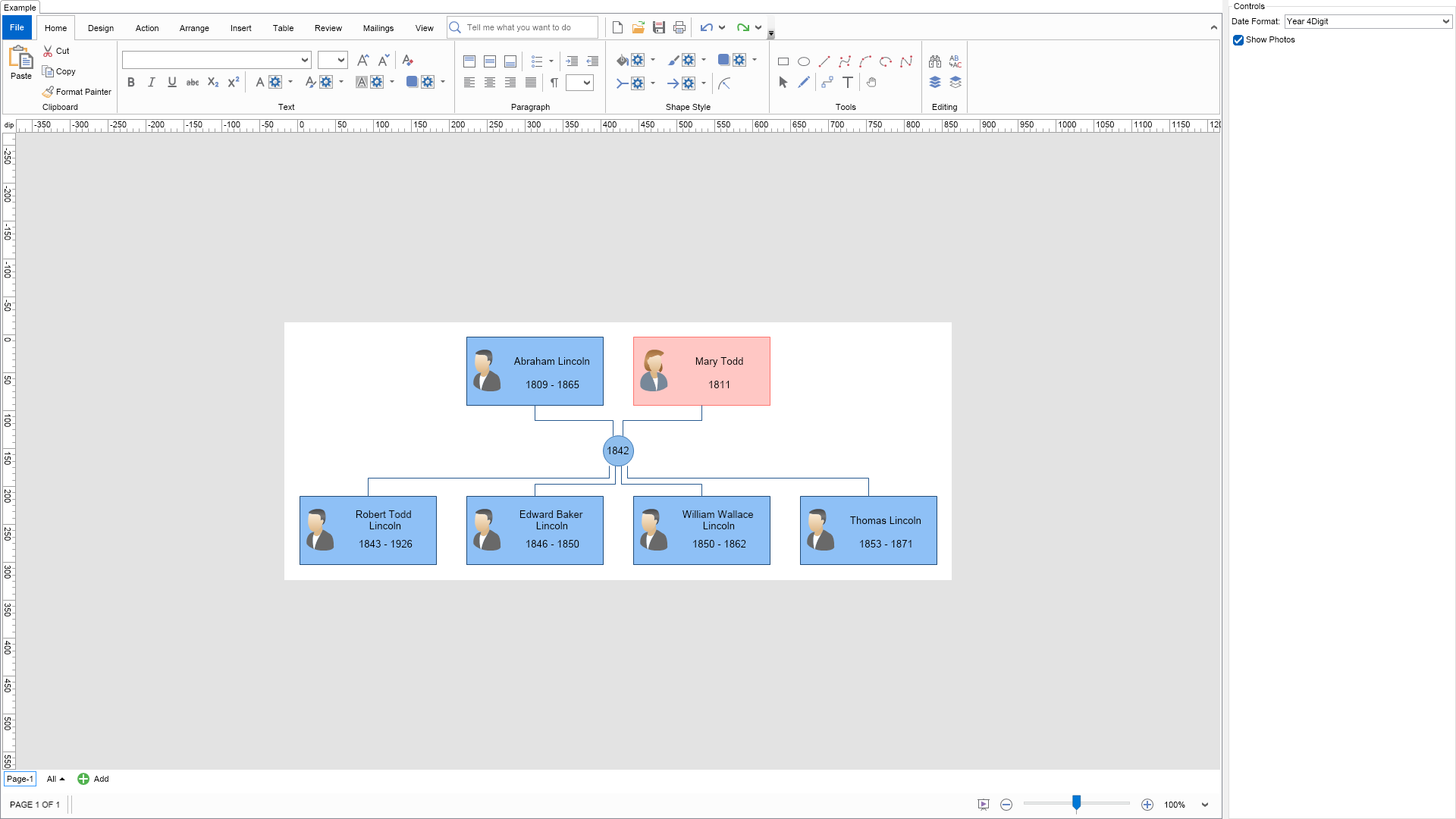
This example demonstrates how to create and arrange Family Tree diagrams. Use the controls
on the right to change the family tree settings. You can also click the "Settings" button
in the "Family Tree" contextual ribbon tab.
C# Family Tree (Lincoln Family) Example Code for Nevron Diagram for WPF
Language: C#
using Nevron.Nov;
using Nevron.Nov.DataStructures;
using Nevron.Nov.Diagram;
using Nevron.Nov.Diagram.Layout;
using Nevron.Nov.Diagram.Shapes.FamilyTree.FamilyTree;
using Nevron.Nov.Dom;
using Nevron.Nov.Editors;
using Nevron.Nov.Graphics;
using Nevron.Nov.Layout;
using Nevron.Nov.UI;
using Nevron.Nov.Windows.Forms;
using System.Windows.Forms;
namespace NovWinFormsProject
{
public partial class Form1 : Form
{
#region Constructors
public Form1()
{
InitializeComponent();
// Set form title
Text = "NOV WinForms - NFamilyTreeExample";
// Create the NOV example and its controls
NWidget exampleContent = CreateExampleContent();
NWidget exampleControls = CreateExampleControls();
if (exampleControls != null)
{
exampleControls.PreferredWidth = 300;
}
// Place the example and its controls in a pair box
NPairBox pairBox = new NPairBox(exampleContent, exampleControls);
pairBox.FillMode = ENStackFillMode.First;
pairBox.FitMode = ENStackFitMode.First;
pairBox.Margins = new NMargins(NDesign.HorizontalSpacing, NDesign.VerticalSpacing);
// Host the example in the form
NNovWidgetHost host = new NNovWidgetHost(pairBox);
host.Dock = DockStyle.Fill;
Controls.Add(host);
}
#endregion
#region Example
public NWidget CreateExampleContent()
{
// Create a drawing view with a ribbon
NDrawingViewWithRibbon drawingViewWithRibbon = new NDrawingViewWithRibbon();
m_DrawingView = drawingViewWithRibbon.View;
// hide grid and ports
m_DrawingView.Content.ScreenVisibility.ShowGrid = false;
m_DrawingView.Content.ScreenVisibility.ShowPorts = false;
// Create a family tree diagram
m_DrawingView.Document.HistoryService.Pause();
try
{
InitDiagram(m_DrawingView.Document);
}
finally
{
m_DrawingView.Document.HistoryService.Resume();
}
return drawingViewWithRibbon;
}
public NWidget CreateExampleControls()
{
NStackPanel stack = new NStackPanel();
// Get the family tree drawing extension
NFamilyTreeExtension familyTreeExtension = (NFamilyTreeExtension)m_DrawingView.Content.Extensions.FindByType(NFamilyTreeExtension.FamilyTreeExtensionType);
// Create property editors
NList propertyEditors = NDesigner.GetDesigner(familyTreeExtension).CreateMemberEditors(familyTreeExtension,
NFamilyTreeExtension.DateFormatProperty,
NFamilyTreeExtension.ShowPhotosProperty
);
for (int i = 0; i < propertyEditors.Count; i++)
{
stack.Add(propertyEditors[i]);
}
return new NUniSizeBoxGroup(stack);
}
public string GetExampleDescription()
{
return @"
This example demonstrates how to create and arrange Family Tree diagrams. Use the controls
on the right to change the family tree settings. You can also click the ""Settings"" button
in the ""Family Tree"" contextual ribbon tab.
";
}
///
/// Gets the relevant documentation links for the example
///
///
public (string Name, string Url)[] GetDocumentationUrls()
{
return new[]
{
("Shapes", "https://www.nevron.com/docs/openvision/diagram-shapes.html"),
("Layered Tree Layout", "https://www.nevron.com/docs/openvision/diagram-layered-tree-layout.html"),
("Routable Connectors", "https://www.nevron.com/docs/openvision/diagram-routable-connectors.html"),
("Text Block", "https://www.nevron.com/docs/openvision/diagram-text-block.html"),
};
}
#endregion
#region Implementation
private void InitDiagram(NDrawingDocument drawingDocument)
{
// Get drawing and the active page
NDrawing drawing = drawingDocument.Content;
// Set the family tree extension to the drawing to activate the "Family Tree" ribbon tab
drawing.Extensions = new NDiagramExtensionCollection();
drawing.Extensions.Add(new NFamilyTreeExtension());
// Create a family tree diagram in the active page of the drawing
CreateFamilyTree(drawing.ActivePage);
}
private void CreateFamilyTree(NPage page)
{
NFamilyTreeShapeFactory shapeFactory = new NFamilyTreeShapeFactory();
// Create the parents
NShape fatherShape = shapeFactory.CreateShape(ENFamilyTreeShape.Male);
fatherShape.SetShapePropertyValue("FirstName", "Abraham");
fatherShape.SetShapePropertyValue("LastName", "Lincoln");
fatherShape.SetShapePropertyValue("BirthDate", new NMaskedDateTime(1809, 02, 12));// NMaskedDateTime
fatherShape.SetShapePropertyValue("DeathDate", new NMaskedDateTime(1865, 04, 15));
page.Items.Add(fatherShape);
NShape motherShape = shapeFactory.CreateShape(ENFamilyTreeShape.Female);
motherShape.SetShapePropertyValue("FirstName", "Mary");
motherShape.SetShapePropertyValue("LastName", "Todd");
motherShape.SetShapePropertyValue("BirthDate", new NMaskedDateTime(1811));
page.Items.Add(motherShape);
// Create the children
NShape childShape1 = shapeFactory.CreateShape(ENFamilyTreeShape.Male);
childShape1.SetShapePropertyValue("FirstName", "Thomas");
childShape1.SetShapePropertyValue("LastName", "Lincoln");
childShape1.SetShapePropertyValue("BirthDate", new NMaskedDateTime(1853, 4, 4));
childShape1.SetShapePropertyValue("DeathDate", new NMaskedDateTime(1871));
page.Items.Add(childShape1);
NShape childShape2 = shapeFactory.CreateShape(ENFamilyTreeShape.Male);
childShape2.SetShapePropertyValue("FirstName", "Robert Todd");
childShape2.SetShapePropertyValue("LastName", "Lincoln");
childShape2.SetShapePropertyValue("BirthDate", new NMaskedDateTime(1843, 8, 1));
childShape2.SetShapePropertyValue("DeathDate", new NMaskedDateTime(1926, 7, 26));
page.Items.Add(childShape2);
NShape childShape3 = shapeFactory.CreateShape(ENFamilyTreeShape.Male);
childShape3.SetShapePropertyValue("FirstName", "William Wallace");
childShape3.SetShapePropertyValue("LastName", "Lincoln");
childShape3.SetShapePropertyValue("BirthDate", new NMaskedDateTime(1850, 12, 21));
childShape3.SetShapePropertyValue("DeathDate", new NMaskedDateTime(1862, 2, 20));
page.Items.Add(childShape3);
NShape childShape4 = shapeFactory.CreateShape(ENFamilyTreeShape.Male);
childShape4.SetShapePropertyValue("FirstName", "Edward Baker");
childShape4.SetShapePropertyValue("LastName", "Lincoln");
childShape4.SetShapePropertyValue("BirthDate", new NMaskedDateTime(1846, 3, 10));
childShape4.SetShapePropertyValue("DeathDate", new NMaskedDateTime(1850, 2, 1));
page.Items.Add(childShape4);
// Create the relationship shape
NShape relShape = shapeFactory.CreateShape(ENFamilyTreeShape.Relationship);
relShape.SetShapePropertyValue("MarriageDate", new NMaskedDateTime(1842, 11, 4));
page.Items.Add(relShape);
page.Items.Add(CreateConnector(fatherShape, relShape));
page.Items.Add(CreateConnector(motherShape, relShape));
page.Items.Add(CreateConnector(relShape, childShape1));
page.Items.Add(CreateConnector(relShape, childShape2));
page.Items.Add(CreateConnector(relShape, childShape3));
page.Items.Add(CreateConnector(relShape, childShape4));
// Arrange the family tree shapes
NFamilyGraphLayout layout = new NFamilyGraphLayout();
object[] shapes = page.GetShapes(false).ToArray
Download a fully functional C# (.cs) Family Tree (Lincoln Family) Example for WPF Solution
VB.NET Family Tree (Lincoln Family) Example Code for Nevron Diagram for WPF
Language: VB.NET
Imports Nevron.Nov
Imports Nevron.Nov.Diagram
Imports Nevron.Nov.Diagram.Layout
Imports Nevron.Nov.Diagram.Shapes.FamilyTree.FamilyTree
Imports Nevron.Nov.Dom
Imports Nevron.Nov.Editors
Imports Nevron.Nov.Graphics
Imports Nevron.Nov.Layout
Imports Nevron.Nov.UI
Imports Nevron.Nov.Windows.Wpf

Class MainWindow

#Region "Constructors"

	Public Sub New()
		' This call is required by the designer.
		InitializeComponent()

		' Add any initialization after the InitializeComponent() call.

		' Set form title
		Title = "NOV WPF - NFamilyTreeExample"

		' Create the NOV example and its controls
		Dim exampleContent As NWidget = CreateExampleContent()
		Dim exampleControls As NWidget = CreateExampleControls()
		If Not exampleControls Is Nothing Then
			exampleControls.PreferredWidth = 300
		End If

		' Place the example and its controls in a pair box
		Dim pairBox As NPairBox = New NPairBox(exampleContent, exampleControls)
		pairBox.FillMode = ENStackFillMode.First
		pairBox.FitMode = ENStackFitMode.First
		pairBox.Margins = New NMargins(NDesign.HorizontalSpacing, NDesign.VerticalSpacing)

		' Host the example in the form
		Dim host As NNovWidgetHost(Of NWidget) = New NNovWidgetHost(Of NWidget)(pairBox)
		Content = host
	End Sub


#End Region

#Region "Example"

        Public Function CreateExampleContent() As NWidget
            ' Create a drawing view with a ribbon
            Dim drawingViewWithRibbon As NDrawingViewWithRibbon = New NDrawingViewWithRibbon()
            m_DrawingView = drawingViewWithRibbon.View

            ' hide grid and ports
            m_DrawingView.Content.ScreenVisibility.ShowGrid = False
            m_DrawingView.Content.ScreenVisibility.ShowPorts = False

            ' Create a family tree diagram
            m_DrawingView.Document.HistoryService.Pause()
            Try
                InitDiagram(m_DrawingView.Document)
            Finally
                m_DrawingView.Document.HistoryService.Resume()
            End Try

            Return drawingViewWithRibbon
        End Function
        Public Function CreateExampleControls() As NWidget
            Dim stack As NStackPanel = New NStackPanel()

            ' Get the family tree drawing extension
            Dim familyTreeExtension As NFamilyTreeExtension = CType(m_DrawingView.Content.Extensions.FindByType(NFamilyTreeExtension.FamilyTreeExtensionType), NFamilyTreeExtension)

            ' Create property editors
            Dim propertyEditors = NDesigner.GetDesigner(familyTreeExtension).CreateMemberEditors(familyTreeExtension, NFamilyTreeExtension.DateFormatProperty, NFamilyTreeExtension.ShowPhotosProperty)

            For i = 0 To propertyEditors.Count - 1
                stack.Add(propertyEditors(i))
            Next

            Return New NUniSizeBoxGroup(stack)
        End Function
        Public Function GetExampleDescription() As String
            Return "

	This example demonstrates how to create and arrange Family Tree diagrams. Use the controls
	on the right to change the family tree settings. You can also click the ""Settings"" button
	in the ""Family Tree"" contextual ribbon tab.
"
        End Function

        '''
        ''' Gets the relevant documentation links for the example
        '''
        '''
        Public Function GetDocumentationUrls() As (String, String)()
            Return {("Shapes", "https://www.nevron.com/docs/openvision/diagram-shapes.html"), ("Layered Tree Layout", "https://www.nevron.com/docs/openvision/diagram-layered-tree-layout.html"), ("Routable Connectors", "https://www.nevron.com/docs/openvision/diagram-routable-connectors.html"), ("Text Block", "https://www.nevron.com/docs/openvision/diagram-text-block.html")}
        End Function

#End Region

#Region "Implementation"

        Private Sub InitDiagram(drawingDocument As NDrawingDocument)
            ' Get drawing and the active page
            Dim drawing = drawingDocument.Content

            ' Set the family tree extension to the drawing to activate the "Family Tree" ribbon tab
            drawing.Extensions = New NDiagramExtensionCollection()
            drawing.Extensions.Add(New NFamilyTreeExtension())

            ' Create a family tree diagram in the active page of the drawing
            CreateFamilyTree(drawing.ActivePage)
        End Sub
        Private Sub CreateFamilyTree(page As NPage)
            Dim shapeFactory As NFamilyTreeShapeFactory = New NFamilyTreeShapeFactory()

            ' Create the parents
            Dim fatherShape As NShape = shapeFactory.CreateShape(ENFamilyTreeShape.Male)
            fatherShape.SetShapePropertyValue("FirstName", "Abraham")
            fatherShape.SetShapePropertyValue("LastName", "Lincoln")
            fatherShape.SetShapePropertyValue("BirthDate", New NMaskedDateTime(1809, 02, 12)) ' NMaskedDateTime
            fatherShape.SetShapePropertyValue("DeathDate", New NMaskedDateTime(1865, 04, 15))
            page.Items.Add(fatherShape)

            Dim motherShape As NShape = shapeFactory.CreateShape(ENFamilyTreeShape.Female)
            motherShape.SetShapePropertyValue("FirstName", "Mary")
            motherShape.SetShapePropertyValue("LastName", "Todd")
            motherShape.SetShapePropertyValue("BirthDate", New NMaskedDateTime(1811))
            page.Items.Add(motherShape)

            ' Create the children
            Dim childShape1 As NShape = shapeFactory.CreateShape(ENFamilyTreeShape.Male)
            childShape1.SetShapePropertyValue("FirstName", "Thomas")
            childShape1.SetShapePropertyValue("LastName", "Lincoln")
            childShape1.SetShapePropertyValue("BirthDate", New NMaskedDateTime(1853, 4, 4))
            childShape1.SetShapePropertyValue("DeathDate", New NMaskedDateTime(1871))
            page.Items.Add(childShape1)

            Dim childShape2 As NShape = shapeFactory.CreateShape(ENFamilyTreeShape.Male)
            childShape2.SetShapePropertyValue("FirstName", "Robert Todd")
            childShape2.SetShapePropertyValue("LastName", "Lincoln")
            childShape2.SetShapePropertyValue("BirthDate", New NMaskedDateTime(1843, 8, 1))
            childShape2.SetShapePropertyValue("DeathDate", New NMaskedDateTime(1926, 7, 26))
            page.Items.Add(childShape2)

            Dim childShape3 As NShape = shapeFactory.CreateShape(ENFamilyTreeShape.Male)
            childShape3.SetShapePropertyValue("FirstName", "William Wallace")
            childShape3.SetShapePropertyValue("LastName", "Lincoln")
            childShape3.SetShapePropertyValue("BirthDate", New NMaskedDateTime(1850, 12, 21))
            childShape3.SetShapePropertyValue("DeathDate", New NMaskedDateTime(1862, 2, 20))
            page.Items.Add(childShape3)

            Dim childShape4 As NShape = shapeFactory.CreateShape(ENFamilyTreeShape.Male)
            childShape4.SetShapePropertyValue("FirstName", "Edward Baker")
            childShape4.SetShapePropertyValue("LastName", "Lincoln")
            childShape4.SetShapePropertyValue("BirthDate", New NMaskedDateTime(1846, 3, 10))
            childShape4.SetShapePropertyValue("DeathDate", New NMaskedDateTime(1850, 2, 1))
            page.Items.Add(childShape4)

            ' Create the relationship shape
            Dim relShape As NShape = shapeFactory.CreateShape(ENFamilyTreeShape.Relationship)
            relShape.SetShapePropertyValue("MarriageDate", New NMaskedDateTime(1842, 11, 4))
            page.Items.Add(relShape)

            page.Items.Add(CreateConnector(fatherShape, relShape))
            page.Items.Add(CreateConnector(motherShape, relShape))

            page.Items.Add(CreateConnector(relShape, childShape1))
            page.Items.Add(CreateConnector(relShape, childShape2))
            page.Items.Add(CreateConnector(relShape, childShape3))
            page.Items.Add(CreateConnector(relShape, childShape4))

            ' Arrange the family tree shapes
            Dim layout As NFamilyGraphLayout = New NFamilyGraphLayout()
            Dim shapes As Object() = page.GetShapes(False).ToArray(Of Object)()
            layout.Arrange(shapes, New NDrawingLayoutContext(page))

            ' Size the page to its content
            page.SizeToContent()
        End Sub

#End Region

#Region "Event Handlers"
#End Region

#Region "Fields"

        Private m_DrawingView As NDrawingView

#End Region

#Region "Static Methods"

        Private Shared Function CreateConnector(fromShape As NShape, toShape As NShape) As NRoutableConnector
            Dim connector As NRoutableConnector = New NRoutableConnector()
            connector.GlueBeginToShape(fromShape)
            connector.GlueEndToShape(toShape)

            Return connector
        End Function

#End Region

#Region "Constants"
#End Region

#Region "Nested Types"
#End Region

End Class
Download a fully functional VB.NET (.vb) Family Tree (Lincoln Family) Example for WPF Solution

 Chart for .NET
 Diagram for .NET
 User Interface for .NET
 Vision for SSRS
 Chart for SSRS
 Gauge for SSRS
 Map for SSRS
 Barcode for SSRS
 Vision for SharePoint
 Chart for SharePoint
 Gauge for SharePoint
 Map for SharePoint
 Barcode for SharePoint
 Open Vision for .NET


 Vision for .NET