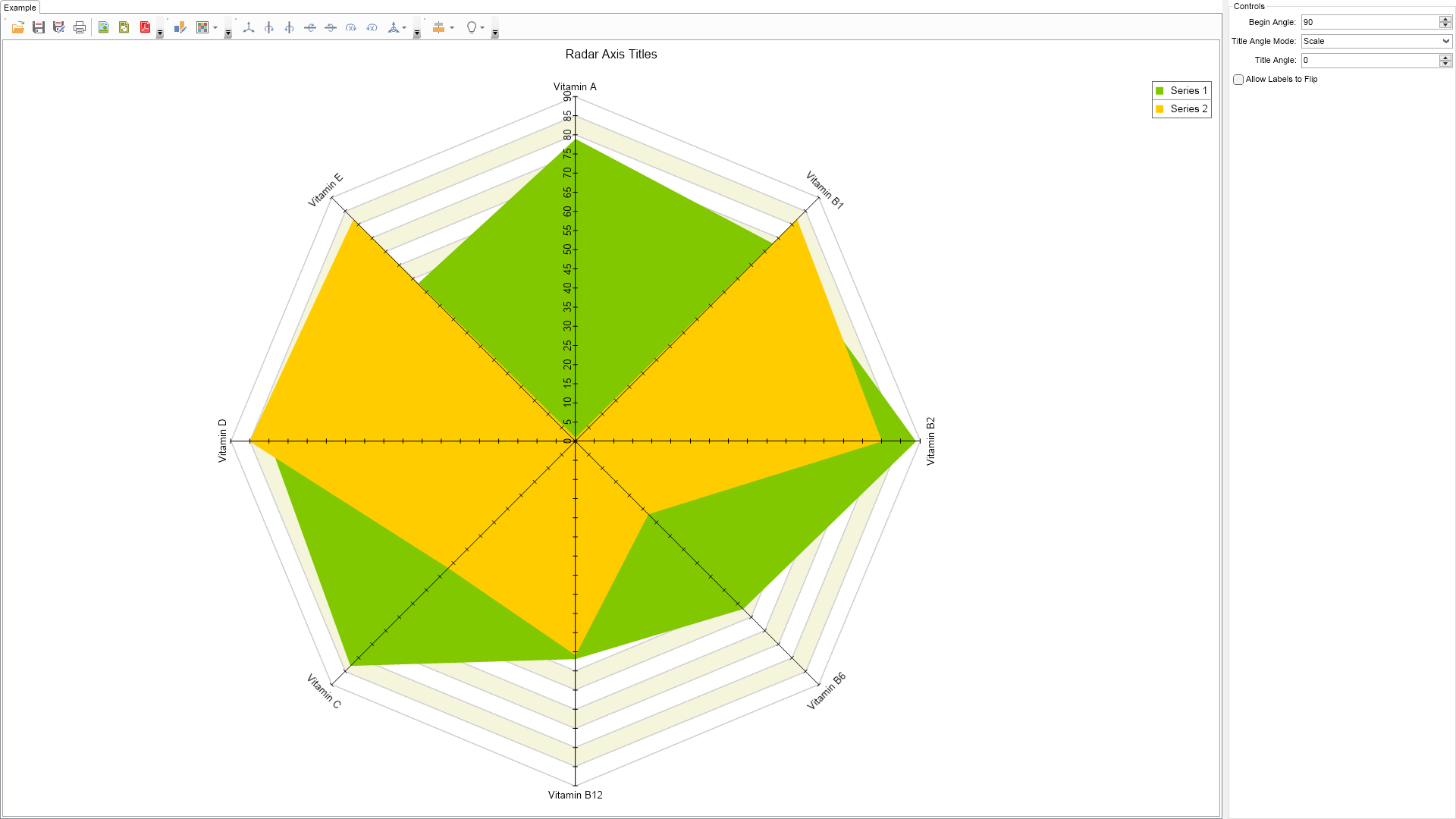
using Nevron.Nov;
using Nevron.Nov.Chart;
using Nevron.Nov.Dom;
using Nevron.Nov.Graphics;
using Nevron.Nov.Layout;
using Nevron.Nov.UI;
using Nevron.Nov.Windows.Forms;
using System;
using System.Windows.Forms;
namespace NovWinFormsProject
{
public partial class Form1 : Form
{
#region Constructors
public Form1()
{
InitializeComponent();
// Set form title
Text = "NOV WinForms - NRadarAxisTitlesExample";
// Create the NOV example and its controls
NWidget exampleContent = CreateExampleContent();
NWidget exampleControls = CreateExampleControls();
if (exampleControls != null)
{
exampleControls.PreferredWidth = 300;
}
// Place the example and its controls in a pair box
NPairBox pairBox = new NPairBox(exampleContent, exampleControls);
pairBox.FillMode = ENStackFillMode.First;
pairBox.FitMode = ENStackFitMode.First;
pairBox.Margins = new NMargins(NDesign.HorizontalSpacing, NDesign.VerticalSpacing);
// Host the example in the form
NNovWidgetHost host = new NNovWidgetHost(pairBox);
host.Dock = DockStyle.Fill;
Controls.Add(host);
}
#endregion
#region Example
public NWidget CreateExampleContent()
{
NChartViewWithCommandBars chartViewWithCommandBars = new NChartViewWithCommandBars();
NChartView chartView = chartViewWithCommandBars.View;
chartView.Surface.CreatePredefinedChart(ENPredefinedChartType.Radar);
// configure title
chartView.Surface.Titles[0].Text = "Radar Axis Titles";
// configure chart
m_Chart = (NRadarChart)chartView.Surface.Charts[0];
AddAxis("Vitamin A");
AddAxis("Vitamin B1");
AddAxis("Vitamin B2");
AddAxis("Vitamin B6");
AddAxis("Vitamin B12");
AddAxis("Vitamin C");
AddAxis("Vitamin D");
AddAxis("Vitamin E");
NLinearScale radarScale = (NLinearScale)m_Chart.Axes[0].Scale;
radarScale.MajorGridLines.Visible = true;
NScaleStrip strip = new NScaleStrip(new NColorFill(ENNamedColor.Beige), null, true, 0, 0, 1, 1);
strip.Interlaced = true;
radarScale.Strips.Add(strip);
// create the radar series
m_RadarArea1 = new NRadarAreaSeries();
m_Chart.Series.Add(m_RadarArea1);
m_RadarArea1.Name = "Series 1";
m_RadarArea1.DataLabelStyle = new NDataLabelStyle(false);
m_RadarArea1.DataLabelStyle.Format = "";
m_RadarArea2 = new NRadarAreaSeries();
m_Chart.Series.Add(m_RadarArea2);
m_RadarArea2.Name = "Series 2";
m_RadarArea2.DataLabelStyle = new NDataLabelStyle(false);
// fill random data
Random random = new Random();
for (int i = 0; i < 8; i++)
{
m_RadarArea1.DataPoints.Add(new NRadarAreaDataPoint(random.Next(50, 90)));
m_RadarArea2.DataPoints.Add(new NRadarAreaDataPoint(random.Next(0, 100)));
}
chartView.Document.StyleSheets.ApplyTheme(new NChartTheme(ENChartPalette.Bright, ENChartPaletteTarget.Series));
return chartViewWithCommandBars;
}
public NWidget CreateExampleControls()
{
NStackPanel stack = new NStackPanel();
NUniSizeBoxGroup group = new NUniSizeBoxGroup(stack);
NNumericUpDown beginAngleUpDown = new NNumericUpDown();
beginAngleUpDown.ValueChanged += OnBeginAngleUpDownValueChanged;
beginAngleUpDown.Value = 90;
stack.Add(NPairBox.Create("Begin Angle:", beginAngleUpDown));
NComboBox titleAngleModeComboBox = new NComboBox();
titleAngleModeComboBox.Items.FillFromEnum();
titleAngleModeComboBox.SelectedIndexChanged += OnTitleAngleModeComboBoxSelectedIndexChanged;
titleAngleModeComboBox.SelectedIndex = (int)ENScaleLabelAngleMode.Scale;
stack.Add(NPairBox.Create("Title Angle Mode:", titleAngleModeComboBox));
NNumericUpDown titleAngleUpDown = new NNumericUpDown();
titleAngleUpDown.ValueChanged += OnTitleAngleUpDownValueChanged;
titleAngleUpDown.Value = 0;
stack.Add(NPairBox.Create("Title Angle:", titleAngleUpDown));
NCheckBox allowLabelsToFlipCheckBox = new NCheckBox("Allow Labels to Flip");
allowLabelsToFlipCheckBox.CheckedChanged += OnAllowLabelsToFlipCheckBoxCheckedChanged;
allowLabelsToFlipCheckBox.Checked = false;
stack.Add(allowLabelsToFlipCheckBox);
return group;
}
public string GetExampleDescription()
{
return @"This example demonstrates how to set radar axis titles.
";
}
///
/// Gets the relevant documentation links for the example
///
///
public (string Name, string Url)[] GetDocumentationUrls()
{
return new[]
{
("Radar Axes", "https://www.nevron.com/docs/openvision/radar-chart-axes.html"),
("Scale Title", "https://www.nevron.com/docs/openvision/scale-title.html"),
("Radar Chart", "https://www.nevron.com/docs/openvision/radar-chart.html"),
};
}
#endregion
#region Implementation
private void AddAxis(string title)
{
NRadarAxis axis = new NRadarAxis();
// set title
axis.Title = title;
// axis.TitleTextStyle.TextFormat = TextFormat.XML;
// setup scale
NLinearScale linearScale = (NLinearScale)axis.Scale;
if (m_Chart.Axes.Count == 0)
{
// if the first axis then configure grid style and stripes
linearScale.MajorGridLines.Stroke = new NStroke(1, NColor.Gainsboro, ENDashStyle.Dot);
// add interlaced stripe
NScaleStrip strip = new NScaleStrip();
strip.Fill = new NColorFill(NColor.FromRGBA(200, 200, 200, 64));
strip.Interlaced = true;
linearScale.Strips.Add(strip);
}
else
{
// hide labels
linearScale.Labels.Visible = false;
}
m_Chart.Axes.Add(axis);
}
#endregion
#region Event Handlers
void OnBeginAngleUpDownValueChanged(NValueChangeEventArgs arg)
{
m_Chart.BeginAngle = new NAngle(((NNumericUpDown)arg.TargetNode).Value, NUnit.Degree);
}
void OnTitleAngleModeComboBoxSelectedIndexChanged(NValueChangeEventArgs arg)
{
for (int i = 0; i < m_Chart.Axes.Count; i++)
{
NScaleLabelAngle oldTitleAngle = m_Chart.Axes[i].TitleAngle;
m_Chart.Axes[i].TitleAngle = new NScaleLabelAngle((ENScaleLabelAngleMode)((NComboBox)arg.TargetNode).SelectedIndex, oldTitleAngle.CustomAngle);
}
}
void OnTitleAngleUpDownValueChanged(NValueChangeEventArgs arg)
{
for (int i = 0; i < m_Chart.Axes.Count; i++)
{
NScaleLabelAngle oldTitleAngle = m_Chart.Axes[i].TitleAngle;
m_Chart.Axes[i].TitleAngle = new NScaleLabelAngle(oldTitleAngle.LabelAngleMode, ((NNumericUpDown)arg.TargetNode).Value);
}
}
void OnAllowLabelsToFlipCheckBoxCheckedChanged(NValueChangeEventArgs arg)
{
for (int i = 0; i < m_Chart.Axes.Count; i++)
{
NScaleLabelAngle titleAngle = m_Chart.Axes[i].TitleAngle;
titleAngle.AllowTextFlip = ((NCheckBox)arg.TargetNode).Checked;
m_Chart.Axes[i].TitleAngle = titleAngle;
}
}
#endregion
#region Fields
NRadarChart m_Chart;
NRadarAreaSeries m_RadarArea1;
NRadarAreaSeries m_RadarArea2;
#endregion
#region Static Methods
#endregion
#region Constants
#endregion
#region Nested Types
#endregion
}
}

 Chart for .NET
 Diagram for .NET
 User Interface for .NET
 Vision for SSRS
 Chart for SSRS
 Gauge for SSRS
 Map for SSRS
 Barcode for SSRS
 Vision for SharePoint
 Chart for SharePoint
 Gauge for SharePoint
 Map for SharePoint
 Barcode for SharePoint
 Open Vision for .NET


 Vision for .NET