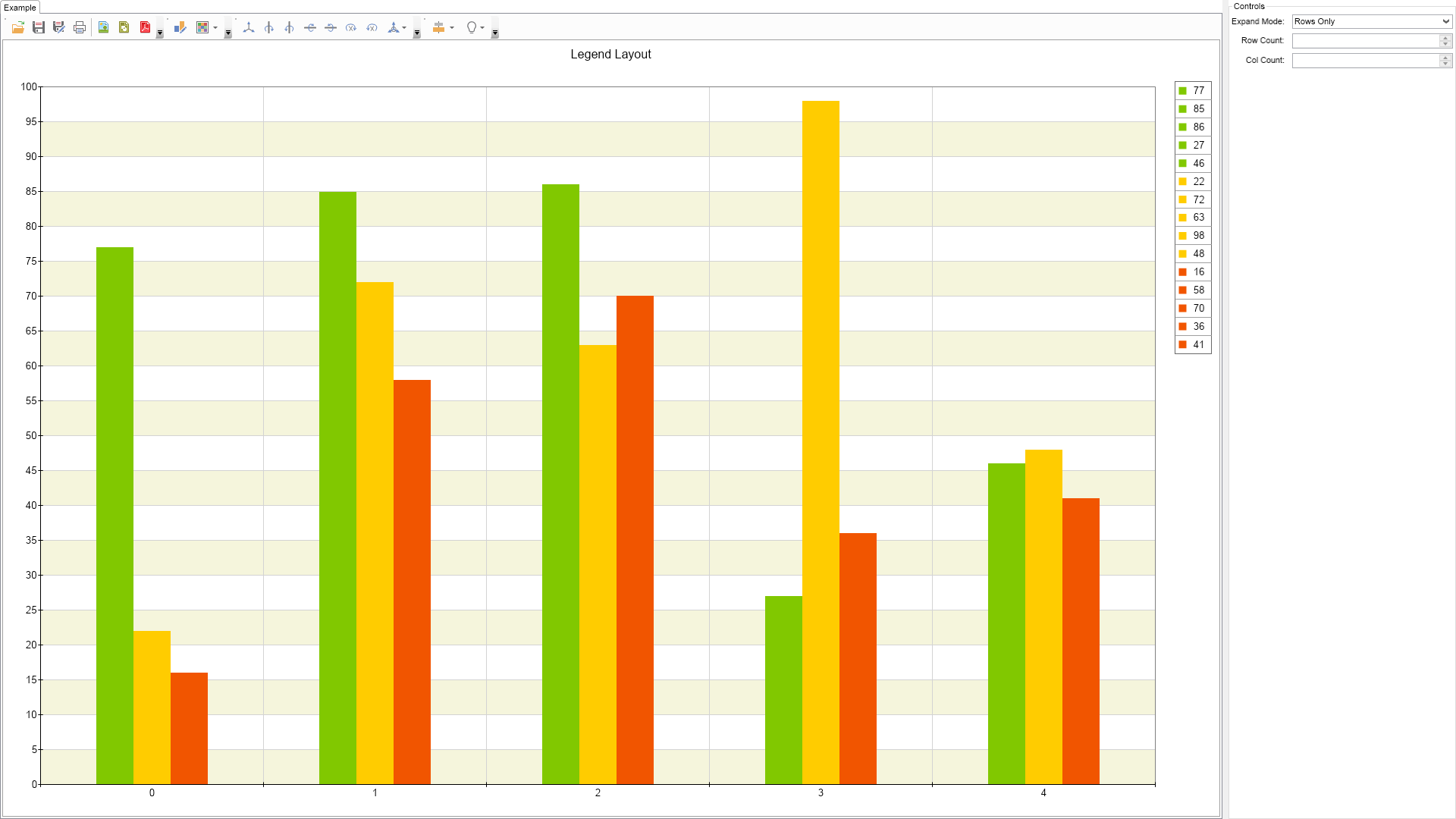
This example demonstrates different settings related to legend layout.

| Language: C# |
using Nevron.Nov;
using Nevron.Nov.Chart;
using Nevron.Nov.Dom;
using Nevron.Nov.Graphics;
using Nevron.Nov.Layout;
using Nevron.Nov.UI;
using Nevron.Nov.Windows.Forms;
using System;
using System.Windows.Forms;
namespace NovWinFormsProject
{
public partial class Form1 : Form
{
#region Constructors
public Form1()
{
InitializeComponent();
// Set form title
Text = "NOV WinForms - NLegendLayoutExample";
// Create the NOV example and its controls
NWidget exampleContent = CreateExampleContent();
NWidget exampleControls = CreateExampleControls();
if (exampleControls != null)
{
exampleControls.PreferredWidth = 300;
}
// Place the example and its controls in a pair box
NPairBox pairBox = new NPairBox(exampleContent, exampleControls);
pairBox.FillMode = ENStackFillMode.First;
pairBox.FitMode = ENStackFitMode.First;
pairBox.Margins = new NMargins(NDesign.HorizontalSpacing, NDesign.VerticalSpacing);
// Host the example in the form
NNovWidgetHost host = new NNovWidgetHost(pairBox);
host.Dock = DockStyle.Fill;
Controls.Add(host);
}
#endregion
#region Example
public NWidget CreateExampleContent()
{
NChartViewWithCommandBars chartViewWithCommandBars = new NChartViewWithCommandBars();
m_ChartView = chartViewWithCommandBars.View;
m_ChartView.Surface.CreatePredefinedChart(ENPredefinedChartType.Cartesian);
// configure title
m_ChartView.Surface.Titles[0].Text = "Legend Layout";
// configure chart
NCartesianChart chart = (NCartesianChart)m_ChartView.Surface.Charts[0];
// add interlace stripe
NLinearScale linearScale = chart.Axes[ENCartesianAxis.PrimaryY].Scale as NLinearScale;
NScaleStrip strip = new NScaleStrip(new NColorFill(ENNamedColor.Beige), null, true, 0, 0, 1, 1);
strip.Interlaced = true;
linearScale.Strips.Add(strip);
// add a bar series
NBarSeries bar1 = new NBarSeries();
bar1.Name = "Bar1";
bar1.MultiBarMode = ENMultiBarMode.Series;
bar1.LegendView.Mode = ENSeriesLegendMode.DataPoints;
bar1.DataLabelStyle = new NDataLabelStyle(false);
bar1.ValueFormatter = new NNumericValueFormatter("0.###");
chart.Series.Add(bar1);
// add another bar series
NBarSeries bar2 = new NBarSeries();
bar2.Name = "Bar2";
bar2.MultiBarMode = ENMultiBarMode.Clustered;
bar2.LegendView.Mode = ENSeriesLegendMode.DataPoints;
bar2.DataLabelStyle = new NDataLabelStyle(false);
bar2.ValueFormatter = new NNumericValueFormatter("0.###");
chart.Series.Add(bar2);
// add another bar series
NBarSeries bar3 = new NBarSeries();
bar3.Name = "Bar2";
bar3.MultiBarMode = ENMultiBarMode.Clustered;
bar3.LegendView.Mode = ENSeriesLegendMode.DataPoints;
bar3.DataLabelStyle = new NDataLabelStyle(false);
bar3.ValueFormatter = new NNumericValueFormatter("0.###");
chart.Series.Add(bar3);
Random random = new Random();
for (int i = 0; i < 5; i++)
{
bar1.DataPoints.Add(new NBarDataPoint(random.Next(10, 100)));
bar2.DataPoints.Add(new NBarDataPoint(random.Next(10, 100)));
bar3.DataPoints.Add(new NBarDataPoint(random.Next(10, 100)));
}
m_ChartView.Document.StyleSheets.ApplyTheme(new NChartTheme(ENChartPalette.Bright, ENChartPaletteTarget.Series));
return chartViewWithCommandBars;
}
public NWidget CreateExampleControls()
{
NStackPanel stack = new NStackPanel();
NUniSizeBoxGroup boxGroup = new NUniSizeBoxGroup(stack);
NComboBox legendExpandModeComboBox = new NComboBox();
legendExpandModeComboBox.Items.FillFromEnum();
legendExpandModeComboBox.SelectedIndexChanged += OnLegendExpandModeComboBoxSelectedIndexChanged;
stack.Add(NPairBox.Create("Expand Mode: ", legendExpandModeComboBox));
m_RowCountUpDown = new NNumericUpDown();
m_RowCountUpDown.Enabled = false;
m_RowCountUpDown.Minimum = 1;
m_RowCountUpDown.Value = 1;
m_RowCountUpDown.ValueChanged += OnRowCountUpDownValueChanged;
stack.Add(NPairBox.Create("Row Count: ", m_RowCountUpDown));
m_ColCountUpDown = new NNumericUpDown();
m_ColCountUpDown.Enabled = false;
m_ColCountUpDown.Minimum = 1;
m_ColCountUpDown.Value = 1;
m_ColCountUpDown.ValueChanged += OnColCountUpDownValueChanged;
stack.Add(NPairBox.Create("Col Count: ", m_ColCountUpDown));
legendExpandModeComboBox.SelectedIndex = (int)ENLegendExpandMode.RowsOnly;
return boxGroup;
}
public string GetExampleDescription()
{
return @"This example demonstrates different settings related to legend layout.
";
}
///
/// Gets the relevant documentation links for the example
///
///
public (string Name, string Url)[] GetDocumentationUrls()
{
return new[]
{
("Legend Layout", "https://www.nevron.com/docs/openvision/chart-legend-layout.html"),
("Overview", "https://www.nevron.com/docs/openvision/chart-legeng-overview.html"),
};
}
#endregion
#region Implementation
#endregion
#region Event Handlers
void OnRowCountUpDownValueChanged(NValueChangeEventArgs arg)
{
m_ChartView.Surface.Legends[0].RowCount = (int)((NNumericUpDown)arg.TargetNode).Value;
}
void OnColCountUpDownValueChanged(NValueChangeEventArgs arg)
{
m_ChartView.Surface.Legends[0].ColCount = (int)((NNumericUpDown)arg.TargetNode).Value;
}
void OnLegendExpandModeComboBoxSelectedIndexChanged(NValueChangeEventArgs arg)
{
m_ChartView.Surface.Legends[0].ExpandMode = (ENLegendExpandMode)(((NComboBox)arg.TargetNode).SelectedIndex);
switch (m_ChartView.Surface.Legends[0].ExpandMode)
{
case ENLegendExpandMode.ColsFixed:
m_ColCountUpDown.Enabled = true;
m_RowCountUpDown.Enabled = false;
break;
case ENLegendExpandMode.RowsFixed:
m_ColCountUpDown.Enabled = false;
m_RowCountUpDown.Enabled = true;
break;
default:
m_ColCountUpDown.Enabled = false;
m_RowCountUpDown.Enabled = false;
break;
}
}
#endregion
#region Fields
private NChartView m_ChartView;
private NNumericUpDown m_ColCountUpDown;
private NNumericUpDown m_RowCountUpDown;
#endregion
#region Static Methods
#endregion
#region Constants
#endregion
#region Nested Types
#endregion
}
}