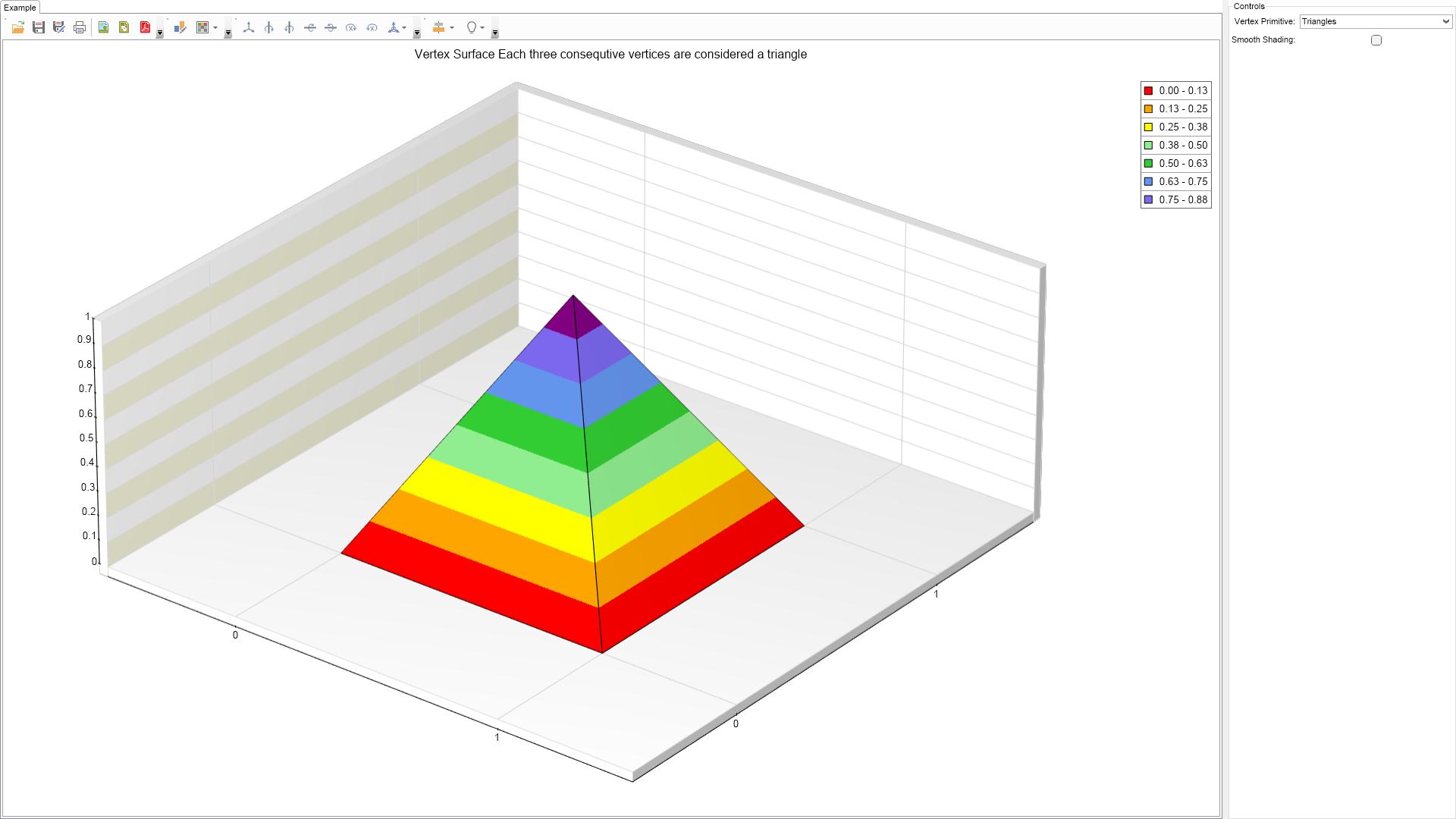
using Nevron.Nov;
using Nevron.Nov.Chart;
using Nevron.Nov.Chart.Tools;
using Nevron.Nov.Dom;
using Nevron.Nov.Graphics;
using Nevron.Nov.Layout;
using Nevron.Nov.UI;
using Nevron.Nov.Windows.Forms;
using System;
using System.Windows.Forms;
namespace NovWinFormsProject
{
public partial class Form1 : Form
{
#region Constructors
public Form1()
{
InitializeComponent();
// Set form title
Text = "NOV WinForms - NVertexSurfaceExample";
// Create the NOV example and its controls
NWidget exampleContent = CreateExampleContent();
NWidget exampleControls = CreateExampleControls();
if (exampleControls != null)
{
exampleControls.PreferredWidth = 300;
}
// Place the example and its controls in a pair box
NPairBox pairBox = new NPairBox(exampleContent, exampleControls);
pairBox.FillMode = ENStackFillMode.First;
pairBox.FitMode = ENStackFitMode.First;
pairBox.Margins = new NMargins(NDesign.HorizontalSpacing, NDesign.VerticalSpacing);
// Host the example in the form
NNovWidgetHost host = new NNovWidgetHost(pairBox);
host.Dock = DockStyle.Fill;
Controls.Add(host);
}
#endregion
#region Example
public NWidget CreateExampleContent()
{
NChartViewWithCommandBars chartViewWithCommandBars = new NChartViewWithCommandBars();
NChartView chartView = chartViewWithCommandBars.View;
chartView.Surface.CreatePredefinedChart(ENPredefinedChartType.Cartesian);
// configure title
m_Label = chartView.Surface.Titles[0];
chartView.Surface.Titles[0].Text = "Vertex Surface Series";
// setup chart
NCartesianChart chart = (NCartesianChart)chartView.Surface.Charts[0];
chart.Enable3D = true;
chart.ModelWidth = 60.0f;
chart.ModelDepth = 60.0f;
chart.ModelHeight = 25.0f;
chart.Projection.SetPredefinedProjection(ENPredefinedProjection.PerspectiveTilted);
chart.LightModel.SetPredefinedLightModel(ENPredefinedLightModel.ShinyTopLeft);
chart.Interactor = new NInteractor(new NTrackballTool());
NLinearScale scaleY = (NLinearScale)chart.Axes[ENCartesianAxis.PrimaryY].Scale;
scaleY.ViewRangeInflateMode = ENScaleViewRangeInflateMode.None;
// add interlace stripe to the Y axis
NScaleStrip stripStyleY = new NScaleStrip(new NColorFill(NColor.Beige), null, true, 0, 0, 1, 1);
stripStyleY.Interlaced = true;
stripStyleY.SetShowAtWall(ENChartWall.Back, true);
stripStyleY.SetShowAtWall(ENChartWall.Left, true);
scaleY.Strips.Add(stripStyleY);
// setup axes
NOrdinalScale scaleX = (NOrdinalScale)chart.Axes[ENCartesianAxis.PrimaryX].Scale;
scaleX.MajorGridLines.SetShowAtWall(ENChartWall.Bottom, true);
scaleX.MajorGridLines.SetShowAtWall(ENChartWall.Back, true);
scaleX.DisplayDataPointsBetweenTicks = false;
NOrdinalScale scaleZ = (NOrdinalScale)chart.Axes[ENCartesianAxis.Depth].Scale;
scaleZ.MajorGridLines.SetShowAtWall(ENChartWall.Bottom, true);
scaleZ.MajorGridLines.SetShowAtWall(ENChartWall.Left, true);
scaleZ.DisplayDataPointsBetweenTicks = false;
// add the surface series
m_Surface = new NVertexSurfaceSeries();
chart.Series.Add(m_Surface);
m_Surface.Name = "Surface";
m_Surface.LegendView.Mode = ENSeriesLegendMode.SeriesLogic;
m_Surface.FlatPositionValue = 10.0;
m_Surface.Palette.InterpolateColors = false;
m_Surface.ValueFormatter = new NNumericValueFormatter("0.00");
m_Surface.Fill = new NColorFill(NColor.YellowGreen);
m_Surface.FillColorMode = ENColorMode.Zone;
m_Surface.ShowFrame = true;
m_Surface.FrameMode = ENSurfaceFrameMode.Contour;
m_Surface.FrameColorMode = ENColorMode.Uniform;
m_Surface.ShadingMode = ENShadingMode.Smooth;
return chartViewWithCommandBars;
}
public NWidget CreateExampleControls()
{
NStackPanel stack = new NStackPanel();
NUniSizeBoxGroup group = new NUniSizeBoxGroup(stack);
NComboBox vertexPrimitiveCombo = new NComboBox();
vertexPrimitiveCombo.Items.FillFromEnum();
vertexPrimitiveCombo.SelectedIndexChanged += OnVertexPrimitiveComboSelectedIndexChanged;
vertexPrimitiveCombo.SelectedIndex = (int)m_Surface.VertexPrimitive;
stack.Add(NPairBox.Create("Vertex Primitive:", vertexPrimitiveCombo));
NCheckBox smoothShadingCheckBox = new NCheckBox();
smoothShadingCheckBox.CheckedChanged += OnSmoothShadingCheckBoxCheckedChanged;
stack.Add(NPairBox.Create("Smooth Shading:", smoothShadingCheckBox));
return group;
}
private void OnSmoothShadingCheckBoxCheckedChanged(NValueChangeEventArgs arg)
{
m_Surface.ShadingMode = (bool)arg.NewValue ? ENShadingMode.Smooth : ENShadingMode.Flat;
}
private void OnVertexPrimitiveComboSelectedIndexChanged(NValueChangeEventArgs arg)
{
m_Surface.VertexPrimitive = (ENVertexPrimitive)arg.NewValue;
m_Surface.UseIndices = false;
Random rand = new Random();
string descriptionText = string.Empty;
m_Surface.Data.Clear();
switch (m_Surface.VertexPrimitive)
{
case ENVertexPrimitive.Points:
{
descriptionText = "Each vertex represents a 3d point";
m_Surface.FrameMode = ENSurfaceFrameMode.Dots;
for (int i = 0; i < 10000; i++)
{
m_Surface.Data.AddValue(rand.Next(100),
rand.Next(100),
rand.Next(100));
}
}
break;
case ENVertexPrimitive.Lines:
{
descriptionText = "Each consecutive pair of vertices represents a line segment";
m_Surface.FrameMode = ENSurfaceFrameMode.Dots;
for (int i = 0; i < 200; i++)
{
m_Surface.Data.AddValue(rand.Next(100),
rand.Next(100),
rand.Next(100));
m_Surface.Data.AddValue(rand.Next(100),
rand.Next(100),
rand.Next(100));
}
}
break;
case ENVertexPrimitive.LineLoop:
case ENVertexPrimitive.LineStrip:
{
descriptionText = "Adjacent vertices are connected with a line segment";
for (int i = 0; i < 5; i++)
{
m_Surface.Data.AddValue(rand.Next(100),
rand.Next(100),
rand.Next(100));
}
}
break;
case ENVertexPrimitive.Triangles:
{
descriptionText = "Each three consequtive vertices are considered a triangle";
m_Surface.FrameMode = ENSurfaceFrameMode.Mesh;
NVector3DD top = new NVector3DD(0.5, 1, 0.5);
NVector3DD baseA = new NVector3DD(0, 0, 0);
NVector3DD baseB = new NVector3DD(1, 0, 0);
NVector3DD baseC = new NVector3DD(1, 0, 1);
NVector3DD baseD = new NVector3DD(0, 0, 1);
m_Surface.Data.AddValue(top);
m_Surface.Data.AddValue(baseA);
m_Surface.Data.AddValue(baseB);
m_Surface.Data.AddValue(top);
m_Surface.Data.AddValue(baseB);
m_Surface.Data.AddValue(baseC);
m_Surface.Data.AddValue(top);
m_Surface.Data.AddValue(baseC);
m_Surface.Data.AddValue(baseD);
m_Surface.Data.AddValue(top);
m_Surface.Data.AddValue(baseD);
m_Surface.Data.AddValue(baseA);
}
break;
case ENVertexPrimitive.TriangleStrip:
{
descriptionText = "A series of connected triangles that share common vertices";
m_Surface.FrameMode = ENSurfaceFrameMode.Mesh;
NVector3DD A = new NVector3DD(0, 0, 0);
NVector3DD B = new NVector3DD(1, 0, 0);
NVector3DD C = new NVector3DD(0, 1, 1);
NVector3DD D = new NVector3DD(1, 1, 1);
m_Surface.Data.AddValue(A);
m_Surface.Data.AddValue(B);
m_Surface.Data.AddValue(C);
m_Surface.Data.AddValue(D);
}
break;
case ENVertexPrimitive.TriangleFan:
{
descriptionText = "A series of connected triangles that share a common vertex";
m_Surface.FrameMode = ENSurfaceFrameMode.Mesh;
m_Surface.Data.AddValue(0, 100, 0);
int steps = 10;
for (int i = 0; i < 3000; i++)
{
double angle = i * 2 * Math.PI / steps;
m_Surface.Data.AddValue(Math.Cos(angle) * 100,
0,
Math.Sin(angle) * 100);
}
}
break;
case ENVertexPrimitive.Quads:
{
descriptionText = "Each for consecutive vertices form a quad";
m_Surface.FrameMode = ENSurfaceFrameMode.Mesh;
m_Surface.FillColorMode = ENColorMode.Zone;
NVector3DD A = new NVector3DD(0, 0, 0);
NVector3DD B = new NVector3DD(1, 0, 0);
NVector3DD C = new NVector3DD(0, 1, 1);
NVector3DD D = new NVector3DD(1, 1, 1);
m_Surface.Data.AddValue(A);
m_Surface.Data.AddValue(B);
m_Surface.Data.AddValue(D);
m_Surface.Data.AddValue(C);
}
break;
case ENVertexPrimitive.QuadStrip:
{
descriptionText = "A series of connected quads that share common vertices";
m_Surface.FrameMode = ENSurfaceFrameMode.Mesh;
m_Surface.FillColorMode = ENColorMode.Zone;
NVector3DD A = new NVector3DD(0, 0, 0);
NVector3DD B = new NVector3DD(1, 0, 0);
NVector3DD C = new NVector3DD(0, 1, 1);
NVector3DD D = new NVector3DD(1, 1, 1);
NVector3DD E = new NVector3DD(0, 2, 2);
NVector3DD F = new NVector3DD(1, 2, 2);
m_Surface.Data.AddValue(A);
m_Surface.Data.AddValue(B);
m_Surface.Data.AddValue(C);
m_Surface.Data.AddValue(D);
m_Surface.Data.AddValue(E);
m_Surface.Data.AddValue(F);
}
break;
}
m_Label.Text = "Vertex Surface " + descriptionText;
}
///
///
///
///
public string GetExampleDescription()
{
return @"This example demonstrates the capabilities of the Vertex Surface Series, which allows you to plot arbitrary OpenGL primitives such as lines, quads, triangles, and more.
";
}
///
/// Gets the relevant documentation links for the example
///
///
public (string Name, string Url)[] GetDocumentationUrls()
{
return new[]
{
("Vertex Surface Series", "https://www.nevron.com/docs/openvision/vertex-surface-chart-series.html"),
("Surface Series Overview", "https://www.nevron.com/docs/openvision/surface-chart-series-overview.html"),
("3D Charts", "https://www.nevron.com/docs/openvision/3d-charts.html"),
("chart-palettes", "https://www.nevron.com/docs/openvision/chart-palettes.html"),
};
}
#endregion
#region Implementation
#endregion
#region Event Handlers
#endregion
#region Fields
NLabel m_Label;
NVertexSurfaceSeries m_Surface;
#endregion
#region Static Methods
#endregion
#region Constants
#endregion
#region Nested Types
#endregion
}
}

 Chart for .NET
 Diagram for .NET
 User Interface for .NET
 Vision for SSRS
 Chart for SSRS
 Gauge for SSRS
 Map for SSRS
 Barcode for SSRS
 Vision for SharePoint
 Chart for SharePoint
 Gauge for SharePoint
 Map for SharePoint
 Barcode for SharePoint
 Open Vision for .NET


 Vision for .NET