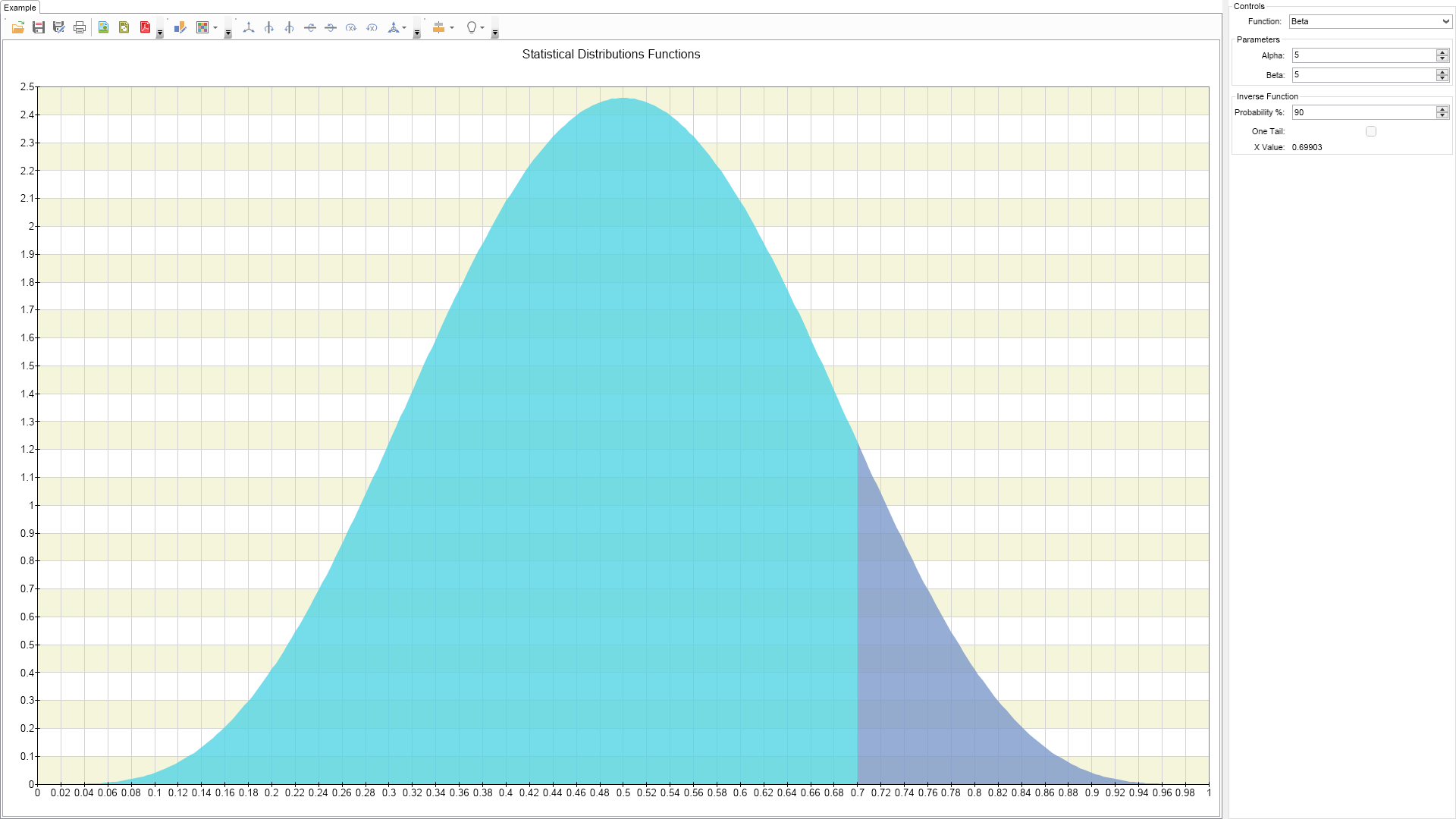
using Nevron.Nov;
using Nevron.Nov.Chart;
using Nevron.Nov.DataStructures;
using Nevron.Nov.Dom;
using Nevron.Nov.Formulas;
using Nevron.Nov.Graphics;
using Nevron.Nov.Layout;
using Nevron.Nov.UI;
using Nevron.Nov.Windows.Forms;
using System;
using System.Windows.Forms;
namespace NovWinFormsProject
{
public partial class Form1 : Form
{
#region Constructors
public Form1()
{
InitializeComponent();
// Set form title
Text = "NOV WinForms - NStatisticalDistributionsExample";
// Create the NOV example and its controls
NWidget exampleContent = CreateExampleContent();
NWidget exampleControls = CreateExampleControls();
if (exampleControls != null)
{
exampleControls.PreferredWidth = 300;
}
// Place the example and its controls in a pair box
NPairBox pairBox = new NPairBox(exampleContent, exampleControls);
pairBox.FillMode = ENStackFillMode.First;
pairBox.FitMode = ENStackFitMode.First;
pairBox.Margins = new NMargins(NDesign.HorizontalSpacing, NDesign.VerticalSpacing);
// Host the example in the form
NNovWidgetHost host = new NNovWidgetHost(pairBox);
host.Dock = DockStyle.Fill;
Controls.Add(host);
}
#endregion
#region Example
public NWidget CreateExampleContent()
{
NChartViewWithCommandBars chartViewWithCommandBars = new NChartViewWithCommandBars();
NChartView chartView = chartViewWithCommandBars.View;
chartView.Surface.CreatePredefinedChart(ENPredefinedChartType.Cartesian);
// configure title
chartView.Surface.Titles[0].Text = "Statistical Distributions Functions";
// configure chart
m_Chart = (NCartesianChart)chartView.Surface.Charts[0];
// add interlaced stripe for Y axis
NScaleStrip strip = new NScaleStrip(new NColorFill(NColor.Beige), null, true, 0, 0, 1, 1);
strip.Interlaced = true;
m_Chart.Axes[ENCartesianAxis.PrimaryY].Scale.Strips.Add(strip);
// hide legend
m_Chart.Legend.Mode = ENLegendMode.Disabled;
// create area series
m_DistributionArea = new NAreaSeries();
m_DistributionArea.Visible = false;
m_DistributionArea.Fill = new NColorFill(DefaultColor);
m_Chart.Series.Add(m_DistributionArea);
m_DistributionArea.UseXValues = true;
// create bar sereis
m_DistributionBars = new NBarSeries();
m_DistributionBars.Visible = false;
m_DistributionBars.Fill = new NColorFill(DefaultColor);
m_Chart.Series.Add(m_DistributionBars);
m_DistributionBars.UseXValues = false;
return chartViewWithCommandBars;
}
public NWidget CreateExampleControls()
{
NStackPanel stack = new NStackPanel();
NUniSizeBoxGroup boxGroup = new NUniSizeBoxGroup(stack);
// function combo
m_DistributionTypeComboBox = new NComboBox();
m_DistributionTypeComboBox.SelectedIndexChanged += (e) =>
{
RebuildParams();
FillDistribution();
};
stack.Add(NPairBox.Create("Function: ", m_DistributionTypeComboBox));
// parameters stack
m_ParamsStack = new NStackPanel();
stack.Add(new NGroupBox("Parameters", m_ParamsStack));
// inverse function
NStackPanel inverseStack = new NStackPanel();
m_InverseGroup = new NGroupBox("Inverse Function", inverseStack);
stack.Add(m_InverseGroup);
m_ProbabilityNUD = new NNumericUpDown();
m_ProbabilityNUD.Minimum = 1;
m_ProbabilityNUD.Maximum = 99;
m_ProbabilityNUD.Value = 90;
m_ProbabilityNUD.ValueChanged += (e) =>
{
SolveInverted();
};
inverseStack.Add(NPairBox.Create("Probability %: ", m_ProbabilityNUD));
// one tail check
m_OneTailCheckBox = new NCheckBox();
m_OneTailCheckBox.Checked = false;
m_OneTailCheckBox.CheckedChanged += (e) =>
{
SolveInverted();
};
inverseStack.Add(NPairBox.Create("One Tail: ", m_OneTailCheckBox));
// Result X Value label
m_XValueLabel = new NLabel();
inverseStack.Add(NPairBox.Create("X Value: ", m_XValueLabel));
// finally when all controls are created fill the distributions combo
m_DistributionTypeComboBox.Items.FillFromEnum();
m_DistributionTypeComboBox.SelectedIndex = (int)StatisticalDistribution.Beta;
return boxGroup;
}
public string GetExampleDescription()
{
return @"This example demonstrates statistical distribution formulas.
A statistical distribution, or probability distribution, describes how values are distributed for a field. In other words, the statistical distribution shows which values are common and uncommon.
The NOV NFormulaCalculator supports most of the statistical distribution functions used in Microsoft Excel. In this example we demonstrate how to use NOV Chart for .NET to display and analyze these functions.
";
}
///
/// Gets the relevant documentation links for the example
///
///
public (string Name, string Url)[] GetDocumentationUrls()
{
return new[]
{
("Chart Data Series", "https://www.nevron.com/docs/openvision/chart-data-series.html"),
("Statistical Functions", "https://www.nevron.com/docs/openvision/formula-statistical-functions.html"),
("Formulas Overview", "https://www.nevron.com/docs/openvision/formula-overview.html"),
("Array Functions", "https://www.nevron.com/docs/openvision/formula-array-functions.html"),
};
}
#endregion
#region Implementation
private void RebuildParams()
{
m_ParamsStack.Clear();
m_ParamToWidgetMap.Clear();
switch ((StatisticalDistribution)m_DistributionTypeComboBox.SelectedIndex)
{
case StatisticalDistribution.Beta:
AddNumberParameter("Alpha", 5, 1, 30, 0);
AddNumberParameter("Beta", 5, 1, 30, 0);
m_InverseGroup.Visibility = ENVisibility.Visible;
m_OneTailCheckBox.Enabled = false;
break;
case StatisticalDistribution.Binomial:
AddNumberParameter("Trials", 21, 10, 100, 0);
AddNumberParameter("Probability of Success", 0.6, 0, 1, 2);
m_InverseGroup.Visibility = ENVisibility.Collapsed;
break;
case StatisticalDistribution.ChiSquared:
AddNumberParameter("Degree of Freedom", 4, 1, 30, 0);
m_InverseGroup.Visibility = ENVisibility.Visible;
m_OneTailCheckBox.Enabled = false;
break;
case StatisticalDistribution.Exponential:
AddNumberParameter("Lambda", 1, 0, 4, 2);
m_InverseGroup.Visibility = ENVisibility.Visible;
m_OneTailCheckBox.Enabled = false;
break;
case StatisticalDistribution.F:
AddNumberParameter("Degree of Freedom 1", 4, 1, 30, 0);
AddNumberParameter("Degree of Freedom 2", 4, 1, 30, 0);
m_InverseGroup.Visibility = ENVisibility.Visible;
m_OneTailCheckBox.Enabled = false;
break;
case StatisticalDistribution.Gamma:
AddNumberParameter("Alpha", 2, 0.01, 4, 2);
AddNumberParameter("Beta", 1, 0.01, 4, 2);
m_InverseGroup.Visibility = ENVisibility.Visible;
m_OneTailCheckBox.Enabled = false;
break;
case StatisticalDistribution.Hypergeometric:
AddNumberParameter("Population Size", 200, 0, 100, 0);
AddNumberParameter("Success Size", 100, 0, 100, 0);
AddNumberParameter("Sample Size", 50, 0, 100, 0);
m_InverseGroup.Visibility = ENVisibility.Collapsed;
break;
case StatisticalDistribution.LogNormal:
AddNumberParameter("Mean", 0, -100, 100, 2);
AddNumberParameter("Standard Deviation", 1, 0, 100, 2);
m_InverseGroup.Visibility = ENVisibility.Visible;
m_OneTailCheckBox.Enabled = false;
break;
case StatisticalDistribution.NegativeBinomial:
AddNumberParameter("Successses", 50, 1, 100, 0);
AddNumberParameter("Probability of Success", 0.6, 0.01, 1, 2);
m_InverseGroup.Visibility = ENVisibility.Collapsed;
break;
case StatisticalDistribution.Normal:
m_InverseGroup.Visibility = ENVisibility.Visible;
m_OneTailCheckBox.Enabled = true;
break;
case StatisticalDistribution.Poisson:
AddNumberParameter("Mean", 10, 1, 100, 0);
m_InverseGroup.Visibility = ENVisibility.Collapsed;
break;
case StatisticalDistribution.T:
AddNumberParameter("Degree of Freedom", 4, 1, 30, 0);
m_InverseGroup.Visibility = ENVisibility.Visible;
m_OneTailCheckBox.Enabled = true;
break;
case StatisticalDistribution.Weilbull:
AddNumberParameter("Alpha", 2, 0.01, 10, 2);
AddNumberParameter("Beta", 5, 0.01, 10, 2);
m_InverseGroup.Visibility = ENVisibility.Collapsed;
break;
default:
break;
}
}
private void FillDistribution()
{
switch ((StatisticalDistribution)m_DistributionTypeComboBox.SelectedIndex)
{
case StatisticalDistribution.Beta:
FillBetaDistribution();
break;
case StatisticalDistribution.Binomial:
FillBinomialDistribution();
break;
case StatisticalDistribution.ChiSquared:
FillChiSquaredDistribution();
break;
case StatisticalDistribution.Exponential:
FillExponentialDistribution();
break;
case StatisticalDistribution.F:
FillFDistribution();
break;
case StatisticalDistribution.Gamma:
FillGammaDistribution();
break;
case StatisticalDistribution.Hypergeometric:
FillHypergeometricDistribution();
break;
case StatisticalDistribution.LogNormal:
FillLogNormalDistribution();
break;
case StatisticalDistribution.NegativeBinomial:
FillNegativeBinomialDistrubution();
break;
case StatisticalDistribution.Normal:
FillNormalDistribution();
break;
case StatisticalDistribution.Poisson:
FillPoissonDistribution();
break;
case StatisticalDistribution.T:
FillTDistribution();
break;
case StatisticalDistribution.Weilbull:
FillWeibullDistribution();
break;
default:
break;
}
}
private void SolveInverted()
{
switch ((StatisticalDistribution)m_DistributionTypeComboBox.SelectedItem.Tag)
{
case StatisticalDistribution.Beta:
SolveBetaInverted();
break;
case StatisticalDistribution.Binomial:
break;
case StatisticalDistribution.ChiSquared:
SolveChiSquaredInverted();
break;
case StatisticalDistribution.Exponential:
SolveExponentialInverted();
break;
case StatisticalDistribution.F:
SolveFInverted();
break;
case StatisticalDistribution.Gamma:
SolveGammaInverted();
break;
case StatisticalDistribution.Hypergeometric:
break;
case StatisticalDistribution.LogNormal:
SolveLogNormalInverted();
break;
case StatisticalDistribution.NegativeBinomial:
break;
case StatisticalDistribution.Normal:
SolveNormalInverted();
break;
case StatisticalDistribution.Poisson:
break;
case StatisticalDistribution.T:
SolveTInverted();
break;
case StatisticalDistribution.Weilbull:
break;
default:
break;
}
}
private void FillBetaDistribution()
{
// rebuild data points with values from the Beta-Distribution probability density function
NFormulaCalculator calculator = new NFormulaCalculator();
calculator.Formula = string.Format("BETADIST(x, alpha, beta, false)");
calculator.Variables["alpha"] = GetParameterValue("Alpha");
calculator.Variables["beta"] = GetParameterValue("Beta");
// rebuild data points
RebuildDistributionAreaDataPoints(calculator, 0, 1);
// solve inverted function
SolveBetaInverted();
}
private void SolveBetaInverted()
{
// Probability value
double probability = m_ProbabilityNUD.Value / 100;
// Calculate Inverse BETA distribution
NFormulaCalculator calculator = new NFormulaCalculator();
calculator.Formula = "BETAINV(probability, alpha, beta)";
calculator.Variables["probability"] = new NVariant(probability);
calculator.Variables["alpha"] = GetParameterValue("Alpha");
calculator.Variables["beta"] = GetParameterValue("Beta");
double x = calculator.Evaluate().ToDouble(null);
// update X result label
m_XValueLabel.Text = x.ToString("G5");
// highlight result
HighlightDataPoints(x, true);
}
private void FillBinomialDistribution()
{
// rebuild data points with values from the Beta-Distribution probability density function
NFormulaCalculator calculator = new NFormulaCalculator();
calculator.Formula = string.Format("BINOMDIST(x, trials, probability, false)");
calculator.Variables["trials"] = GetParameterValue("Trials");
calculator.Variables["probability"] = GetParameterValue("Probability of Success");
// rebuild data points
RebuildDistributionBarsDataPoints(calculator, 0, (int)GetParameterValue("Trials"));
}
private void FillChiSquaredDistribution()
{
// rebuild data points with values from the ChiSq-Distribution probability density function
NFormulaCalculator calculator = new NFormulaCalculator();
calculator.Formula = string.Format("CHISQDIST(x, dof, false)");
calculator.Variables["dof"] = GetParameterValue("Degree of Freedom");
// rebuild data points
RebuildDistributionAreaDataPoints(calculator, 0, 15);
// solve inverted function
SolveChiSquaredInverted();
}
private void SolveChiSquaredInverted()
{
// Probability value
double probability = m_ProbabilityNUD.Value / 100;
// Calculate Inverse ChiSquared distribution
NFormulaCalculator calculator = new NFormulaCalculator();
calculator.Formula = "CHISQINV(probability, dof)";
calculator.Variables["probability"] = new NVariant(probability);
calculator.Variables["dof"] = GetParameterValue("Degree of Freedom");
double x = calculator.Evaluate().ToDouble(null);
// update X result label
m_XValueLabel.Text = x.ToString("G5");
// highlight result
HighlightDataPoints(x, true);
}
private void FillExponentialDistribution()
{
// rebuild data points with values from the Exponent distribution probability density function
NFormulaCalculator calculator = new NFormulaCalculator();
calculator.Formula = string.Format("EXPONDIST(x, lambda, false)");
calculator.Variables["lambda"] = GetParameterValue("Lambda");
// rebuild data points
RebuildDistributionAreaDataPoints(calculator, 0, 5);
// solve inverted function
SolveExponentialInverted();
}
private void SolveExponentialInverted()
{
// get probability value
double probability = m_ProbabilityNUD.Value / 100;
// calculate Inverse Exponent distribution
NFormulaCalculator calculator = new NFormulaCalculator();
calculator.Formula = "EXPONINV(probability, lambda)";
calculator.Variables["probability"] = new NVariant(probability);
calculator.Variables["lambda"] = GetParameterValue("Lambda");
double x = calculator.Evaluate().ToDouble(null);
// update X result label
m_XValueLabel.Text = x.ToString("G5");
// highlight result
HighlightDataPoints(x, true);
}
private void FillFDistribution()
{
// rebuild data points with values from the F distribution probability density function, using the specified degrees of freedom
NFormulaCalculator calculator = new NFormulaCalculator();
calculator.Formula = "FDIST(x, dof1, dof2, false)";
calculator.Variables["dof1"] = GetParameterValue("Degree of Freedom 1");
calculator.Variables["dof2"] = GetParameterValue("Degree of Freedom 2");
// rebuild data points of distribution area
RebuildDistributionAreaDataPoints(calculator, 0, 15);
// solve inverted
SolveFInverted();
}
private void SolveFInverted()
{
// Probability value
double probability = m_ProbabilityNUD.Value / 100;
// Calculate Inverse F distribution
NFormulaCalculator calculator = new NFormulaCalculator();
calculator.Formula = "FINV(probability, dof1, dof1)";
calculator.Variables["probability"] = new NVariant(probability);
calculator.Variables["dof1"] = GetParameterValue("Degree of Freedom 1");
calculator.Variables["dof2"] = GetParameterValue("Degree of Freedom 2");
double x = calculator.Evaluate().ToDouble(null);
// update X result label
m_XValueLabel.Text = x.ToString("G5");
// highlight result
HighlightDataPoints(x, true);
}
private void FillGammaDistribution()
{
// rebuild data points with values from the Gamma-Distribution probability density function
NFormulaCalculator calculator = new NFormulaCalculator();
calculator.Formula = string.Format("GAMMADIST(x, alpha, beta, false)");
calculator.Variables["alpha"] = GetParameterValue("Alpha");
calculator.Variables["beta"] = GetParameterValue("Beta");
// rebuild data points
RebuildDistributionAreaDataPoints(calculator, 0, 15);
// solve inverted function
SolveGammaInverted();
}
private void SolveGammaInverted()
{
// Probability value
double probability = m_ProbabilityNUD.Value / 100;
// Calculate Inverse ChiSquared distribution
NFormulaCalculator calculator = new NFormulaCalculator();
calculator.Formula = "GAMMAINV(probability, alpha, beta)";
calculator.Variables["probability"] = new NVariant(probability);
calculator.Variables["alpha"] = GetParameterValue("Alpha");
calculator.Variables["beta"] = GetParameterValue("Beta");
double x = calculator.Evaluate().ToDouble(null);
// update X result label
m_XValueLabel.Text = x.ToString("G5");
// highlight result
HighlightDataPoints(x, true);
}
private void FillHypergeometricDistribution()
{
// rebuild data points with values from the Gamma-Distribution probability density function
NFormulaCalculator calculator = new NFormulaCalculator();
calculator.Formula = string.Format("HYPGEOMDIST(x, sampleSize, popSuccess, popSize, false)");
NVariant popSize = GetParameterValue("Population Size");
NVariant popSuccess = GetParameterValue("Success Size");
NVariant sampleSize = GetParameterValue("Sample Size");
calculator.Variables["popSize"] = popSize;
calculator.Variables["popSuccess"] = popSuccess;
calculator.Variables["sampleSize"] = sampleSize;
// rebuild data points
RebuildDistributionBarsDataPoints(calculator, 0, NMath.Min((int)sampleSize, (int)popSuccess, (int)popSize));
}
private void FillLogNormalDistribution()
{
NFormulaCalculator calculator = new NFormulaCalculator();
calculator.Formula = "LOGNORMDIST(x, mean, stdDev, false)";
calculator.Variables["mean"] = GetParameterValue("Mean");
calculator.Variables["stdDev"] = GetParameterValue("Standard Deviation");
// rebuild data points of distribution area
RebuildDistributionAreaDataPoints(calculator, 0, 12);
// solve inverted
SolveLogNormalInverted();
}
private void SolveLogNormalInverted()
{
// Probability value
double probability = m_ProbabilityNUD.Value / 100;
// solve the LOGNORMINV
NFormulaCalculator calculator = new NFormulaCalculator();
calculator.Formula = string.Format("LOGNORMINV(probability, mean, stdDev)");
calculator.Variables["probability"] = new NVariant(probability);
calculator.Variables["mean"] = GetParameterValue("Mean");
calculator.Variables["stdDev"] = GetParameterValue("Standard Deviation");
double x = calculator.Evaluate().ToDouble(null);
// update X result label
m_XValueLabel.Text = x.ToString("G5");
// highlight result
HighlightDataPoints(x, false);
}
private void FillNegativeBinomialDistrubution()
{
NFormulaCalculator calculator = new NFormulaCalculator();
calculator.Formula = "NEGBINOMDIST(x, number_s, probability_s, false)";
NVariant number_s = GetParameterValue("Successses");
calculator.Variables["number_s"] = number_s;
calculator.Variables["probability_s"] = GetParameterValue("Probability of Success");
// rebuild data points of distribution area
RebuildDistributionBarsDataPoints(calculator, 0, 100 + (int)number_s);
}
private void FillNormalDistribution()
{
// rebuild data points with values from the Standard Normal distribution (mean = 0, stdDev = 1)
NFormulaCalculator calculator = new NFormulaCalculator();
calculator.Formula = "NORMDIST(x, 0, 1, false)";
// rebuild data points of distribution area
RebuildDistributionAreaDataPoints(calculator, -5, 5);
// solve inverted
SolveNormalInverted();
}
private void SolveNormalInverted()
{
// One tailed normal distribution or two tails
bool oneTail = m_OneTailCheckBox.Checked;
// Probability value
double probability = m_ProbabilityNUD.Value / 100.0;
// for two-tail normal inversion -> calculate probability like this
if (!oneTail)
{
probability = (probability + 1.0) / 2.0;
}
// solve the NORM distribution invert function for the specified probability
NFormulaCalculator calculator = new NFormulaCalculator();
calculator.Formula = string.Format("NORMINV(probability, 0, 1)");
calculator.Variables["probability"] = new NVariant(probability);
double x = calculator.Evaluate().ToDouble(null);
// update X result label
m_XValueLabel.Text = x.ToString("G5");
// highlight result
HighlightDataPoints(x, oneTail);
}
private void FillPoissonDistribution()
{
// rebuild data points with values from the Poison Normal distribution
NFormulaCalculator calculator = new NFormulaCalculator();
calculator.Formula = "POISSONDIST(x, mean, false)";
calculator.Variables["mean"] = GetParameterValue("Mean");
// rebuild data points of distribution area
RebuildDistributionBarsDataPoints(calculator, 0, 40);
}
private void FillTDistribution()
{
// rebuild data points with values from the T-Distribution probability density function, using the specified Degree of Freedom
NFormulaCalculator calculator = new NFormulaCalculator();
calculator.Formula = string.Format("TDIST(x, dof, false)");
calculator.Variables["dof"] = GetParameterValue("Degree of Freedom");
// rebuild data points of distribution area
RebuildDistributionAreaDataPoints(calculator, -12, 12);
// solve inverted function
SolveTInverted();
}
private void SolveTInverted()
{
// One tailed normal distribution or two tails
bool oneTail = m_OneTailCheckBox.Checked;
// Probability value
double probability = m_ProbabilityNUD.Value / 100;
// determine the formula
string formula;
if (oneTail)
{
formula = "TINV(probability, dof)";
}
else
{
formula = "TINV2T(probability, dof)";
}
// Calculate Inverse T Distribution (Students Distribution)
NFormulaCalculator calculator = new NFormulaCalculator();
calculator.Formula = formula;
calculator.Variables["probability"] = new NVariant(probability);
calculator.Variables["dof"] = GetParameterValue("Degree of Freedom");
double x = calculator.Evaluate().ToDouble(null);
// update X result label
m_XValueLabel.Text = x.ToString("G5");
// highligh data points
HighlightDataPoints(x, oneTail);
}
private void FillWeibullDistribution()
{
// rebuild data points with values from the Weibull distribution
NFormulaCalculator calculator = new NFormulaCalculator();
calculator.Formula = "WEIBULLDIST(x, alpha, beta, false)";
calculator.Variables["alpha"] = GetParameterValue("Alpha");
calculator.Variables["beta"] = GetParameterValue("Beta");
// rebuild data points of distribution area
RebuildDistributionAreaDataPoints(calculator, 0, 20);
}
///
/// Rebuilds the data points of the m_DistributionArea
///
///
///
///
///
private void RebuildDistributionAreaDataPoints(NFormulaCalculator calculator, double xmin, double xmax)
{
// show area and hide bars
m_DistributionArea.Visible = true;
m_DistributionBars.Visible = false;
// switch X axis in linear scale
m_Chart.Axes[ENCartesianAxis.PrimaryX].Scale = new NLinearScale();
// clear data points
m_DistributionArea.DataPoints.Clear();
m_DistributionBars.DataPoints.Clear();
// we aim for 300 data points to make a smooth graph
double step = (xmax - xmin) / 300;
for (double x = xmin; x <= xmax; x += step)
{
// calculate y for the current x
calculator.Variables["x"] = new NVariant(x);
double y = (double)calculator.Evaluate();
// create new data point
NAreaDataPoint dataPoint = new NAreaDataPoint(x, y);
m_DistributionArea.DataPoints.Add(dataPoint);
}
}
///
/// Rebuilds the data points of the m_DistributionBars
///
///
///
///
///
private void RebuildDistributionBarsDataPoints(NFormulaCalculator calculator, int xmin, int xmax)
{
// show area and hide bars
m_DistributionArea.Visible = false;
m_DistributionBars.Visible = true;
// switch X axis in linear scale
m_Chart.Axes[ENCartesianAxis.PrimaryX].Scale = new NOrdinalScale();
// clear data points
m_DistributionArea.DataPoints.Clear();
m_DistributionBars.DataPoints.Clear();
// fill data poionts
for (int x = xmin; x <= xmax; x++)
{
// calculate y for the current x
calculator.Variables["x"] = new NVariant(x);
double y = (double)calculator.Evaluate();
// create new data point
NBarDataPoint dataPoint = new NBarDataPoint(x, y);
m_DistributionBars.DataPoints.Add(dataPoint);
}
}
///
/// Fills the m_DistributionArea data points with a color, that highlights its X location relative to the specified xValue.
///
///
///
private void HighlightDataPoints(double xValue, bool oneTail)
{
for (int i = 0; i < m_DistributionArea.DataPoints.Count; i++)
{
NAreaDataPoint point = m_DistributionArea.DataPoints[i];
if (oneTail)
{
if (xValue < point.X)
{
point.Fill = new NColorFill(SelectedColor);
}
else
{
point.Fill = new NColorFill(DeselectedColor);
}
}
else
{
if (xValue < Math.Abs(point.X))
{
point.Fill = new NColorFill(SelectedColor);
}
else
{
point.Fill = new NColorFill(DeselectedColor);
}
}
}
}
///
/// Adds a number parameter widget
///
///
///
///
///
///
private void AddNumberParameter(string paramName, double value, double min, double max, int decimalPlaces)
{
// add numeric up-down for the number parameters
NNumericUpDown nud = new NNumericUpDown();
nud.Minimum = min;
nud.Maximum = max;
nud.Value = value;
nud.DecimalPlaces = decimalPlaces;
if (decimalPlaces == 2)
{
nud.Step = 0.01;
}
else
{
nud.Step = 1;
}
nud.ValueChanged += (e) => { FillDistribution(); };
m_ParamsStack.Add(NPairBox.Create(paramName + ": ", nud));
// register in params map
m_ParamToWidgetMap.Add(paramName, nud);
}
///
/// Gets the value of a number parameter
///
///
///
private NVariant GetParameterValue(string paramName)
{
NWidget widget = m_ParamToWidgetMap[paramName];
if (widget is NNumericUpDown)
return new NVariant(((NNumericUpDown)widget).Value);
return NVariant.Empty;
}
#endregion
#region Event Handlers
#endregion
#region Fields
// chart elements
NCartesianChart m_Chart;
NAreaSeries m_DistributionArea;
NBarSeries m_DistributionBars;
// parameter ui controls for distribution function
NComboBox m_DistributionTypeComboBox;
NStackPanel m_ParamsStack;
NMap m_ParamToWidgetMap = new NMap();
// parameter ui controls for inverse function
NGroupBox m_InverseGroup;
NNumericUpDown m_ProbabilityNUD;
NCheckBox m_OneTailCheckBox;
NLabel m_XValueLabel;
#endregion
#region Static Methods
#endregion
#region Constants
#endregion
#region Nested Types
#endregion
}
}

 Chart for .NET
 Diagram for .NET
 User Interface for .NET
 Vision for SSRS
 Chart for SSRS
 Gauge for SSRS
 Map for SSRS
 Barcode for SSRS
 Vision for SharePoint
 Chart for SharePoint
 Gauge for SharePoint
 Map for SharePoint
 Barcode for SharePoint
 Open Vision for .NET


 Vision for .NET