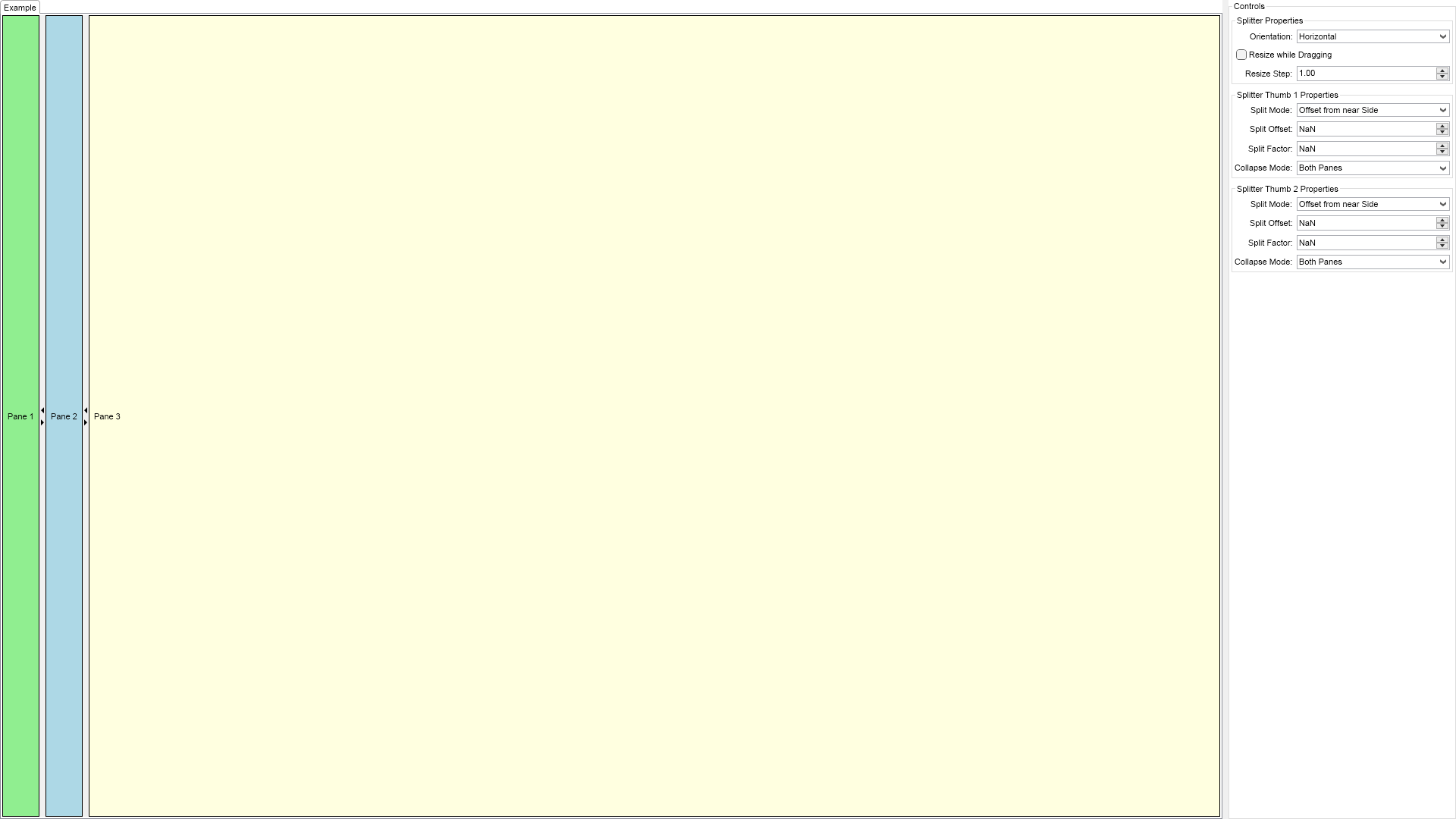
Multi Splitter Example for Blazor

Nevron NOV UserInterface for Blazor ships with hundreds of examples with full source code, as part of the Nevron Open Vision Suite. All Blazor UserInterface examples are also available as a stand-alone Visual Studio solution in C#, which you can download from the links below.

Multi Splitter Example for Blazor Description

This example demonstrates how to create and configure a multi splitter. The multi splitter is a widget that splits its content area into multiple resizable panes, which can be interactively resized with help of thumbs. Using the Orientation property you can specify whether the splitter is horizontal or vertical. To control how the splitter splits its content area you can use the SplitMode property.


Multi Splitter Example

C# Multi Splitter Example Code for Nevron UserInterface for Blazor
Language: C#

using Nevron.Nov;
using Nevron.Nov.DataStructures;
using Nevron.Nov.Dom;
using Nevron.Nov.Editors;
using Nevron.Nov.Graphics;
using Nevron.Nov.Layout;
using Nevron.Nov.Presentation;
using Nevron.Nov.UI;
using Nevron.Nov.Windows.Forms;
using System.Windows.Forms;

namespace NovWinFormsProject
{
	public partial class Form1 : Form
	{
		#region Constructors

		public Form1()
		{
			InitializeComponent();

			// Set form title
			Text = "NOV WinForms - NMultiSplitterExample";

			// Create the NOV example and its controls
			NWidget exampleContent = CreateExampleContent();
			NWidget exampleControls = CreateExampleControls();
			if (exampleControls != null)
			{
				exampleControls.PreferredWidth = 300;
			}

			// Place the example and its controls in a pair box
			NPairBox pairBox = new NPairBox(exampleContent, exampleControls);
			pairBox.FillMode = ENStackFillMode.First;
			pairBox.FitMode = ENStackFitMode.First;
			pairBox.Margins = new NMargins(NDesign.HorizontalSpacing, NDesign.VerticalSpacing);

			// Host the example in the form
			NNovWidgetHost host = new NNovWidgetHost(pairBox);
			host.Dock = DockStyle.Fill;
			Controls.Add(host);
		}

		#endregion

		#region Example

		public NWidget CreateExampleContent()
		{
			// Create a multi splitter
			m_MultiSplitter = new NMultiSplitter();

			NSplitterPane pane1 = new NSplitterPane();
			pane1.Padding = new NMargins(NDesign.HorizontalSpacing, NDesign.VerticalSpacing);
			pane1.BackgroundFill = new NColorFill(NColor.LightGreen);
			pane1.Border = NBorder.CreateFilledBorder(NColor.Black);
			pane1.BorderThickness = new NMargins(1);
			pane1.Content = new NLabel("Pane 1");
			m_MultiSplitter.Widgets.Add(pane1);

			NSplitterThumb thumb1 = new NSplitterThumb();
			thumb1.CollapseMode = ENSplitterCollapseMode.BothPanes;
			m_MultiSplitter.Widgets.Add(thumb1);

			NSplitterPane pane2 = new NSplitterPane();
			pane2.Padding = new NMargins(NDesign.HorizontalSpacing, NDesign.VerticalSpacing);
			pane2.BackgroundFill = new NColorFill(NColor.LightBlue);
			pane2.Border = NBorder.CreateFilledBorder(NColor.Black);
			pane2.BorderThickness = new NMargins(1);
			pane2.Content = new NLabel("Pane 2");
			m_MultiSplitter.Widgets.Add(pane2);

			NSplitterThumb thumb2 = new NSplitterThumb();
			thumb2.CollapseMode = ENSplitterCollapseMode.BothPanes;
			m_MultiSplitter.Widgets.Add(thumb2);

			NSplitterPane pane3 = new NSplitterPane();
			pane3.Padding = new NMargins(NDesign.HorizontalSpacing, NDesign.VerticalSpacing);
			pane3.BackgroundFill = new NColorFill(NColor.LightYellow);
			pane3.Border = NBorder.CreateFilledBorder(NColor.Black);
			pane3.BorderThickness = new NMargins(1);
			pane3.Content = new NLabel("Pane 3");
			m_MultiSplitter.Widgets.Add(pane3);

			return m_MultiSplitter;
		}
		public NWidget CreateExampleControls()
		{
			NStackPanel stack = new NStackPanel();

			// Create multi splitter property editors
			NList editors = NDesigner.GetDesigner(m_MultiSplitter).CreateMemberEditors(
				m_MultiSplitter,
				NSplitterBase.OrientationProperty,
				NSplitterBase.ResizeWhileDraggingProperty,
				NSplitterBase.ResizeStepProperty);

			NStackPanel propertyStack = new NStackPanel();
			for (int i = 0; i < editors.Count; i++)
			{
				propertyStack.Add(editors[i]);
			}

			stack.Add(new NGroupBox("Splitter Properties", propertyStack));

			// Create splitter thumb property editors
			NList thumbs = m_MultiSplitter.Widgets.GetChildren();
			for (int i = 0; i < thumbs.Count; i++)
			{
				editors = NDesigner.GetDesigner(thumbs[i]).CreateMemberEditors(
					thumbs[i],
					NSplitterThumb.SplitModeProperty,
					NSplitterThumb.SplitOffsetProperty,
					NSplitterThumb.SplitFactorProperty,
					NSplitterThumb.CollapseModeProperty
				);

				propertyStack = new NStackPanel();
				for (int j = 0; j < editors.Count; j++)
				{
					propertyStack.Add(editors[j]);
				}

				stack.Add(new NGroupBox("Splitter Thumb " + (i + 1).ToString() + " Properties", propertyStack));
			}

			return new NUniSizeBoxGroup(stack);
		}
		public string GetExampleDescription()
		{
			return @"

This example demonstrates how to create and configure a multi splitter. The multi splitter is a widget that splits its content area into multiple resizable panes, which can be interactively resized with help of thumbs. Using the Orientation property you can specify whether the splitter is horizontal or vertical. To control how the splitter splits its content area you can use the SplitMode property.

"; } /// /// Gets the relevant documentation links for the example /// /// public (string Name, string Url)[] GetDocumentationUrls() { return new[] { ("Splitter", "https://www.nevron.com/docs/openvision/ui-splitter.html"), ("Containers Overview", "https://www.nevron.com/docs/openvision/ui-containers-overview.html"), }; } #endregion #region Implementation #endregion #region Event Handlers #endregion #region Fields private NMultiSplitter m_MultiSplitter; #endregion #region Static Methods #endregion #region Constants #endregion #region Nested Types #endregion } }

Download a fully functional C# (.cs) Multi Splitter Example for Blazor Solution

Related Documentation Links