Nevron NOV Diagram for Blazor ships with hundreds of examples with full source code, as part of the Nevron Open Vision Suite.
All Blazor Diagram examples are also available as a stand-alone Visual Studio solution
in C#,
which you can download from the links below.
Wrap Flow Layout Example for Blazor Description
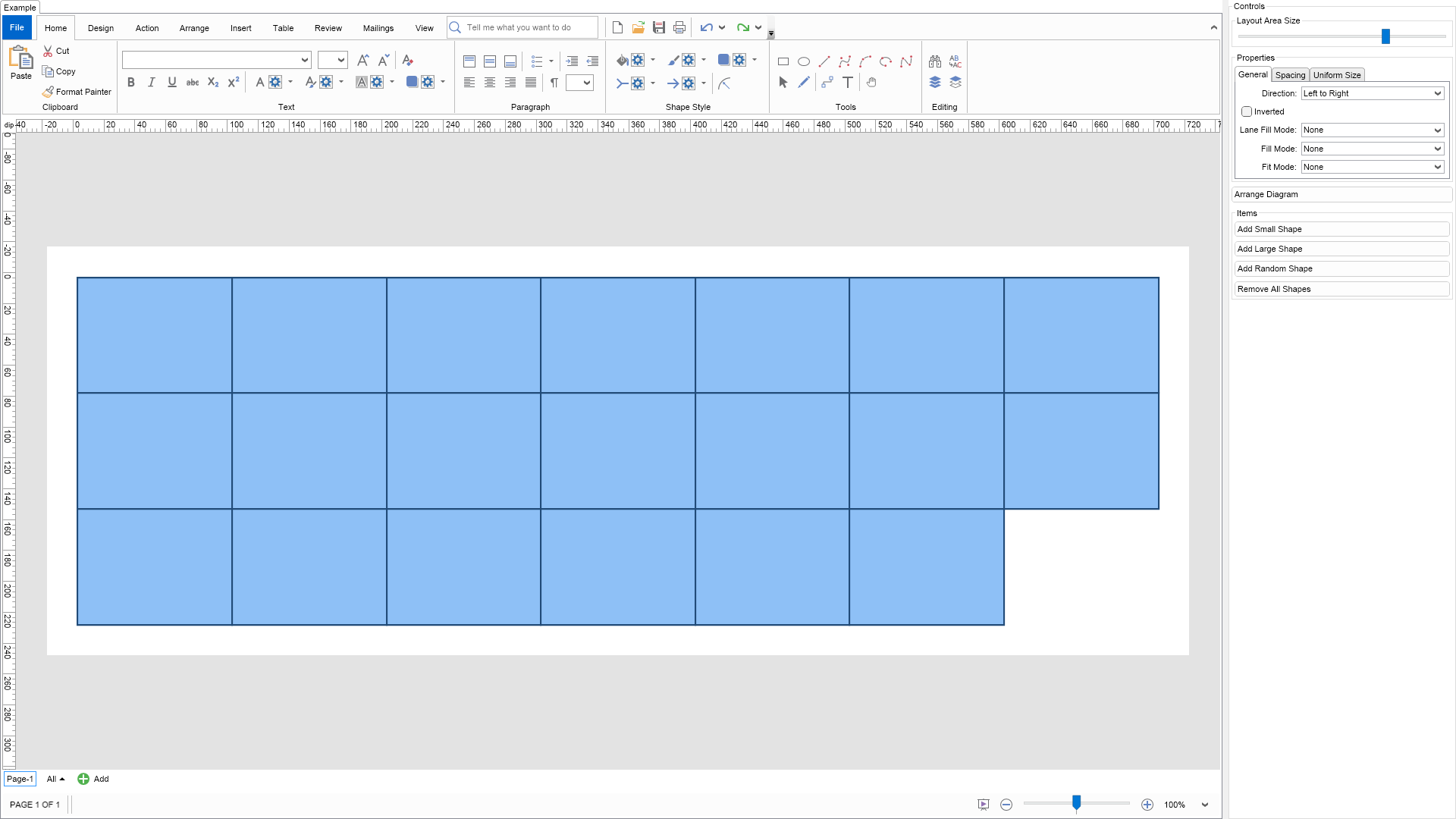
The wrap flow layout arranges cells sequentially in horizontal or vertical lanes.
When the next cell would exceed the available width or height, the layout starts a new lane.
The most important properties of this layout are:
Direction - determines the flow within each lane:
LeftToRight, RightToLeft, TopToBottom, or BottomToTop.
Inverted - reverses the order in which lanes are arranged.
The default value is false.
HorizontalSpacing and VerticalSpacing - control spacing between cells and lanes.
For horizontal flow, HorizontalSpacing separates cells and VerticalSpacing separates lanes.
For vertical flow, their roles are reversed.
LaneFillMode - controls how cells fill unused space along each lane.
No lane fitting mode is needed because cells wrap to a new lane when space is insufficient.
FillMode - controls how lanes fill unused space perpendicular to the flow direction:
vertically for horizontal flow and horizontally for vertical flow.
FitMode - controls how lanes shrink when their combined size exceeds the available space perpendicular to the flow direction.
To experiment with the layout, change its properties in the property grid and click the Layout button.
Change the drawing width and height to see how cells wrap into new lanes and how the filling and fitting settings affect the arrangement.
C# Wrap Flow Layout Example Code for Nevron Diagram for Blazor
Language: C#
using Nevron.Nov;
using Nevron.Nov.DataStructures;
using Nevron.Nov.Diagram;
using Nevron.Nov.Diagram.Layout;
using Nevron.Nov.Diagram.Shapes;
using Nevron.Nov.Dom;
using Nevron.Nov.Editors;
using Nevron.Nov.Graphics;
using Nevron.Nov.Layout;
using Nevron.Nov.UI;
using Nevron.Nov.Windows.Forms;
using System;
using System.Windows.Forms;
namespace NovWinFormsProject
{
public partial class Form1 : Form
{
#region Constructors
public Form1()
{
InitializeComponent();
// Set form title
Text = "NOV WinForms - NWrapFlowLayoutExample";
// Create the NOV example and its controls
NWidget exampleContent = CreateExampleContent();
NWidget exampleControls = CreateExampleControls();
if (exampleControls != null)
{
exampleControls.PreferredWidth = 300;
}
// Place the example and its controls in a pair box
NPairBox pairBox = new NPairBox(exampleContent, exampleControls);
pairBox.FillMode = ENStackFillMode.First;
pairBox.FitMode = ENStackFitMode.First;
pairBox.Margins = new NMargins(NDesign.HorizontalSpacing, NDesign.VerticalSpacing);
// Host the example in the form
NNovWidgetHost host = new NNovWidgetHost(pairBox);
host.Dock = DockStyle.Fill;
Controls.Add(host);
}
#endregion
#region Example
public NWidget CreateExampleContent()
{
// Create a simple drawing
NDrawingViewWithRibbon drawingViewWithRibbon = new NDrawingViewWithRibbon();
m_DrawingView = drawingViewWithRibbon.View;
m_DrawingView.Document.HistoryService.Pause();
try
{
InitDiagram(m_DrawingView.Document);
}
finally
{
m_DrawingView.Document.HistoryService.Resume();
}
return drawingViewWithRibbon;
}
public NWidget CreateExampleControls()
{
m_Layout.Changed += OnLayoutChanged;
NStackPanel stack = new NStackPanel();
// layout area size -> controls either page width or height depending on layout direction
NGroupBox layoutAreaGroupBox = new NGroupBox("Layout Area Size");
stack.Add(layoutAreaGroupBox);
NSlider sizeSlider = CreateSlider(m_DrawingView.ActivePage.Width, 100, 1000, (args) =>
{
SetPageSize((double)args.NewValue);
});
layoutAreaGroupBox.Content = sizeSlider;
m_Layout.AddValueChangedEventHandler(NStackLayout.DirectionProperty, (args) =>
{
SetPageSize(sizeSlider.Value);
});
// property editor
NEditor editor = NDesigner.GetDesigner(m_Layout).CreateStandaloneEditor(m_Layout);
stack.Add(new NGroupBox("Properties", editor));
NButton arrangeButton = new NButton("Arrange Diagram");
arrangeButton.Click += OnArrangeButtonClick;
stack.Add(arrangeButton);
// items stack
NStackPanel itemsStack = new NStackPanel();
// NOTE: For Cells layout we provide the user with the ability to add shapes with different sizes so that he/she can test the layouts
NButton addSmallItemButton = new NButton("Add Small Shape");
addSmallItemButton.Click += OnAddSmallItemButtonClick;
itemsStack.Add(addSmallItemButton);
NButton addLargeItemButton = new NButton("Add Large Shape");
addLargeItemButton.Click += OnAddLargeItemButtonClick;
itemsStack.Add(addLargeItemButton);
NButton addRandomItemButton = new NButton("Add Random Shape");
addRandomItemButton.Click += OnAddRandomItemButtonClick;
itemsStack.Add(addRandomItemButton);
NButton removeAllItemsButton = new NButton("Remove All Shapes");
removeAllItemsButton.Click += OnRemoveAllItemsButtonClick;
itemsStack.Add(removeAllItemsButton);
stack.Add(new NGroupBox("Items", itemsStack));
return stack;
}
public string GetExampleDescription()
{
return @"
The wrap flow layout arranges cells sequentially in horizontal or vertical lanes.
When the next cell would exceed the available width or height, the layout starts a new lane.
The most important properties of this layout are:
Direction - determines the flow within each lane:
LeftToRight, RightToLeft, TopToBottom, or BottomToTop.
Inverted - reverses the order in which lanes are arranged.
The default value is false.
HorizontalSpacing and VerticalSpacing - control spacing between cells and lanes.
For horizontal flow, HorizontalSpacing separates cells and VerticalSpacing separates lanes.
For vertical flow, their roles are reversed.
LaneFillMode - controls how cells fill unused space along each lane.
No lane fitting mode is needed because cells wrap to a new lane when space is insufficient.
FillMode - controls how lanes fill unused space perpendicular to the flow direction:
vertically for horizontal flow and horizontally for vertical flow.
FitMode - controls how lanes shrink when their combined size exceeds the available space perpendicular to the flow direction.
To experiment with the layout, change its properties in the property grid and click the Layout button.
Change the drawing width and height to see how cells wrap into new lanes and how the filling and fitting settings affect the arrangement.
";
}
///
/// Gets the relevant documentation links for the example
///
///
public (string Name, string Url)[] GetDocumentationUrls()
{
return new[]
{
("Wrap Flow Layout", "https://www.nevron.com/docs/openvision/wrap-flow-layout.html"),
("Layouts Overview", "https://www.nevron.com/docs/openvision/diagram-drawing-layouts-overview.html"),
("Graph Regions and Regions Layouts", "https://www.nevron.com/docs/openvision/diagram-graph-regions-and-region-layouts.html"),
("Layouts Overview", "https://www.nevron.com/docs/openvision/layouts-overview.html"),
};
}
private void InitDiagram(NDrawingDocument drawingDocument)
{
m_Factory = new NBasicShapeFactory();
// Hide ports
drawingDocument.Content.ScreenVisibility.ShowPorts = false;
// Create some shapes
NPage activePage = drawingDocument.Content.ActivePage;
NBasicShapeFactory basicShapes = new NBasicShapeFactory();
for (int i = 0; i < 20; i++)
{
NShape shape = basicShapes.CreateShape(ENBasicShape.Rectangle);
activePage.Items.Add(shape);
}
// Arrange diagram
ArrangeDiagram(drawingDocument);
// Fit page
drawingDocument.Content.ActivePage.ZoomMode = ENZoomMode.Fit;
}
#endregion
#region Implementation
private NSlider CreateSlider(double value, double min, double max, DNFunction valueChanged)
{
NSlider slider = new NSlider(value, min, max);
slider.TicksPlacement = ENTicksPlacement.None;
slider.ValueChanged += valueChanged;
return slider;
}
private void SetPageSize(double size)
{
if (m_Layout.Direction == ENHVDirection.LeftToRight ||
m_Layout.Direction == ENHVDirection.RightToLeft)
{
m_DrawingView.ActivePage.Width = size;
}
else
{
m_DrawingView.ActivePage.Height = size;
}
ArrangeDiagram(m_DrawingView.Document);
}
///
/// Arranges the shapes in the active page.
///
///
private void ArrangeDiagram(NDrawingDocument drawingDocument)
{
// get all top-level shapes that reside in the active page
NPage activePage = drawingDocument.Content.ActivePage;
NList shapes = activePage.GetShapes(false);
// create a layout context and use it to arrange the shapes using the current layout
NDrawingLayoutContext layoutContext = new NDrawingLayoutContext(drawingDocument, activePage);
m_Layout.Arrange(shapes.CastAll
Download a fully functional C# (.cs) Wrap Flow Layout Example for Blazor Solution

 Chart for .NET
 Diagram for .NET
 User Interface for .NET
 Vision for SSRS
 Chart for SSRS
 Gauge for SSRS
 Map for SSRS
 Barcode for SSRS
 Vision for SharePoint
 Chart for SharePoint
 Gauge for SharePoint
 Map for SharePoint
 Barcode for SharePoint
 Open Vision for .NET


 Vision for .NET