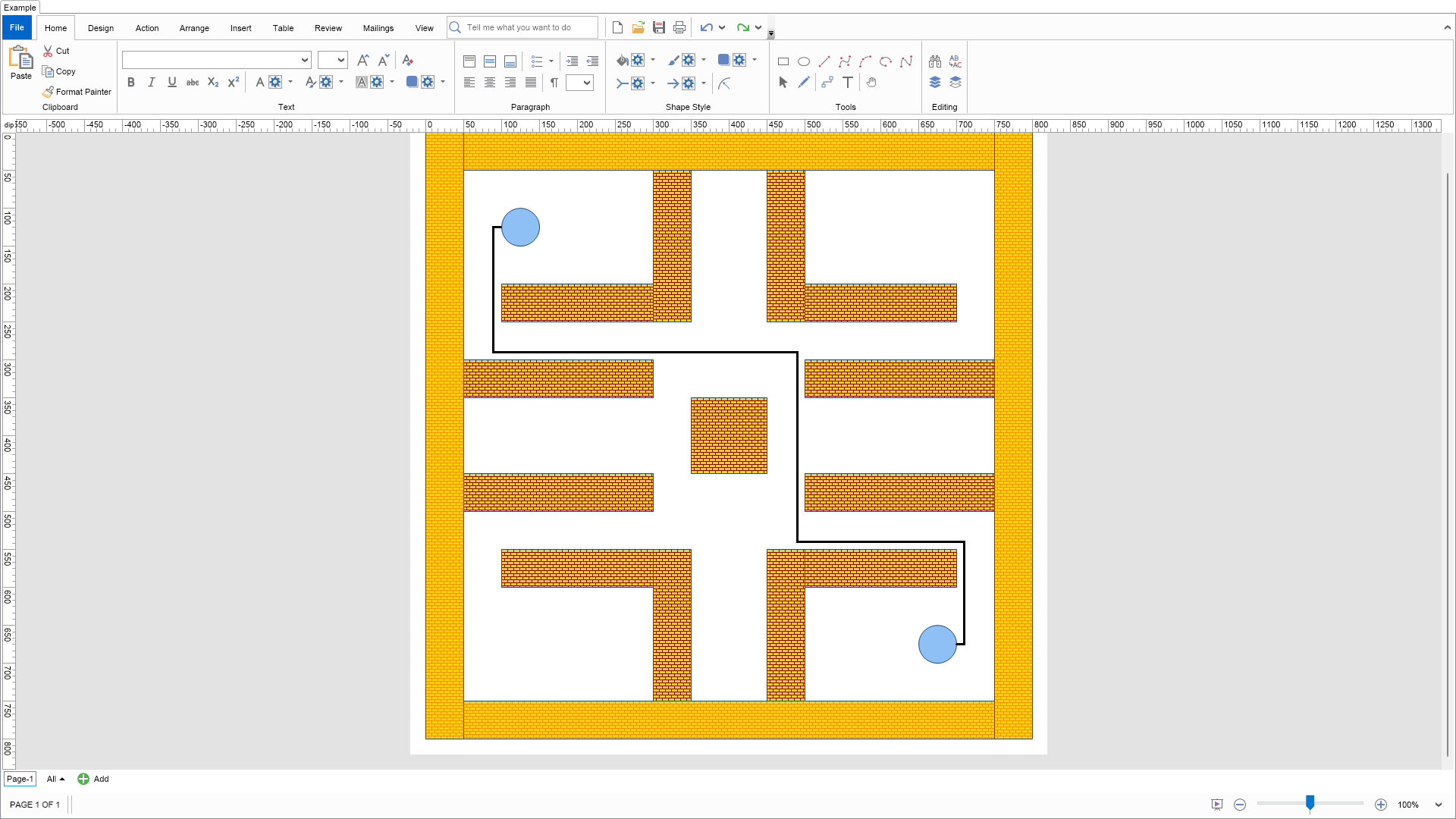
using Nevron.Nov;
using Nevron.Nov.Diagram;
using Nevron.Nov.Diagram.Shapes;
using Nevron.Nov.Dom;
using Nevron.Nov.Graphics;
using Nevron.Nov.Layout;
using Nevron.Nov.UI;
using Nevron.Nov.Windows.Forms;
using System.Windows.Forms;
namespace NovWinFormsProject
{
public partial class Form1 : Form
{
#region Constructors
public Form1()
{
InitializeComponent();
// Set form title
Text = "NOV WinForms - NRoutableConnectorsExample";
// Create the NOV example and its controls
NWidget exampleContent = CreateExampleContent();
NWidget exampleControls = CreateExampleControls();
if (exampleControls != null)
{
exampleControls.PreferredWidth = 300;
}
// Place the example and its controls in a pair box
NPairBox pairBox = new NPairBox(exampleContent, exampleControls);
pairBox.FillMode = ENStackFillMode.First;
pairBox.FitMode = ENStackFitMode.First;
pairBox.Margins = new NMargins(NDesign.HorizontalSpacing, NDesign.VerticalSpacing);
// Host the example in the form
NNovWidgetHost host = new NNovWidgetHost(pairBox);
host.Dock = DockStyle.Fill;
Controls.Add(host);
}
#endregion
#region Example
public NWidget CreateExampleContent()
{
// Create a simple drawing
NDrawingViewWithRibbon drawingViewWithRibbon = new NDrawingViewWithRibbon();
m_DrawingView = drawingViewWithRibbon.View;
m_DrawingView.Document.HistoryService.Pause();
try
{
InitDiagram(m_DrawingView.Document);
}
finally
{
m_DrawingView.Document.HistoryService.Resume();
}
return drawingViewWithRibbon;
}
public NWidget CreateExampleControls()
{
return null;
}
public string GetExampleDescription()
{
return @"
This example demonstrates routable connectors and routing.
Routing is the process of finding a path between two points, which strives not
to cross any obstacles and also tries to obey certain aesthetic criteria (such
as minimal number of turns, port orientation etc.).
Routing works with three corner stone objects: routable connector, obstacle shapes and router.
A routable connector tries to avoid the current set of obstacle shapes (residing in the page) by obtaining routing points from the router.
The router is responsible for creating and maintaining a routing graph for the current set of obstacle shapes existing in the page.
A routable connector can be automatically rerouted in three modes:
-
Never - the connector is never automatically rerouted. You can still reroute the
route by executing the Reroute command (from the context menu or from code).
-
Always - the connector is automatically rerouted when any of the obstacles have
changed (i.e. there is a possibility for the route to be rerouted in a better way).
-
When Needed - the connector is automatically rerouted when an obstacle is placed on it
(i.e. the route needs to be rerouted cause it crosses an obstacle).
";
}
///
/// Gets the relevant documentation links for the example
///
///
public (string Name, string Url)[] GetDocumentationUrls()
{
return new[]
{
("Routable Connectors", "https://www.nevron.com/docs/openvision/diagram-routable-connectors.html"),
("Ports", "https://www.nevron.com/docs/openvision/diagram-ports.html"),
("Snap and Glue", "https://www.nevron.com/docs/openvision/diagram-snap-and-glue.html"),
};
}
private void InitDiagram(NDrawingDocument drawingDocument)
{
NDrawing drawing = drawingDocument.Content;
NPage activePage = drawing.ActivePage;
// hide grid and ports
drawing.ScreenVisibility.ShowGrid = false;
drawing.ScreenVisibility.ShowPorts = false;
// create a stylesheet for styling the different bricks
NStyleSheet styleSheet = new NStyleSheet();
drawingDocument.StyleSheets.AddChild(styleSheet);
// the first rule fills brichs with UserClass BRICK1
NRule ruleBrick1 = new NRule();
styleSheet.Add(ruleBrick1);
NSelectorBuilder sb = ruleBrick1.GetSelectorBuilder();
sb.Start();
sb.Type(NGeometry.NGeometrySchema);
sb.ChildOf();
sb.UserClass("BRICK1");
sb.End();
ruleBrick1.Declarations.Add(new NValueDeclaration(NGeometry.FillProperty, new NHatchFill(ENHatchStyle.HorizontalBrick, NColor.DarkOrange, NColor.Gold)));
// the second rule fills brichs with UserClass BRICK2
NRule ruleBrick2 = new NRule();
styleSheet.Add(ruleBrick2);
sb = ruleBrick2.GetSelectorBuilder();
sb.Start();
sb.Type(NGeometry.NGeometrySchema);
sb.ChildOf();
sb.UserClass("BRICK2");
sb.End();
ruleBrick2.Declarations.Add(new NValueDeclaration(NGeometry.FillProperty, new NHatchFill(ENHatchStyle.HorizontalBrick, NColor.DarkRed, NColor.Gold)));
// create all shapes
// create the maze frame
CreateBrick(new NRectangle(50, 0, 700, 50), "BRICK1");
CreateBrick(new NRectangle(750, 0, 50, 800), "BRICK1");
CreateBrick(new NRectangle(50, 750, 700, 50), "BRICK1");
CreateBrick(new NRectangle(0, 0, 50, 800), "BRICK1");
// create the maze obstacles
CreateBrick(new NRectangle(100, 200, 200, 50), "BRICK2");
CreateBrick(new NRectangle(300, 50, 50, 200), "BRICK2");
CreateBrick(new NRectangle(450, 50, 50, 200), "BRICK2");
CreateBrick(new NRectangle(500, 200, 200, 50), "BRICK2");
CreateBrick(new NRectangle(50, 300, 250, 50), "BRICK2");
CreateBrick(new NRectangle(500, 300, 250, 50), "BRICK2");
CreateBrick(new NRectangle(350, 350, 100, 100), "BRICK2");
CreateBrick(new NRectangle(50, 450, 250, 50), "BRICK2");
CreateBrick(new NRectangle(500, 450, 250, 50), "BRICK2");
CreateBrick(new NRectangle(100, 550, 200, 50), "BRICK2");
CreateBrick(new NRectangle(300, 550, 50, 200), "BRICK2");
CreateBrick(new NRectangle(450, 550, 50, 200), "BRICK2");
CreateBrick(new NRectangle(500, 550, 200, 50), "BRICK2");
// create the first set of start/end shapes
NShape start = CreateEllipse(new NRectangle(100, 100, 50, 50), "START");
NShape end = CreateEllipse(new NRectangle(650, 650, 50, 50), "END");
// connect them with a dynamic HV routable connector,
// which is rerouted whenever the obstacles have changed
NRoutableConnector routableConnector = new NRoutableConnector();
routableConnector.RerouteMode = ENRoutableConnectorRerouteMode.Always;
routableConnector.Geometry.Stroke = new NStroke(3, NColor.Black);
activePage.Items.Add(routableConnector);
// connect the start and end shapes
routableConnector.GlueBeginToShape(start);
routableConnector.GlueEndToShape(end);
// reroute the connector
routableConnector.RequestReroute();
// size document to fit the maze
activePage.SizeToContent();
}
#endregion
#region Implementation
///
/// Creates a brick shape (Rectangle) and applies the specified class to ut
///
///
///
///
NShape CreateBrick(NRectangle bounds, string userClass)
{
NShape shape = m_BasicShapes.CreateShape(ENBasicShape.Rectangle);
shape.SetBounds(bounds);
shape.UserClass = userClass;
m_DrawingView.ActivePage.Items.Add(shape);
return shape;
}
///
/// Creates an ellipse shapeand applies the specified class to ut (used for Start and End shapes)
///
///
///
///
NShape CreateEllipse(NRectangle bounds, string userClass)
{
NShape shape = m_BasicShapes.CreateShape(ENBasicShape.Ellipse);
shape.SetBounds(bounds);
shape.UserClass = userClass;
m_DrawingView.ActivePage.Items.Add(shape);
return shape;
}
#endregion
#region Event Handlers
#endregion
#region Fields
private NDrawingView m_DrawingView;
NBasicShapeFactory m_BasicShapes = new NBasicShapeFactory();
#endregion
#region Static Methods
#endregion
#region Constants
#endregion
#region Nested Types
#endregion
}
}

 Chart for .NET
 Diagram for .NET
 User Interface for .NET
 Vision for SSRS
 Chart for SSRS
 Gauge for SSRS
 Map for SSRS
 Barcode for SSRS
 Vision for SharePoint
 Chart for SharePoint
 Gauge for SharePoint
 Map for SharePoint
 Barcode for SharePoint
 Open Vision for .NET


 Vision for .NET