Single Cycle Graph Layout Example for Blazor

Nevron NOV Diagram for Blazor ships with hundreds of examples with full source code, as part of the Nevron Open Vision Suite. All Blazor Diagram examples are also available as a stand-alone Visual Studio solution in C#, which you can download from the links below.

Single Cycle Graph Layout Example for Blazor Description

The single cycle layout layouts all graph vertices on a single circle, trying to minimize the number of edge crossings. The most important properties are:

  • Aspect Ratio - determines the aspect (width/height) ratio of the layout. By default set to 1 which layouts the nodes in a circle. A value different from 1 will make the layout order the nodes in an ellipse.
  • AutoSizeRings - if set to true the RingRadius property is automatically calculated to have such value that the total area of the drawing is minimized and there is no node overlapping.
  • RingRadius - determines the size of the radius of the imaginary circle where nodes are placed. This value is automatically determined if the AutoSizeRings property is set to true.

To experiment with their behavior just change the properties of the layout in the property grid and click the Layout button.
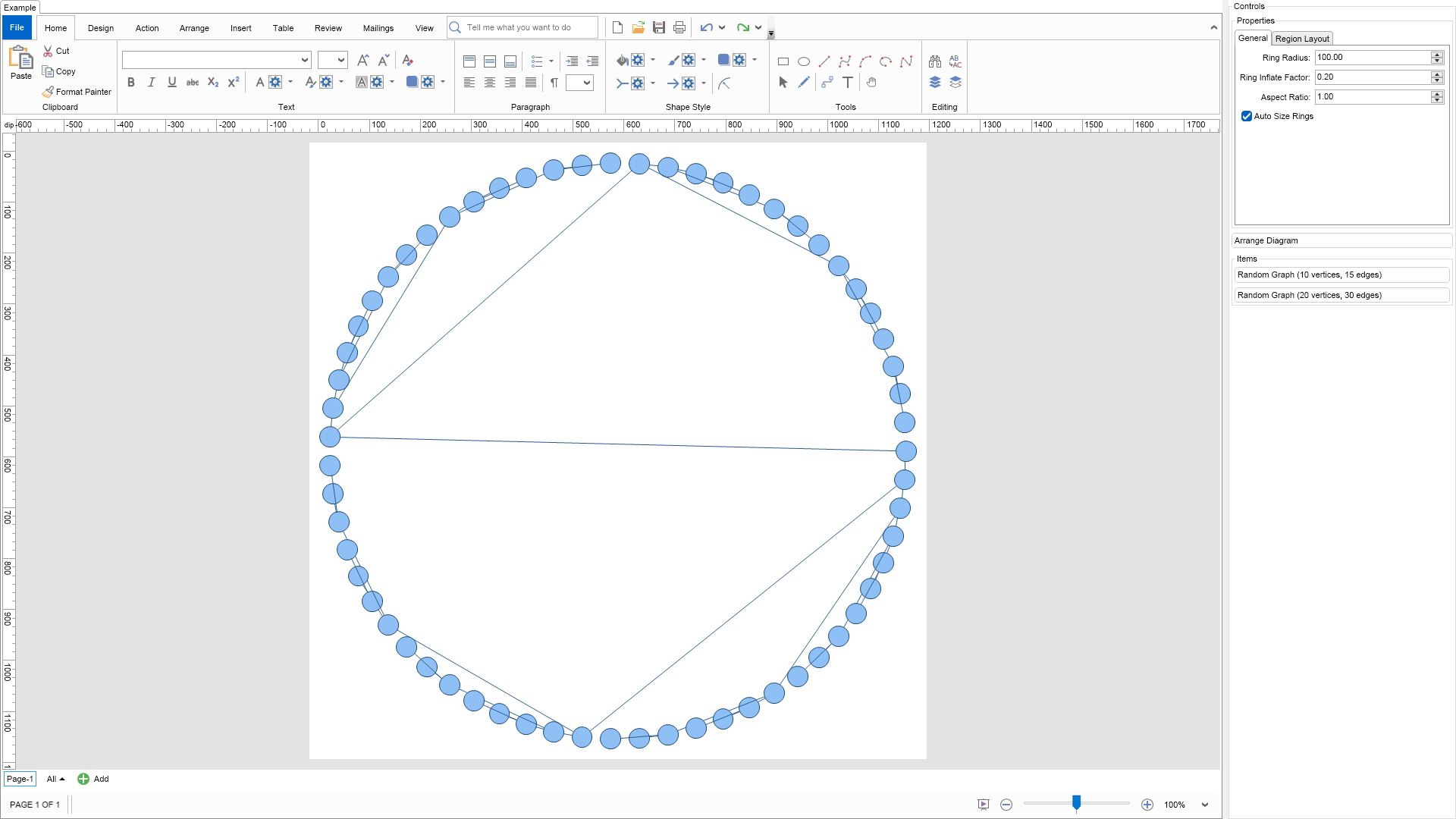

Single Cycle Graph Layout Example

C# Single Cycle Graph Layout Example Code for Nevron Diagram for Blazor
Language: C#

using Nevron.Nov;
using Nevron.Nov.DataStructures;
using Nevron.Nov.Diagram;
using Nevron.Nov.Diagram.Layout;
using Nevron.Nov.Diagram.Shapes;
using Nevron.Nov.Dom;
using Nevron.Nov.Editors;
using Nevron.Nov.Graphics;
using Nevron.Nov.Layout;
using Nevron.Nov.UI;
using Nevron.Nov.Windows.Forms;
using System.Windows.Forms;

namespace NovWinFormsProject
{
	public partial class Form1 : Form
	{
		#region Constructors

		public Form1()
		{
			InitializeComponent();

			// Set form title
			Text = "NOV WinForms - NSingleCycleGraphLayoutExample";

			// Create the NOV example and its controls
			NWidget exampleContent = CreateExampleContent();
			NWidget exampleControls = CreateExampleControls();
			if (exampleControls != null)
			{
				exampleControls.PreferredWidth = 300;
			}

			// Place the example and its controls in a pair box
			NPairBox pairBox = new NPairBox(exampleContent, exampleControls);
			pairBox.FillMode = ENStackFillMode.First;
			pairBox.FitMode = ENStackFitMode.First;
			pairBox.Margins = new NMargins(NDesign.HorizontalSpacing, NDesign.VerticalSpacing);

			// Host the example in the form
			NNovWidgetHost host = new NNovWidgetHost(pairBox);
			host.Dock = DockStyle.Fill;
			Controls.Add(host);
		}

		#endregion

		#region Example

		public NWidget CreateExampleContent()
		{
			// Create a simple drawing
			NDrawingViewWithRibbon drawingViewWithRibbon = new NDrawingViewWithRibbon();
			m_DrawingView = drawingViewWithRibbon.View;

			m_DrawingView.Document.HistoryService.Pause();
			try
			{
				InitDiagram(m_DrawingView.Document);
			}
			finally
			{
				m_DrawingView.Document.HistoryService.Resume();
			}

			return drawingViewWithRibbon;
		}
		public NWidget CreateExampleControls()
		{
			m_Layout.Changed += OnLayoutChanged;

			NStackPanel stack = new NStackPanel();

			// property editor
			NEditor editor = NDesigner.GetDesigner(m_Layout).CreateStandaloneEditor(m_Layout);
			stack.Add(new NGroupBox("Properties", editor));

			NButton arrangeButton = new NButton("Arrange Diagram");
			arrangeButton.Click += OnArrangeButtonClick;
			stack.Add(arrangeButton);

			// items stack
			NStackPanel itemsStack = new NStackPanel();

			// NOTE: For Graph layouts we provide the user with the ability to generate random graph diagrams so that he/she can test the layouts
			NButton randomGraph1Button = new NButton("Random Graph (10 vertices, 15 edges)");
			randomGraph1Button.Click += OnRandomGraph1ButtonClick;
			itemsStack.Add(randomGraph1Button);

			NButton randomGraph2Button = new NButton("Random Graph (20 vertices, 30 edges)");
			randomGraph2Button.Click += OnRandomGraph2ButtonClick;
			itemsStack.Add(randomGraph2Button);

			stack.Add(new NGroupBox("Items", itemsStack));

			return stack;
		}
		public string GetExampleDescription()
        {
            return @"

The single cycle layout layouts all graph vertices on a single circle, trying to minimize the number of edge crossings. The most important properties are:

  • Aspect Ratio - determines the aspect (width/height) ratio of the layout. By default set to 1 which layouts the nodes in a circle. A value different from 1 will make the layout order the nodes in an ellipse.
  • AutoSizeRings - if set to true the RingRadius property is automatically calculated to have such value that the total area of the drawing is minimized and there is no node overlapping.
  • RingRadius - determines the size of the radius of the imaginary circle where nodes are placed. This value is automatically determined if the AutoSizeRings property is set to true.

To experiment with their behavior just change the properties of the layout in the property grid and click the Layout button.

"; } /// /// Gets the relevant documentation links for the example /// /// public (string Name, string Url)[] GetDocumentationUrls() { return new[] { ("Single Cycle Graph Layout", "https://www.nevron.com/docs/openvision/diagram-single-cycle-graph-layout.html"), ("Layouts Overview", "https://www.nevron.com/docs/openvision/diagram-drawing-layouts-overview.html"), ("Graph Regions and Regions Layouts", "https://www.nevron.com/docs/openvision/diagram-graph-regions-and-region-layouts.html"), ("Shape Navigation", "https://www.nevron.com/docs/openvision/diagram-shape-navigation.html"), }; } private void InitDiagram(NDrawingDocument drawingDocument) { // Hide ports drawingDocument.Content.ScreenVisibility.ShowPorts = false; // Create a tree NGenericTreeTemplate tree = new NGenericTreeTemplate(); tree.ConnectorType = ENConnectorShape.RoutableConnector; tree.VertexShape = ENBasicShape.Circle; tree.Levels = 6; tree.BranchNodes = 2; tree.HorizontalSpacing = 10; tree.VerticalSpacing = 10; tree.VertexSize = new NSize(40, 40); tree.Create(drawingDocument); // Arrange diagram ArrangeDiagram(drawingDocument); // Fit active page drawingDocument.Content.ActivePage.ZoomMode = ENZoomMode.Fit; } #endregion #region Implementation /// /// Arranges the shapes in the active page. /// /// private void ArrangeDiagram(NDrawingDocument drawingDocument) { // get all top-level shapes that reside in the active page NPage activePage = drawingDocument.Content.ActivePage; NList shapes = activePage.GetShapes(false); // create a layout context and use it to arrange the shapes using the current layout NDrawingLayoutContext layoutContext = new NDrawingLayoutContext(drawingDocument, activePage); m_Layout.Arrange(shapes.CastAll(), layoutContext); // size the page to the content size activePage.SizeToContent(); } #endregion #region Event Handlers private void OnRandomGraph1ButtonClick(NEventArgs arg) { NDrawingDocument drawingDocument = m_DrawingView.Document; drawingDocument.StartHistoryTransaction("Create Random Graph 1"); try { m_DrawingView.ActivePage.Items.Clear(); // create a test tree NRandomGraphTemplate graph = new NRandomGraphTemplate(); graph.EdgeUserClass = NDR.StyleSheetNameConnectors; graph.VertexCount = 10; graph.EdgeCount = 15; graph.VertexShape = VertexShape; graph.VertexSize = VertexSize; graph.Create(drawingDocument); // layout the tree ArrangeDiagram(drawingDocument); } finally { drawingDocument.CommitHistoryTransaction(); } } private void OnRandomGraph2ButtonClick(NEventArgs arg) { NDrawingDocument drawingDocument = m_DrawingView.Document; drawingDocument.StartHistoryTransaction("Create Random Graph 2"); try { m_DrawingView.ActivePage.Items.Clear(); // create a test tree NRandomGraphTemplate graph = new NRandomGraphTemplate(); graph.EdgeUserClass = NDR.StyleSheetNameConnectors; graph.VertexCount = 20; graph.EdgeCount = 30; graph.VertexShape = VertexShape; graph.VertexSize = VertexSize; graph.Create(drawingDocument); // layout the tree ArrangeDiagram(drawingDocument); } finally { drawingDocument.CommitHistoryTransaction(); } } private void OnLayoutChanged(NEventArgs arg) { ArrangeDiagram(m_DrawingView.Document); } protected virtual void OnArrangeButtonClick(NEventArgs arg) { ArrangeDiagram(m_DrawingView.Document); } #endregion #region Fields private NDrawingView m_DrawingView; private NSingleCycleGraphLayout m_Layout = new NSingleCycleGraphLayout(); #endregion #region Static Methods #endregion #region Constants private const ENBasicShape VertexShape = ENBasicShape.Circle; private static readonly NSize VertexSize = new NSize(50, 50); #endregion #region Nested Types #endregion } }

Download a fully functional C# (.cs) Single Cycle Graph Layout Example for Blazor Solution