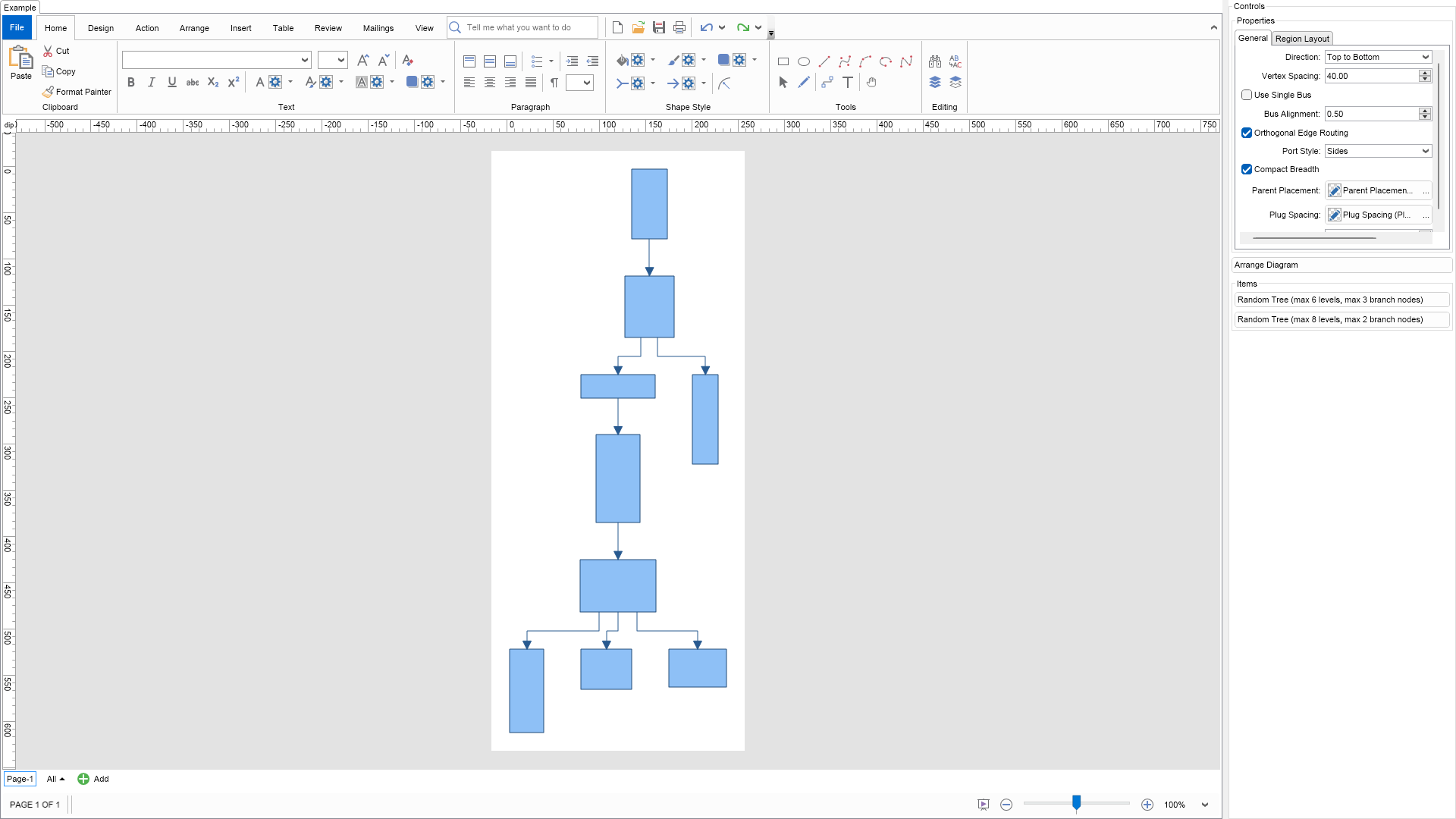
The compact depth tree layout represents a classical directed tree layout (e.g. with uniform parent placement), which compacts the depth of the tree drawing area. It produces both straight line and orthogonal tree drawings, which is controlled by the OrthogonalEdgeRouting property. The PlugSpacing property controls the spacing between the plugs of a node. You can set a fixed amount of spacing or a proportional spacing, which means that the plugs are distributed along the whole side of the node. The layout satisfies to the following aesthetic criteria:
This layout is very useful when arranging deep, unbalanced trees with different node sizes (class diagrams being a perfect example). In cases like these the layout guarantees that the drawing is with minimal depth.
To experiment with the layout just change its properties from the property grid and click the Layout button. To see the layout in action on a different trees, just click the Random Tree button.

| Language: C# |
using Nevron.Nov;
using Nevron.Nov.DataStructures;
using Nevron.Nov.Diagram;
using Nevron.Nov.Diagram.Layout;
using Nevron.Nov.Diagram.Shapes;
using Nevron.Nov.Dom;
using Nevron.Nov.Editors;
using Nevron.Nov.Graphics;
using Nevron.Nov.Layout;
using Nevron.Nov.UI;
using Nevron.Nov.Windows.Forms;
using System.Windows.Forms;
namespace NovWinFormsProject
{
public partial class Form1 : Form
{
#region Constructors
public Form1()
{
InitializeComponent();
// Set form title
Text = "NOV WinForms - NCompactDepthTreeLayoutExample";
// Create the NOV example and its controls
NWidget exampleContent = CreateExampleContent();
NWidget exampleControls = CreateExampleControls();
if (exampleControls != null)
{
exampleControls.PreferredWidth = 300;
}
// Place the example and its controls in a pair box
NPairBox pairBox = new NPairBox(exampleContent, exampleControls);
pairBox.FillMode = ENStackFillMode.First;
pairBox.FitMode = ENStackFitMode.First;
pairBox.Margins = new NMargins(NDesign.HorizontalSpacing, NDesign.VerticalSpacing);
// Host the example in the form
NNovWidgetHost host = new NNovWidgetHost(pairBox);
host.Dock = DockStyle.Fill;
Controls.Add(host);
}
#endregion
#region Example
public NWidget CreateExampleContent()
{
// Create a simple drawing
NDrawingViewWithRibbon drawingViewWithRibbon = new NDrawingViewWithRibbon();
m_DrawingView = drawingViewWithRibbon.View;
m_DrawingView.Document.HistoryService.Pause();
try
{
InitDiagram(m_DrawingView.Document);
}
finally
{
m_DrawingView.Document.HistoryService.Resume();
}
return drawingViewWithRibbon;
}
public NWidget CreateExampleControls()
{
m_Layout.Changed += OnLayoutChanged;
NStackPanel stack = new NStackPanel();
// property editor
NEditor editor = NDesigner.GetDesigner(m_Layout).CreateStandaloneEditor(m_Layout);
stack.Add(new NGroupBox("Properties", editor));
NButton arrangeButton = new NButton("Arrange Diagram");
arrangeButton.Click += OnArrangeButtonClick;
stack.Add(arrangeButton);
// items stack
NStackPanel itemsStack = new NStackPanel();
// NOTE: For Tree layouts we provide the user with the ability to generate random tree diagrams so that he/she can test the layouts
NButton randomTree1Button = new NButton("Random Tree (max 6 levels, max 3 branch nodes)");
randomTree1Button.Click += OnRandomTree1ButtonClick;
itemsStack.Add(randomTree1Button);
NButton randomTree2Button = new NButton("Random Tree (max 8 levels, max 2 branch nodes)");
randomTree2Button.Click += OnRandomTree2ButtonClick;
itemsStack.Add(randomTree2Button);
stack.Add(new NGroupBox("Items", itemsStack));
return stack;
}
public string GetExampleDescription()
{
return @"
The compact depth tree layout represents a classical directed tree layout
(e.g. with uniform parent placement), which compacts the depth of the tree drawing area.
It produces both straight line and orthogonal tree drawings, which is controlled by the OrthogonalEdgeRouting property.
The PlugSpacing property controls the spacing between the plugs of a node.
You can set a fixed amount of spacing or a proportional spacing, which means that the plugs
are distributed along the whole side of the node.
The layout satisfies to the following aesthetic criteria:
- No edge crossings - edges do not cross each other.
- No vertex-vertex overlaps - vertices do not overlap each other.
- No vertex-edge overlaps - vertices do not overlap edges.
- Compactness - you can optimize the compactness of the drawing in the tree breadth dimension
by setting the CompactBreadth property to true. This type of layout is by default depth compact.
This layout is very useful when arranging deep, unbalanced trees with different node sizes
(class diagrams being a perfect example). In cases like these the layout guarantees
that the drawing is with minimal depth.
To experiment with the layout just change its properties from the property grid and click the Layout button.
To see the layout in action on a different trees, just click the Random Tree button.
";
}
///
/// Gets the relevant documentation links for the example
///
///
public (string Name, string Url)[] GetDocumentationUrls()
{
return new[]
{
("Compact Depth Tree Layout", "https://www.nevron.com/docs/openvision/diagram-compact-depth-tree-layout.html"),
("Layouts Overview", "https://www.nevron.com/docs/openvision/diagram-drawing-layouts-overview.html"),
("Graph Regions and Regions Layouts", "https://www.nevron.com/docs/openvision/diagram-graph-regions-and-region-layouts.html"),
};
}
private void InitDiagram(NDrawingDocument drawingDocument)
{
// Hide ports
drawingDocument.Content.ScreenVisibility.ShowPorts = false;
// Create a random diagram
NGenericTreeTemplate template = new NGenericTreeTemplate();
template.EdgeUserClass = NDR.StyleSheetNameConnectors;
template.Balanced = false;
template.Levels = 6;
template.BranchNodes = 3;
template.HorizontalSpacing = 10;
template.VerticalSpacing = 10;
template.VertexSize = new NSize(50, 50);
template.VertexSizeDeviation = 1;
template.Create(drawingDocument);
// Arrange the diagram
ArrangeDiagram(drawingDocument);
// Fit active page
drawingDocument.Content.ActivePage.ZoomMode = ENZoomMode.Fit;
}
#endregion
#region Implementation
///
/// Arranges the shapes in the active page.
///
///
private void ArrangeDiagram(NDrawingDocument drawingDocument)
{
// get all top-level shapes that reside in the active page
NPage activePage = drawingDocument.Content.ActivePage;
NList shapes = activePage.GetShapes(false);
// create a layout context and use it to arrange the shapes using the current layout
NDrawingLayoutContext layoutContext = new NDrawingLayoutContext(drawingDocument, activePage);
m_Layout.Arrange(shapes.CastAll