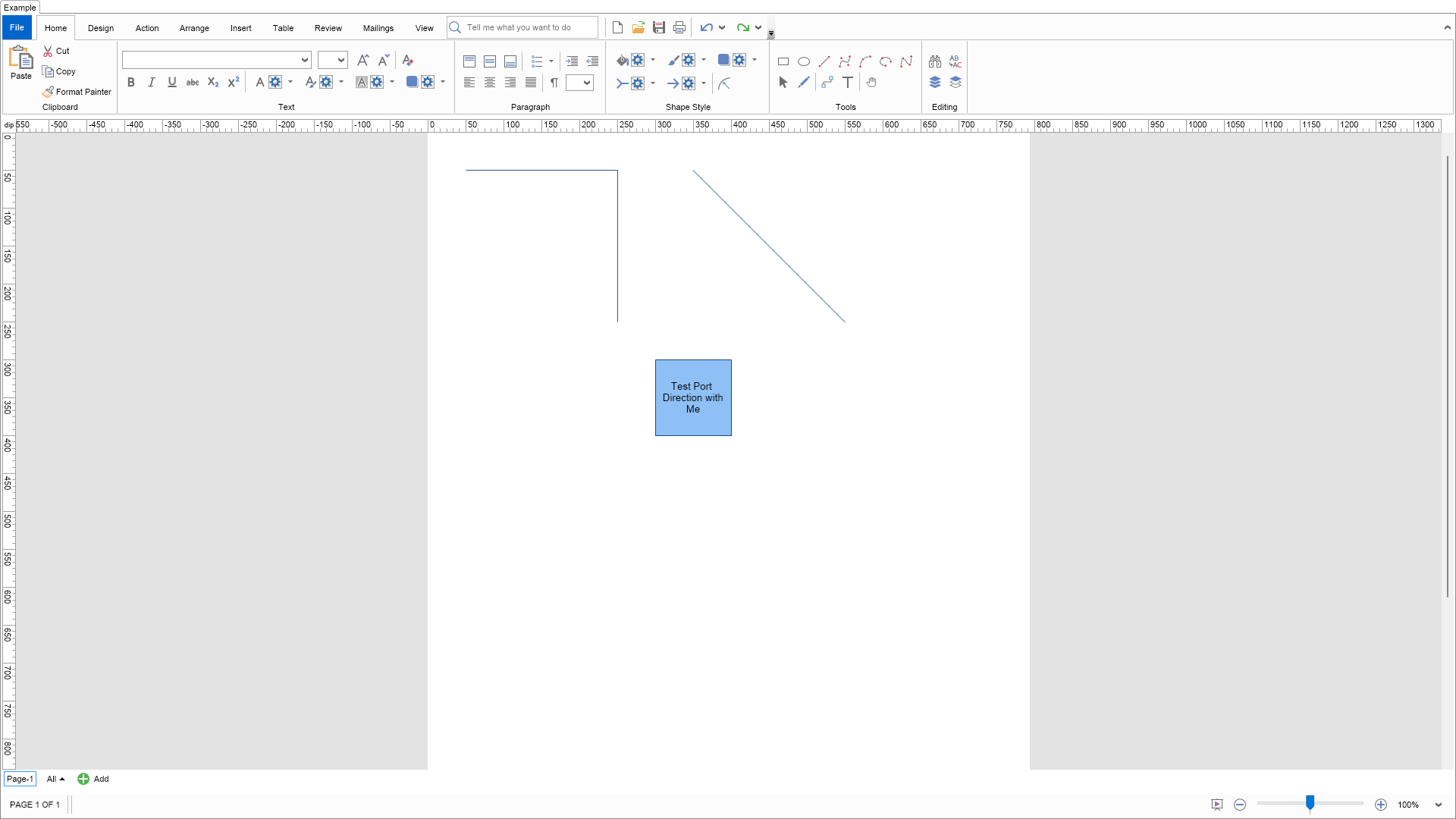
Demonstrates the ports glue. Move the rectangle close to the Connector or the Line to test the port direction that is syncrhonized with the geometry tangenta at this point.
In NOV Diagram each port GlueMode can be set to Inward, Outward or InwardAndOutward.
Inward ports can accept connections with Begin and End points of 1D shapes as well as other shapes Outward ports. Most of the ports are only Inward ports.
Outward ports can be connected only to other shapes Inward ports. When a shape with outward ports is moved closed a shape with inward ports. The two shapes are glued in master-slave relation. The shape to which the outward port belongs is rotated and translated so that its outward port location matches the inward port location and so that the ports directions form a line.
InwardAndOutward ports behave as both inward and outward.
| Language: C# |
using Nevron.Nov;
using Nevron.Nov.Diagram;
using Nevron.Nov.Diagram.Shapes;
using Nevron.Nov.Dom;
using Nevron.Nov.Graphics;
using Nevron.Nov.Layout;
using Nevron.Nov.UI;
using Nevron.Nov.Windows.Forms;
using System.Windows.Forms;
namespace NovWinFormsProject
{
public partial class Form1 : Form
{
#region Constructors
public Form1()
{
InitializeComponent();
// Set form title
Text = "NOV WinForms - NPortsGlueExample";
// Create the NOV example and its controls
NWidget exampleContent = CreateExampleContent();
NWidget exampleControls = CreateExampleControls();
if (exampleControls != null)
{
exampleControls.PreferredWidth = 300;
}
// Place the example and its controls in a pair box
NPairBox pairBox = new NPairBox(exampleContent, exampleControls);
pairBox.FillMode = ENStackFillMode.First;
pairBox.FitMode = ENStackFitMode.First;
pairBox.Margins = new NMargins(NDesign.HorizontalSpacing, NDesign.VerticalSpacing);
// Host the example in the form
NNovWidgetHost host = new NNovWidgetHost(pairBox);
host.Dock = DockStyle.Fill;
Controls.Add(host);
}
#endregion
#region Example
public NWidget CreateExampleContent()
{
// Create a simple drawing
NDrawingViewWithRibbon drawingViewWithRibbon = new NDrawingViewWithRibbon();
m_DrawingView = drawingViewWithRibbon.View;
m_DrawingView.Document.HistoryService.Pause();
try
{
InitDiagram(m_DrawingView.Document);
}
finally
{
m_DrawingView.Document.HistoryService.Resume();
}
return drawingViewWithRibbon;
}
public NWidget CreateExampleControls()
{
return null;
}
public string GetExampleDescription()
{
return @"
Demonstrates the ports glue. Move the rectangle close to the Connector or the Line to test the port direction that is syncrhonized with the geometry tangenta at this point.
In NOV Diagram each port GlueMode can be set to Inward, Outward or InwardAndOutward.
Inward ports can accept connections with Begin and End points of 1D shapes as well as other shapes Outward ports.
Most of the ports are only Inward ports.
Outward ports can be connected only to other shapes Inward ports. When a shape with outward ports
is moved closed a shape with inward ports. The two shapes are glued in master-slave relation. The shape
to which the outward port belongs is rotated and translated so that its outward port location matches
the inward port location and so that the ports directions form a line.
InwardAndOutward ports behave as both inward and outward.
";
}
///
/// Gets the relevant documentation links for the example
///
///
public (string Name, string Url)[] GetDocumentationUrls()
{
return new[]
{
("Ports", "https://www.nevron.com/docs/openvision/diagram-ports.html"),
("Snap and Glue", "https://www.nevron.com/docs/openvision/diagram-snap-and-glue.html"),
("Shapes", "https://www.nevron.com/docs/openvision/diagram-shapes.html"),
("Routable Connectors", "https://www.nevron.com/docs/openvision/diagram-routable-connectors.html"),
};
}
private void InitDiagram(NDrawingDocument drawingDocument)
{
NDrawing drawing = drawingDocument.Content;
NPage activePage = drawing.ActivePage;
activePage.Interaction.Enable1DShapeSplitting = false;
activePage.Interaction.AutoConnectToBeginPoints = false;
activePage.Interaction.AutoConnectToEndPoints = false;
// hide the grid
drawing.ScreenVisibility.ShowGrid = false;
// Port Glue To Geometry Contour
{
// create a connector with begin, end and middle ports
// start and end ports are offset with absolute values
NRoutableConnector connector = new NRoutableConnector();
activePage.Items.Add(connector);
connector.SetBeginPoint(new NPoint(50, 50));
connector.SetEndPoint(new NPoint(250, 250));
NPort beginPort = new NPort();
connector.Ports.Add(beginPort);
beginPort.GlueToGeometryContour(0, 10, true, NAngle.Zero);
NPort endPort = new NPort();
connector.Ports.Add(endPort);
endPort.GlueToGeometryContour(1, -10, true, NAngle.Zero);
NPort middlePort = new NPort();
connector.Ports.Add(middlePort);
middlePort.GlueToGeometryContour(0.5, 0, true, NAngle.Zero);
}
// Port Glue To Shape Line
{
NShape lineShape = NShape.CreateLineShape();
activePage.Items.Add(lineShape);
lineShape.SetBeginPoint(new NPoint(350, 50));
lineShape.SetEndPoint(new NPoint(550, 250));
NPort middlePort = new NPort();
lineShape.Ports.Add(middlePort);
middlePort.GlueToGeometryContour(0.5, 0, true, NAngle.Zero);
}
// create a rectangle shape with
{
NShape rectShape = NShape.CreateRectangle();
rectShape.SetBounds(300, 300, 100, 100);
rectShape.Text = "Test Port Direction with Me";
NPort port = new NPort(0.5, 0, true);
port.DirectionMode = ENPortDirectionMode.AutoCenter;
port.GlueMode = ENPortGlueMode.Outward;
rectShape.Ports.Add(port);
activePage.Items.Add(rectShape);
}
}
#endregion
#region Implementation
#endregion
#region Event Handlers
#endregion
#region Fields
private NDrawingView m_DrawingView;
#endregion
#region Static Methods
#endregion
#region Constants
#endregion
#region Nested Types
#endregion
}
}