Nevron NOV Diagram for Blazor ships with hundreds of examples with full source code, as part of the Nevron Open Vision Suite.
All Blazor Diagram examples are also available as a stand-alone Visual Studio solution
in C#,
which you can download from the links below.
Custom Drawing Tools Example for Blazor Description
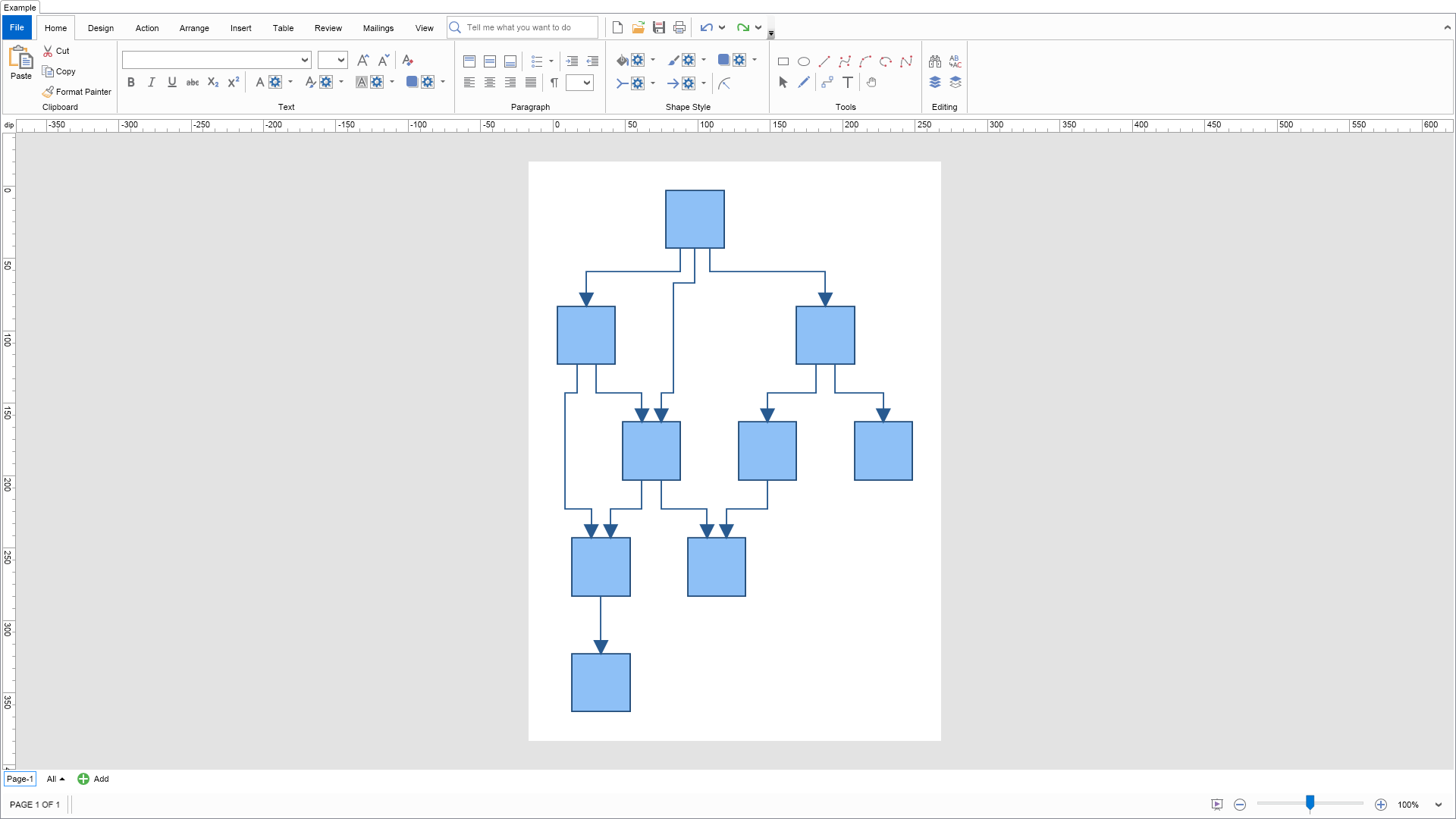
This example demonstrates how to create custom drawing tools. Click on a shape and the custom click select tool of
this example will select it together with its ancestor and descendant shapes.
C# Custom Drawing Tools Example Code for Nevron Diagram for Blazor
Language: C#
using Nevron.Nov;
using Nevron.Nov.DataStructures;
using Nevron.Nov.Diagram;
using Nevron.Nov.Diagram.DrawingTools;
using Nevron.Nov.Diagram.Layout;
using Nevron.Nov.Diagram.Shapes;
using Nevron.Nov.Dom;
using Nevron.Nov.Graphics;
using Nevron.Nov.Layout;
using Nevron.Nov.UI;
using Nevron.Nov.Windows.Forms;
using System.Windows.Forms;
namespace NovWinFormsProject
{
public partial class Form1 : Form
{
#region Constructors
public Form1()
{
InitializeComponent();
// Set form title
Text = "NOV WinForms - NCustomDrawingToolsExample";
// Create the NOV example and its controls
NWidget exampleContent = CreateExampleContent();
NWidget exampleControls = CreateExampleControls();
if (exampleControls != null)
{
exampleControls.PreferredWidth = 300;
}
// Place the example and its controls in a pair box
NPairBox pairBox = new NPairBox(exampleContent, exampleControls);
pairBox.FillMode = ENStackFillMode.First;
pairBox.FitMode = ENStackFitMode.First;
pairBox.Margins = new NMargins(NDesign.HorizontalSpacing, NDesign.VerticalSpacing);
// Host the example in the form
NNovWidgetHost host = new NNovWidgetHost(pairBox);
host.Dock = DockStyle.Fill;
Controls.Add(host);
}
#endregion
#region Example
public NWidget CreateExampleContent()
{
NDrawingViewWithRibbon drawingViewWithRibbon = new NDrawingViewWithRibbon();
NDrawingView drawingView = drawingViewWithRibbon.View;
// Configure the selection
NDrawingSettings drawingSettings = drawingView.Settings;
drawingSettings.ShowSelectionBoxTrackers = false;
drawingSettings.ShowSelectionPinRotationTrackers = false;
// Change selection outline colors
drawingSettings.SelectedOutlineStroke = new NStroke(3, NColor.Firebrick);
drawingSettings.FormatAnchorOutlineStroke = new NStroke(4, NColor.Orange);
drawingSettings.AlignmentAnchorOutlineStroke = (NStroke)drawingSettings.SelectedOutlineStroke.DeepClone();
// Replace the default pointer tool with the ancestor and descendants pointer tool
drawingView.Interactor.ReplaceTool();
drawingView.Document.HistoryService.Pause();
try
{
InitDiagram(drawingView.Document);
// Set selection anchor modes
drawingView.ActivePage.Selection.FormatAnchorMode = ENSelectionAnchorMode.First;
drawingView.ActivePage.Selection.AlignmentAnchorMode = ENSelectionAnchorMode.First;
}
finally
{
drawingView.Document.HistoryService.Resume();
}
return drawingViewWithRibbon;
}
public NWidget CreateExampleControls()
{
return null;
}
public string GetExampleDescription()
{
return @"
This example demonstrates how to create custom drawing tools. Click on a shape and the custom click select tool of
this example will select it together with its ancestor and descendant shapes.
";
}
///
/// Gets the relevant documentation links for the example
///
///
public (string Name, string Url)[] GetDocumentationUrls()
{
return new[]
{
("Drawing View Tools", "https://www.nevron.com/docs/openvision/diagram-drawing-view-tools.html"),
("Interactors", "https://www.nevron.com/docs/openvision/ui-interactors.html"),
};
}
private void InitDiagram(NDrawingDocument drawingDocument)
{
const double width = 40;
const double height = 40;
const double distance = 80;
// Hide ports
drawingDocument.Content.ScreenVisibility.ShowPorts = false;
NBasicShapeFactory basicShapes = new NBasicShapeFactory();
NPage activePage = drawingDocument.Content.ActivePage;
int[] from = new int[] { 1, 1, 1, 2, 2, 3, 3, 4, 4, 5, 6 };
int[] to = new int[] { 2, 3, 4, 4, 5, 6, 7, 5, 9, 8, 9 };
NShape[] shapes = new NShape[9];
int vertexCount = shapes.Length, edgeCount = from.Length;
int i, j, count = vertexCount + edgeCount;
for (i = 0; i < count; i++)
{
if (i < vertexCount)
{
j = vertexCount % 2 == 0 ? i : i + 1;
shapes[i] = basicShapes.CreateShape(ENBasicShape.Rectangle);
if (vertexCount % 2 != 0 && i == 0)
{
shapes[i].SetBounds(new NRectangle(
(width + (distance * 1.5)) / 2,
distance + (j / 2) * (distance * 1.5),
width,
height));
}
else
{
shapes[i].SetBounds(new NRectangle(
width / 2 + (j % 2) * (distance * 1.5),
height + (j / 2) * (distance * 1.5),
width,
height));
}
activePage.Items.Add(shapes[i]);
}
else
{
NRoutableConnector edge = new NRoutableConnector();
edge.UserClass = NDR.StyleSheetNameConnectors;
activePage.Items.Add(edge);
edge.GlueBeginToShape(shapes[from[i - vertexCount] - 1]);
edge.GlueEndToShape(shapes[to[i - vertexCount] - 1]);
}
}
// arrange diagram
ArrangeDiagram(drawingDocument);
// fit active page
drawingDocument.Content.ActivePage.ZoomMode = ENZoomMode.Fit;
}
///
/// Arranges the shapes in the active page.
///
///
private void ArrangeDiagram(NDrawingDocument drawingDocument)
{
// get all top-level shapes that reside in the active page
NPage activePage = drawingDocument.Content.ActivePage;
NList shapes = activePage.GetShapes(false);
// create a layout context and use it to arrange the shapes using the current layout
NDrawingLayoutContext layoutContext = new NDrawingLayoutContext(drawingDocument, activePage);
NLayeredGraphLayout layout = new NLayeredGraphLayout();
layout.Arrange(shapes.CastAll
Download a fully functional C# (.cs) Custom Drawing Tools Example for Blazor Solution

 Chart for .NET
 Diagram for .NET
 User Interface for .NET
 Vision for SSRS
 Chart for SSRS
 Gauge for SSRS
 Map for SSRS
 Barcode for SSRS
 Vision for SharePoint
 Chart for SharePoint
 Gauge for SharePoint
 Map for SharePoint
 Barcode for SharePoint
 Open Vision for .NET


 Vision for .NET